Vectors and Motion in Two Dimensions FRQ Practice

Responses receive AI feedback against a rubric after submission. Scores are practice estimates.

Question 1 of 5

A marble leaves the edge of a table $0.80\,\mathrm{m}$ high, moving horizontally at $2.5\,\mathrm{m/s}$. Take $g=10\,\mathrm{m/s^2}$ and ignore air resistance. (a) Determine the time the marble is in the air. (b) Determine how far from the base of the table it lands. (c) Determine its speed just before impact. (d) Determine the angle of its velocity below the horizontal at impact.
Question 2 of 5

A ball is launched from level ground at $30\,\mathrm{m/s}$ at $37^\circ$ above the horizontal. Use $\sin 37^\circ=0.60$, $\cos 37^\circ=0.80$, $g=10\,\mathrm{m/s^2}$, and ignore air resistance. (a) Determine the horizontal and vertical components of the launch velocity. (b) Determine the maximum height above the launch point. (c) Determine the total time of flight. (d) Determine the horizontal range.

Question 3 of 5

A projectile is launched from level ground and its position is recorded in the table. (a) Show that the horizontal velocity is constant and state its value. (b) Determine the time and height of the apex. (c) Use the vertical data to determine the vertical acceleration, showing the reasoning that supports your value. (d) Determine the launch speed and launch angle.

$t$ (s) $x$ (m) $y$ (m)
0 0 0
1.0 10 15
2.0 20 20
3.0 30 15
4.0 40 0

Question 4 of 5

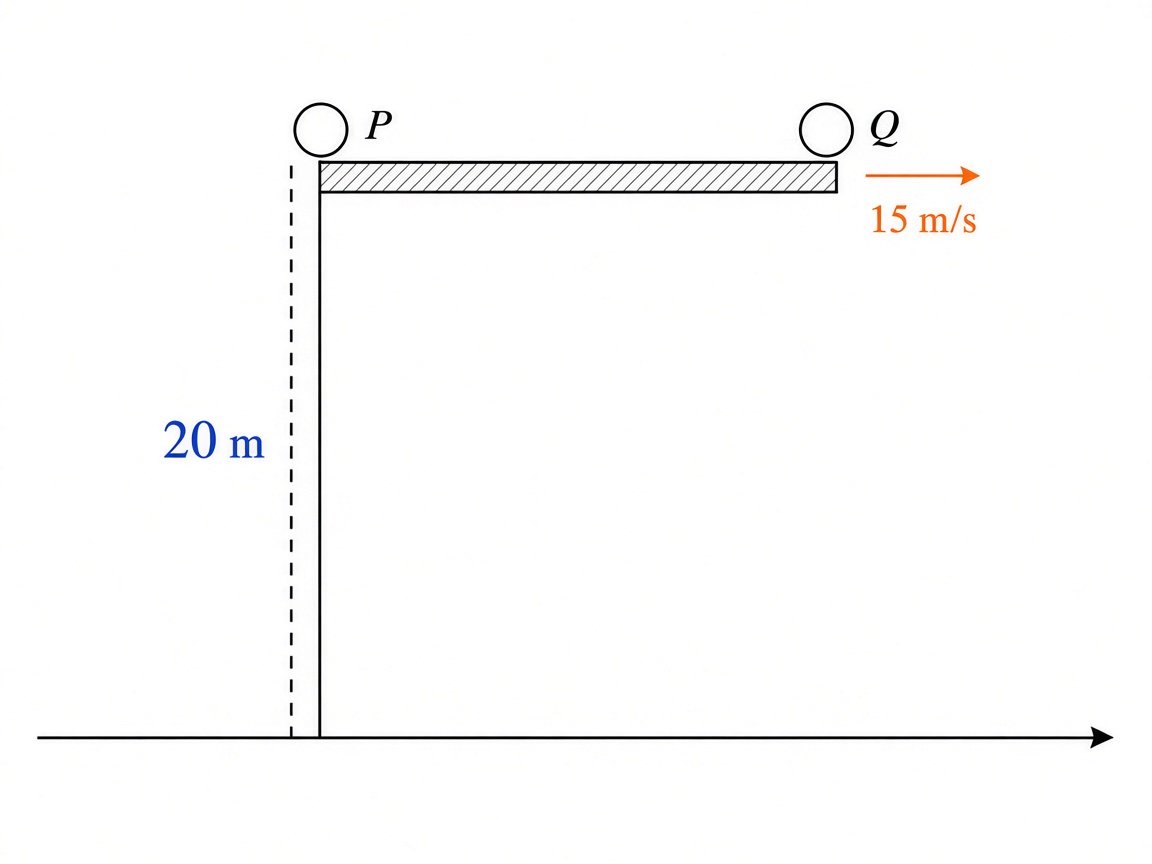
From a height of $20\,\mathrm{m}$ above level ground, ball $P$ is released from rest and ball $Q$ is launched horizontally at $15\,\mathrm{m/s}$ at the same instant. Take $g=10\,\mathrm{m/s^2}$ and ignore air resistance. (a) State which ball lands first and justify your answer using the vertical equations. (b) Determine the time of flight. (c) Determine how far from the launch point ball $Q$ lands. (d) Determine and compare the landing speeds of the two balls.

Ball P is dropped while ball Q launches horizontally from the same 20-meter height.

Question 5 of 5

A robot on a factory floor drives $60\,\mathrm{m}$ east, then $80\,\mathrm{m}$ north, then $20\,\mathrm{m}$ west. (a) Determine the east and north components of the total displacement. (b) Determine the magnitude of the total displacement. (c) Determine its direction relative to east. (d) State the total distance driven and explain why it differs from your answer to (b).