Systems and Center of Mass FRQ Practice

Responses receive AI feedback against a rubric after submission. Scores are practice estimates.

Question 1 of 5

Three particles lie along the $x$-axis: $4.0\,\mathrm{kg}$ at $x=-1.0\,\mathrm{m}$, $1.0\,\mathrm{kg}$ at $x=+2.0\,\mathrm{m}$, and $5.0\,\mathrm{kg}$ at $x=+4.0\,\mathrm{m}$. (a) Calculate the position of the center of mass. (b) Calculate the arithmetic mean of the three positions. (c) Explain physically why the two answers differ, and state which particle is most responsible for the difference.
Question 2 of 5

A $50\,\mathrm{kg}$ child stands at the left end of a $150\,\mathrm{kg}$ flatboat of length $8.0\,\mathrm{m}$. The boat floats at rest on water whose resistance is negligible. The child then walks to the right end of the boat. (a) State the property of the system that is unchanged during the walk, and justify it with a force argument. (b) Determine how far the boat moves relative to the water. (c) A classmate computes the boat’s displacement as $(50/150)(8.0)=2.7\,\mathrm{m}$. Identify the error.

Question 3 of 5

A $6.0\,\mathrm{kg}$ projectile is moving horizontally at $20\,\mathrm{m/s}$ at the top of its flight when an internal charge splits it into a $2.0\,\mathrm{kg}$ piece and a $4.0\,\mathrm{kg}$ piece. Immediately afterward the $2.0\,\mathrm{kg}$ piece moves horizontally at $10\,\mathrm{m/s}$ backward (opposite the original motion). Air resistance is negligible. (a) Determine the horizontal velocity of the $4.0\,\mathrm{kg}$ piece just after the split. (b) State the horizontal velocity of the center of mass just after the split and justify your answer. (c) Explain why your justification in (b) would fail if the split happened while the projectile was sliding along rough ground.

Question 4 of 5

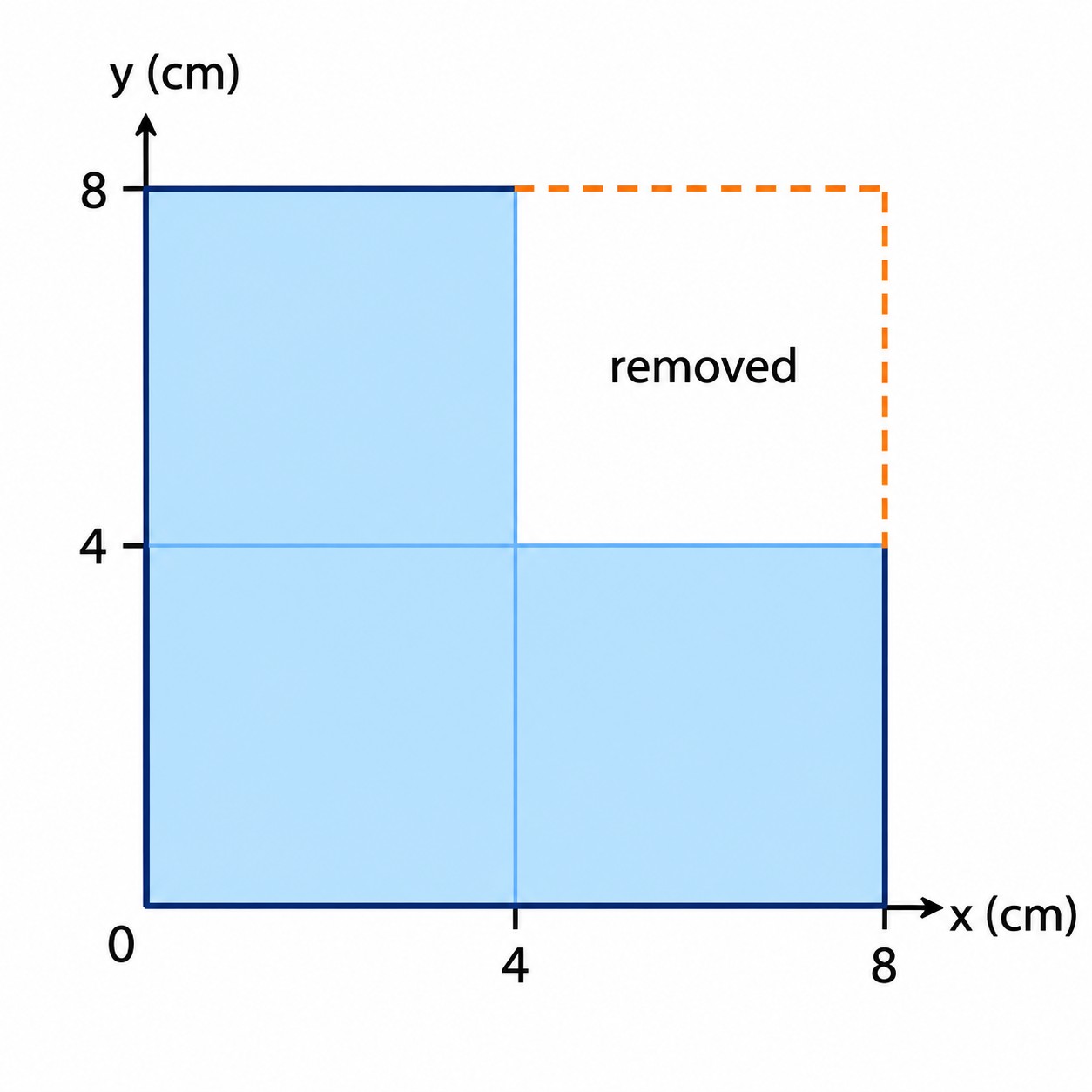
A uniform square plate of side $8.0\,\mathrm{cm}$ occupies the region $0\le x\le 8.0\,\mathrm{cm}$, $0\le y\le 8.0\,\mathrm{cm}$. The square region $4.0\,\mathrm{cm}\le x\le 8.0\,\mathrm{cm}$, $4.0\,\mathrm{cm}\le y\le 8.0\,\mathrm{cm}$ is then cut away and discarded. (a) Using the idea that the full plate is the removed piece plus the remaining piece, determine the center of mass of the remaining piece. (b) Use a symmetry argument to check that your $x$- and $y$-answers must be equal. (c) Explain why the answer would change if the discarded corner piece were made of denser material than the rest.

An 8-centimeter square plate has its upper-right 4-centimeter square corner removed.

Question 5 of 5

A car of total mass $1400\,\mathrm{kg}$ (including engine, wheels, and driver) accelerates forward from rest on a level road. (a) Taking the entire car as the system, explain why the engine cannot be the force that accelerates the center of mass, and identify the external force that does. (b) State one question about this car that the single-particle (center-of-mass) model can answer and one question it cannot, and explain the difference. (c) Predict what happens to the center of mass if the same car sits on frictionless ice and the driver revs the engine and spins the wheels, and justify your prediction.