Systems and Center of Mass MCQ Practice

Question 1 of 10

Three beads are threaded on a straight horizontal wire at the positions listed in the table. Where is the center of mass of the three-bead system?

Bead Mass (kg) Position x (m)
1 1.0 0
2 3.0 2.0
3 2.0 5.0
  1. A. $x=2.3\,\mathrm{m}$
  2. B. $x=2.5\,\mathrm{m}$
  3. C. $x=2.7\,\mathrm{m}$
  4. D. $x=16\,\mathrm{m}$

Question 2 of 10

On a frictionless horizontal track, a $2.0\,\mathrm{kg}$ cart moves at $+4.0\,\mathrm{m/s}$ and a $6.0\,\mathrm{kg}$ cart moves at $-1.0\,\mathrm{m/s}$. The carts collide and stick together. Immediately after the collision, the velocity of the center of mass of the two-cart system is

  1. A. $+1.5\,\mathrm{m/s}$
  2. B. $+0.25\,\mathrm{m/s}$
  3. C. $0$
  4. D. $-0.25\,\mathrm{m/s}$

Question 3 of 10

A firework shell is launched and explodes into three unequal fragments exactly at the top of its parabolic path. Air resistance is negligible. Which statement describes the motion of the center of mass of the fragments after the explosion?

  1. A. It stops moving at the instant of the explosion because the explosion forces cancel.
  2. B. It follows whichever fragment has the largest mass.
  3. C. It falls straight down from the point of the explosion.
  4. D. It continues along the original parabola until the first fragment lands.

Question 4 of 10

A $60\,\mathrm{kg}$ student stands at one end of a $240\,\mathrm{kg}$ raft of length $12\,\mathrm{m}$ that floats at rest on water of negligible resistance. The student walks to the other end of the raft. How far does the raft move relative to the water?

  1. A. $2.4\,\mathrm{m}$
  2. B. $3.0\,\mathrm{m}$
  3. C. $9.6\,\mathrm{m}$
  4. D. $12\,\mathrm{m}$

Question 5 of 10

A compressed spring is held between two carts on a frictionless table. A student defines the system as "the two carts and the spring." Which force is exerted by the environment on that system?

  1. A. The force of the spring on the left cart
  2. B. The force of the left cart on the spring
  3. C. The gravitational force of Earth on the carts
  4. D. The force each cart exerts on the spring as it is released

Question 6 of 10

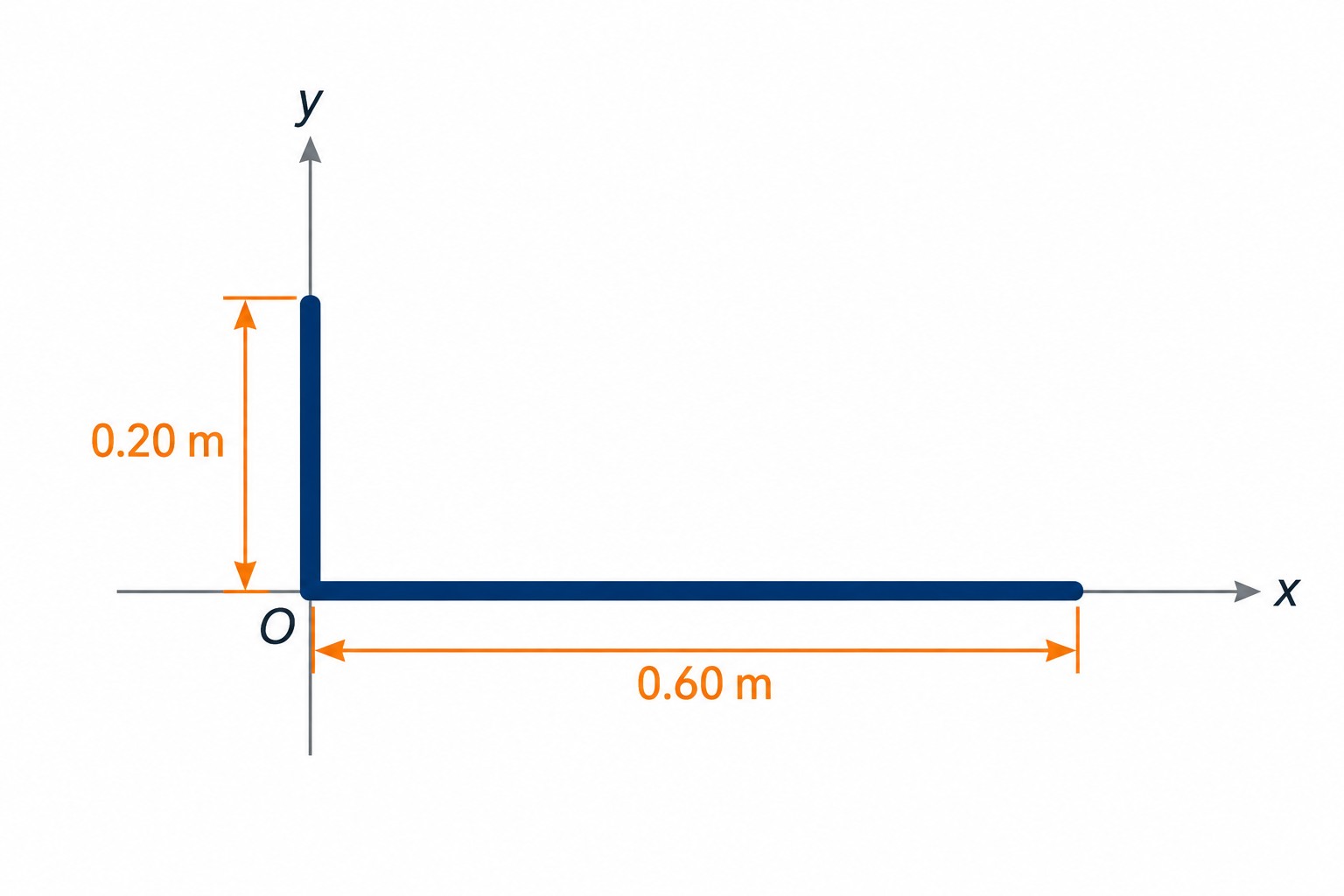
A uniform wire of constant linear density is bent at a right angle. One straight segment of length $0.60\,\mathrm{m}$ runs from the origin to $(0.60\,\mathrm{m},0)$ and the other straight segment of length $0.20\,\mathrm{m}$ runs from the origin to $(0,0.20\,\mathrm{m})$. Where is the center of mass?

A uniform wire bends at a right angle, extending 0.60 meter right and 0.20 meter upward.
  1. A. $(0.150\,\mathrm{m},\,0.050\,\mathrm{m})$
  2. B. $(0.225\,\mathrm{m},\,0.025\,\mathrm{m})$
  3. C. $(0.300\,\mathrm{m},\,0.100\,\mathrm{m})$
  4. D. $(0.225\,\mathrm{m},\,0.100\,\mathrm{m})$

Question 7 of 10

Blocks $P$ ($2.0\,\mathrm{kg}$) and $Q$ ($4.0\,\mathrm{kg}$) sit in contact on a frictionless floor. A constant horizontal force of $18\,\mathrm{N}$ is applied to $P$, pushing both blocks. For the two-block system, the magnitude of the acceleration of the center of mass is

  1. A. $1.0\,\mathrm{m/s^2}$
  2. B. $4.5\,\mathrm{m/s^2}$
  3. C. $9.0\,\mathrm{m/s^2}$
  4. D. $3.0\,\mathrm{m/s^2}$

Question 8 of 10

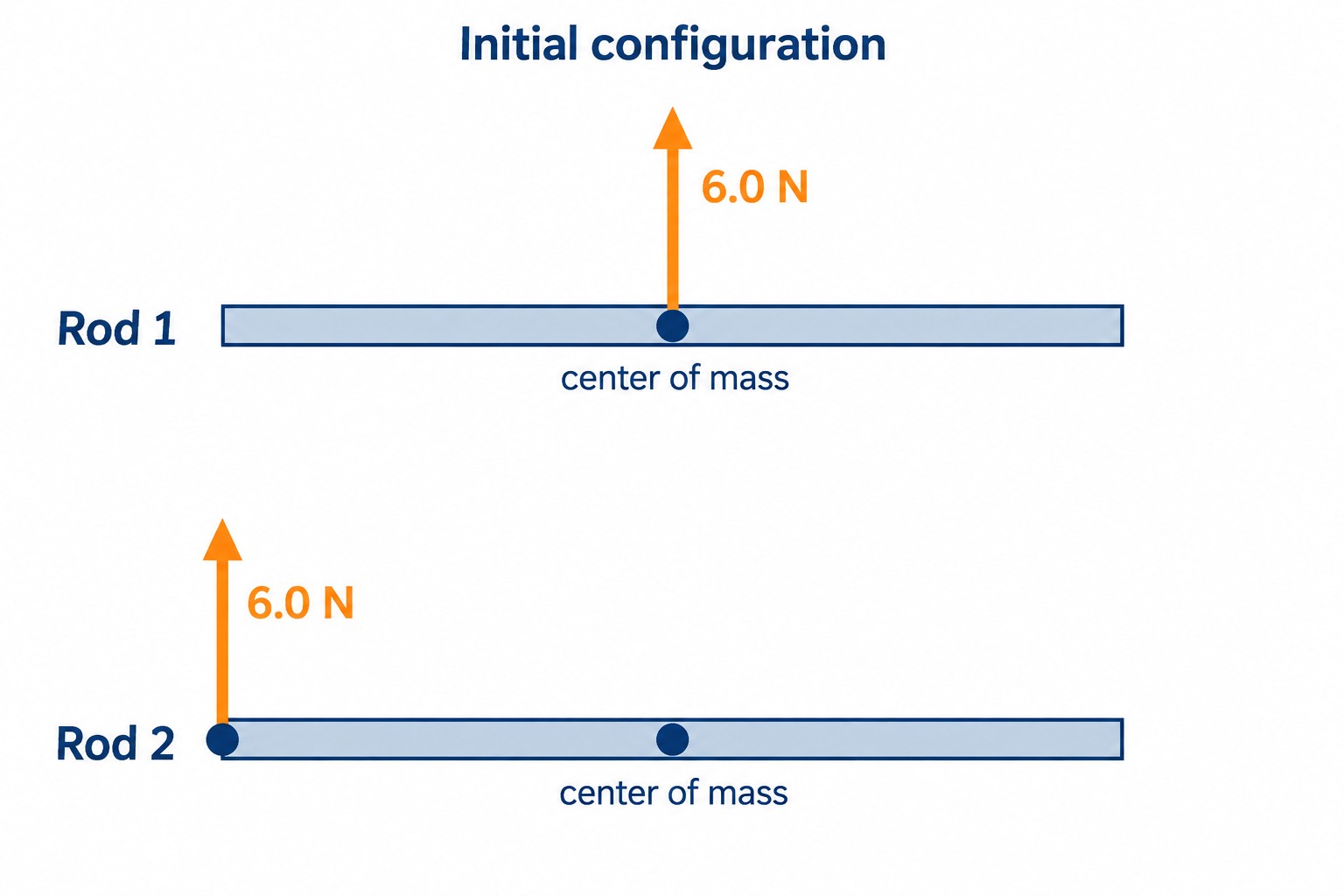
Two identical uniform rods, each of mass $2.0\,\mathrm{kg}$, lie at rest on frictionless ice. Rod 1 is pushed by a constant $6.0\,\mathrm{N}$ force applied at its midpoint; rod 2 is pushed by a constant $6.0\,\mathrm{N}$ force applied at one end. Both forces keep the same fixed direction in space and act for $2.0\,\mathrm{s}$. Comparing the two rods at the end of that interval,

Two identical rods are pushed by equal forces, one at its midpoint and one at an end.
  1. A. both centers of mass move at $6.0\,\mathrm{m/s}$, but rod 2 is also rotating.
  2. B. rod 1’s center of mass is faster, because all of its force went into translation.
  3. C. rod 2’s center of mass is faster, because a force at the end has more leverage.
  4. D. rod 2’s center of mass does not accelerate at all, because the rod rotates instead.

Question 9 of 10

A flat, uniform, boomerang-shaped plate is thrown so that it spins as it flies. Air resistance is negligible. Which statement is correct?

  1. A. Its center of mass cannot follow a parabola, because no material of the plate sits at that point.
  2. B. Every point of the plate follows the same parabola.
  3. C. Its center of mass follows a parabola even though that point lies outside the material of the plate.
  4. D. The path of the center of mass depends on how fast the plate spins.

Question 10 of 10

Two pucks, each of mass $1.5\,\mathrm{kg}$, are joined by a light rigid rod of length $0.80\,\mathrm{m}$ and rest on frictionless ice. A constant $12\,\mathrm{N}$ force is applied to one puck, perpendicular to the rod. Which statement is correct?

  1. A. Each puck accelerates at $4.0\,\mathrm{m/s^2}$, because the rigid rod shares the force equally.
  2. B. The center of mass accelerates at $8.0\,\mathrm{m/s^2}$.
  3. C. The system cannot rotate, because the rod is rigid.
  4. D. The center of mass accelerates at $4.0\,\mathrm{m/s^2}$, but replacing the system with one particle there does not predict each puck’s motion.