Systems and Center of Mass MCQ Practice

Question 1 of 10

Three small spheres are glued along a straight rod of negligible mass at the positions in the table. Where is the center of mass of the three-sphere system?

Sphere Mass (kg) Position x (m)
1 2.0 -3.0
2 3.0 0
3 5.0 4.0
  1. A. $x=0.33\,\mathrm{m}$
  2. B. $x=1.4\,\mathrm{m}$
  3. C. $x=0.50\,\mathrm{m}$
  4. D. $x=14\,\mathrm{m}$

Question 2 of 10

On a frictionless air track, a $4.0\,\mathrm{kg}$ glider moves at $+2.0\,\mathrm{m/s}$ while a $1.0\,\mathrm{kg}$ glider moves at $-3.0\,\mathrm{m/s}$. The velocity of the center of mass of the two-glider system is

  1. A. $-0.50\,\mathrm{m/s}$
  2. B. $+2.2\,\mathrm{m/s}$
  3. C. $+1.0\,\mathrm{m/s}$
  4. D. $+5.0\,\mathrm{m/s}$

Question 3 of 10

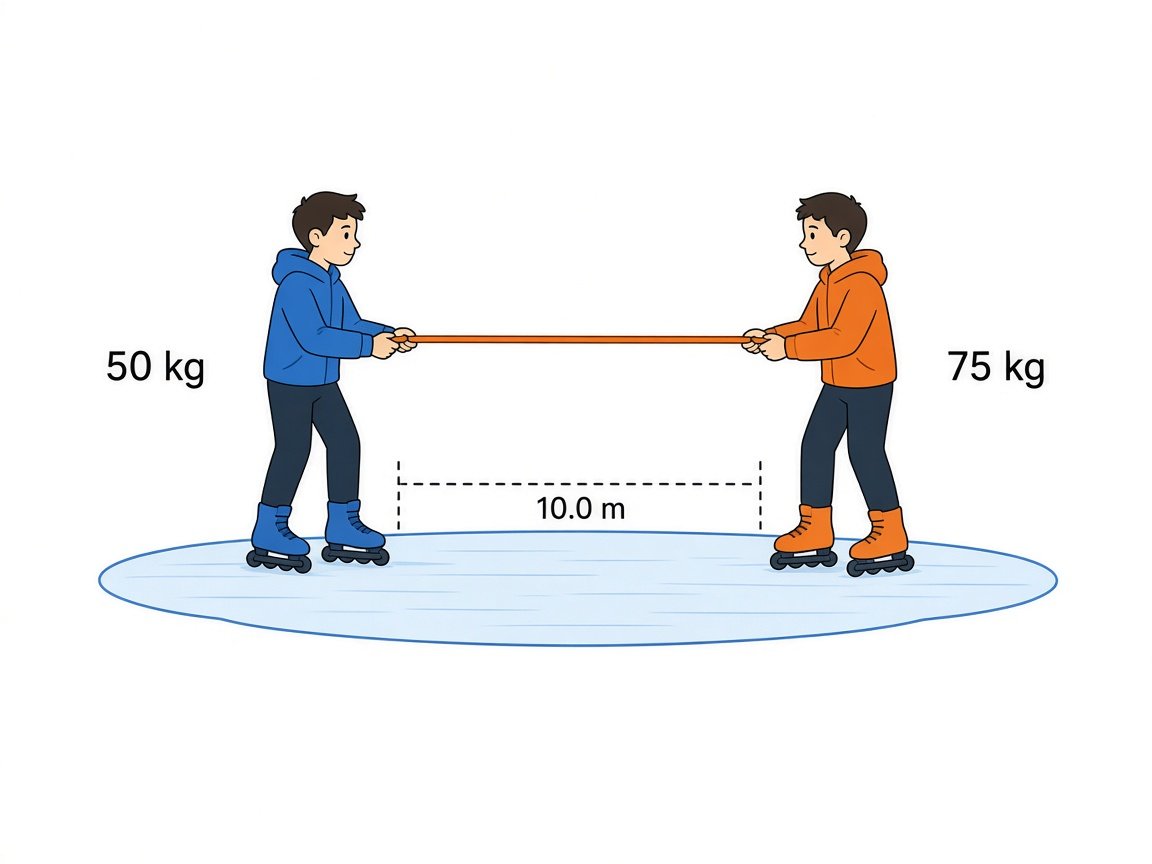
Two skaters stand $10.0\,\mathrm{m}$ apart at rest on frictionless ice, holding the ends of a light rope. One has mass $50\,\mathrm{kg}$ and the other $75\,\mathrm{kg}$. They pull hand over hand until they meet. They meet at a point that is

A 50-kilogram skater and a 75-kilogram skater hold a rope 10 meters apart.
  1. A. $5.0\,\mathrm{m}$ from each skater.
  2. B. $4.0\,\mathrm{m}$ from the $50\,\mathrm{kg}$ skater.
  3. C. $6.7\,\mathrm{m}$ from the $50\,\mathrm{kg}$ skater.
  4. D. $6.0\,\mathrm{m}$ from the $50\,\mathrm{kg}$ skater.

Question 4 of 10

A cyclist pedals hard and the cyclist-plus-bicycle system speeds up on level ground. Which force is external to that system and is responsible for the forward acceleration of its center of mass?

  1. A. The force the rider’s legs exert on the pedals
  2. B. The tension the chain exerts on the rear sprocket
  3. C. The upward force the seat exerts on the rider
  4. D. The static friction the road exerts on the rear tire

Question 5 of 10

A $20\,\mathrm{kg}$ dog stands on a $60\,\mathrm{kg}$ cart that is free to roll with negligible friction; both are initially at rest. The dog then walks so that its velocity relative to the ground is $1.5\,\mathrm{m/s}$ forward. The velocity of the cart relative to the ground is

  1. A. $0.50\,\mathrm{m/s}$ backward
  2. B. $1.5\,\mathrm{m/s}$ backward
  3. C. $0.375\,\mathrm{m/s}$ backward
  4. D. zero, because the dog’s push is internal

Question 6 of 10

Two uniform rods are welded end to end along the $x$-axis. Rod 1 has mass $1.0\,\mathrm{kg}$ and extends from $x=0$ to $x=0.40\,\mathrm{m}$; rod 2 has mass $3.0\,\mathrm{kg}$ and extends from $x=0.40\,\mathrm{m}$ to $x=0.60\,\mathrm{m}$. The center of mass of the welded object is at

  1. A. $x=0.300\,\mathrm{m}$
  2. B. $x=0.350\,\mathrm{m}$
  3. C. $x=0.425\,\mathrm{m}$
  4. D. $x=0.475\,\mathrm{m}$

Question 7 of 10

A $30\,\mathrm{kg}$ sled carries a $10\,\mathrm{kg}$ box that does not slide. A rope pulls horizontally on the sled with $60\,\mathrm{N}$ while the ground exerts a $20\,\mathrm{N}$ friction force backward on the sled runners. For the sled-plus-box system, the magnitude of the center-of-mass acceleration is

  1. A. $1.5\,\mathrm{m/s^2}$
  2. B. $1.0\,\mathrm{m/s^2}$
  3. C. $1.3\,\mathrm{m/s^2}$
  4. D. $6.0\,\mathrm{m/s^2}$

Question 8 of 10

A $1200\,\mathrm{kg}$ car sits at rest on a horizontal sheet of frictionless ice. The driver revs the engine so the drive wheels spin rapidly. Which statement about the car’s center of mass is correct, and why?

  1. A. It stays at rest, because the wheel–engine forces are internal and no external horizontal force acts.
  2. B. It accelerates forward, because the engine exerts a large forward force on the car.
  3. C. It accelerates backward, because the wheels throw the ice backward.
  4. D. It stays at rest only until the wheels reach top speed, after which the car moves forward.

Question 9 of 10

A high jumper arches her back and clears a bar without knocking it down. Which statement is correct?

  1. A. Her center of mass must pass above the bar, since her whole body does.
  2. B. Her center of mass follows a circular arc while she is airborne.
  3. C. Her center of mass can pass below the bar, because that point need not lie inside her body.
  4. D. Arching her back changes the trajectory of her center of mass after she leaves the ground.

Question 10 of 10

A dumbbell is made of two $2.0\,\mathrm{kg}$ spheres joined by a light rod. It is thrown so that it tumbles end over end. A student replaces the dumbbell with a single $4.0\,\mathrm{kg}$ particle at its center of mass. This substitution correctly predicts

  1. A. the speed of each sphere at every instant.
  2. B. the parabolic path of the center of mass, but not the motion of either sphere.
  3. C. neither the path of the center of mass nor the motion of the spheres, since the dumbbell rotates.
  4. D. both the center-of-mass path and the rotation rate of the dumbbell.