Forces and Free-Body Diagrams MCQ Practice

Question 1 of 10

A ball thrown straight up is momentarily at its highest point. Air resistance is negligible. What is on its free-body diagram at that instant?

  1. A. No forces, because the ball is momentarily at rest
  2. B. An upward force from the throw balanced by the gravitational force
  3. C. A single downward gravitational force of magnitude $mg$
  4. D. A downward gravitational force and an upward normal force from the air
Question 2 of 10

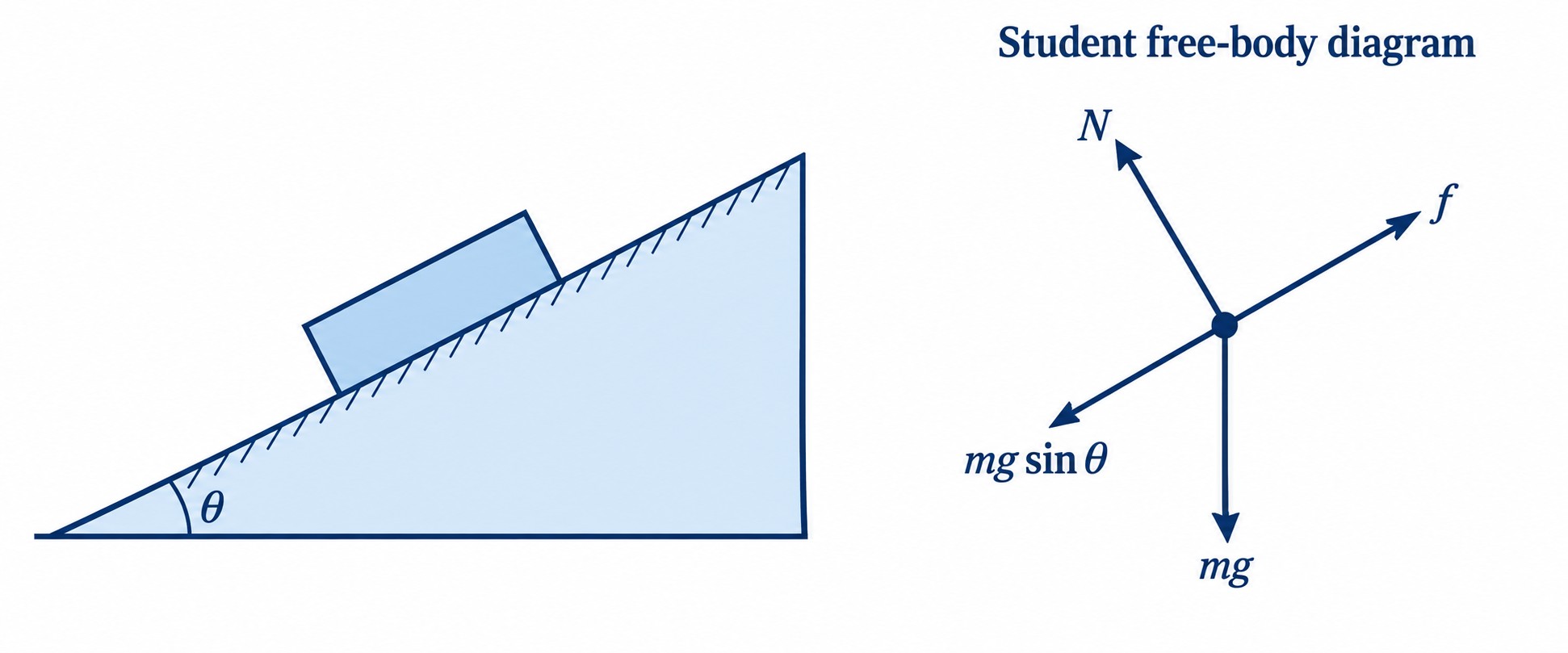
The figure shows a block at rest on a rough incline together with a student’s free-body diagram for the block. Which criticism of the diagram is correct?

A block resting on an incline of angle theta, beside a student free-body diagram showing the normal force perpendicular to the surface, friction up the slope, mg straight down, and an extra arrow labeled mg sin theta pointing down the slope.
  1. A. Both the full gravitational force and one of its components are shown, so gravity is counted twice.
  2. B. The friction arrow should point down the incline, since the block tends to remain at rest.
  3. C. The normal force should be drawn vertically upward, since it balances the gravitational force.
  4. D. The diagram is acceptable, but a fifth arrow for the net force should be added.

Question 3 of 10

A $20\,\mathrm{kg}$ sled is pulled along level ground by a rope with $50\,\mathrm{N}$ of tension directed $30^\circ$ above the horizontal. Take $g=10\,\mathrm{m/s^2}$. The magnitude of the normal force on the sled is

  1. A. $200\,\mathrm{N}$
  2. B. $225\,\mathrm{N}$
  3. C. $157\,\mathrm{N}$
  4. D. $175\,\mathrm{N}$

Question 4 of 10

A student’s free-body diagram for a car accelerating forward on a level road shows a downward gravitational force, an upward normal force, a forward static friction force from the road on the drive tires, and a forward arrow labeled "engine force." What correction is needed?

  1. A. Delete the engine arrow; the engine acts on parts inside the car, and the road’s friction is already the external forward force.
  2. B. Delete the friction arrow; friction always opposes motion, so it cannot point forward.
  3. C. Delete both forward arrows; a car on level ground has no horizontal forces.
  4. D. Keep all four arrows, but draw the engine arrow longer than the friction arrow.

Question 5 of 10

A crate slides down a rough ramp. The table lists four entries from a student’s force inventory. Which entry does not belong on the free-body diagram of the crate?

Entry Type of force Exerted by Exerted on
1 Gravitational Earth Crate
2 Normal Ramp surface Crate
3 Kinetic friction Ramp surface Crate
4 Kinetic friction Crate Ramp surface
  1. A. Entry 1, because gravitation is not a contact force
  2. B. Entry 2, because the normal force is not perpendicular to the ramp
  3. C. Entry 4, because it is exerted on the ramp rather than on the crate
  4. D. Entry 3, because friction is already accounted for by the normal force

Question 6 of 10

A $50\,\mathrm{kg}$ student stands on a scale in an elevator, and the scale reads $600\,\mathrm{N}$. Take $g=10\,\mathrm{m/s^2}$. Which statement is correct?

  1. A. The student’s mass has increased to $60\,\mathrm{kg}$.
  2. B. The acceleration is $2.0\,\mathrm{m/s^2}$ upward, so the elevator is moving up and speeding up or moving down and slowing down.
  3. C. The elevator is moving upward at constant speed.
  4. D. The acceleration is $2.0\,\mathrm{m/s^2}$ downward.

Question 7 of 10

A $3.0\,\mathrm{kg}$ block rests on top of a $5.0\,\mathrm{kg}$ block, which rests on the floor. Take $g=10\,\mathrm{m/s^2}$. Which set of forces is the correct free-body diagram for the lower block?

  1. A. A $50\,\mathrm{N}$ gravitational force down and an $80\,\mathrm{N}$ normal force up from the floor
  2. B. An $80\,\mathrm{N}$ gravitational force down and an $80\,\mathrm{N}$ normal force up from the floor
  3. C. A $50\,\mathrm{N}$ gravitational force down, a $30\,\mathrm{N}$ normal force down from the upper block, and a $50\,\mathrm{N}$ normal force up from the floor
  4. D. A $50\,\mathrm{N}$ gravitational force down, a $30\,\mathrm{N}$ normal force down from the upper block, and an $80\,\mathrm{N}$ normal force up from the floor

Question 8 of 10

A $2.5\,\mathrm{kg}$ block is held at rest on a frictionless $30^\circ$ incline by a rope lying parallel to the incline surface. Take $g=10\,\mathrm{m/s^2}$. The tension and the normal force are, respectively, about

  1. A. $22\,\mathrm{N}$ and $13\,\mathrm{N}$
  2. B. $13\,\mathrm{N}$ and $22\,\mathrm{N}$
  3. C. $25\,\mathrm{N}$ and $25\,\mathrm{N}$
  4. D. $13\,\mathrm{N}$ and $25\,\mathrm{N}$

Question 9 of 10

Two identical metal spheres float a few meters apart in deep space, far from every other object and not touching. What appears on the free-body diagram of one sphere?

  1. A. One force: the gravitational attraction exerted by the other sphere, directed toward it
  2. B. No forces at all, because nothing touches the sphere
  3. C. A normal force exerted by the other sphere
  4. D. Two equal and opposite gravitational forces, so the diagram shows no net force

Question 10 of 10

Why is it standard practice to draw every arrow of a free-body diagram starting from a single dot that represents the object?

  1. A. Because where a force is applied on a real object never affects anything
  2. B. Because the single dot shows that all forces on an object must be equal in magnitude
  3. C. Because the diagram is built to find the net external force, which sets the acceleration of the center of mass
  4. D. Because vectors can only be added when they are drawn from a common starting point