Newton's Third Law MCQ Practice

Question 1 of 10

A mosquito splatters against the windshield of a fast-moving bus. Which statement is correct?

  1. A. The bus exerts a much larger force on the mosquito than the mosquito exerts on the bus.
  2. B. The mosquito exerts no force on the bus.
  3. C. The two forces have equal magnitudes; the mosquito’s acceleration is enormous only because its mass is tiny.
  4. D. The forces are equal, so the two objects suffer equal damage.
Question 2 of 10

A block hangs at rest from a rope attached to a ceiling. Which of the following is not a Newton’s third law pair?

  1. A. The upward pull of the rope on the block and the downward gravitational force of Earth on the block
  2. B. The upward pull of the rope on the block and the downward pull of the block on the rope
  3. C. The downward gravitational force of Earth on the block and the upward gravitational force of the block on Earth
  4. D. The downward pull of the rope on the ceiling and the upward pull of the ceiling on the rope

Question 3 of 10

A student pulls upward hard on her own belt and does not rise off the floor. Which explanation is correct?

  1. A. She simply does not pull hard enough to overcome her weight.
  2. B. Her pull is cancelled by the gravitational force of Earth, which is its Newton’s third law partner.
  3. C. Her arms pull up with less force than her belt pulls down.
  4. D. Her hands and her belt are both part of her body, so the pull is internal and cannot contribute to the net external force on her.

Question 4 of 10

Two blocks are connected by a taut light string and accelerate together on a frictionless horizontal table. A student says, “The force of the string on the front block and the force of the string on the rear block are a Newton’s third-law pair.” Which response is correct?

  1. A. The student is correct because the two string forces have equal magnitudes and opposite directions.
  2. B. The student is correct only if the blocks have equal masses.
  3. C. The student is incorrect because third-law forces must point in the same direction.
  4. D. The student is incorrect because both named forces are exerted by the string; each one is paired with a force exerted by its block on the string.

Question 5 of 10

In a problem you are told the pulley is "ideal." What does that assumption let you conclude?

  1. A. That the two hanging blocks must have equal masses
  2. B. That the tension equals the weight of the heavier block
  3. C. That the pulley only redirects the string, so the tension is the same on both sides
  4. D. That the acceleration of each block is zero

Question 6 of 10

A uniform rope of mass $5.0\,\mathrm{kg}$ hangs from a ceiling with a $10\,\mathrm{kg}$ block attached to its lower end, all at rest. Take $g=10\,\mathrm{m/s^2}$. The tensions at the top and the bottom of the rope are, respectively,

  1. A. $150\,\mathrm{N}$ and $100\,\mathrm{N}$
  2. B. $150\,\mathrm{N}$ and $150\,\mathrm{N}$
  3. C. $100\,\mathrm{N}$ and $100\,\mathrm{N}$
  4. D. $50\,\mathrm{N}$ and $150\,\mathrm{N}$

Question 7 of 10

A $2.0\,\mathrm{kg}$ block and a $4.0\,\mathrm{kg}$ block on a frictionless table are joined by a light horizontal string. A $24\,\mathrm{N}$ horizontal force is applied to the $2.0\,\mathrm{kg}$ block, dragging the $4.0\,\mathrm{kg}$ block behind it. The tension in the connecting string is

  1. A. $24\,\mathrm{N}$
  2. B. $8.0\,\mathrm{N}$
  3. C. $12\,\mathrm{N}$
  4. D. $16\,\mathrm{N}$

Question 8 of 10

A rocket accelerates forward in the vacuum of deep space. Which statement correctly applies Newton’s third law?

  1. A. The exhaust gas pushes against the surrounding air, which pushes the rocket forward.
  2. B. The rocket pushes the exhaust gas backward, and the gas pushes the rocket forward with an equal-magnitude force.
  3. C. The rocket cannot accelerate, because in a vacuum there is nothing to push against.
  4. D. The forward force on the rocket exceeds the backward force on the gas, which is why the rocket speeds up.

Question 9 of 10

A person stands still on a level floor. What is the Newton’s third law partner of the upward normal force the floor exerts on the person?

  1. A. The gravitational force that Earth exerts on the person
  2. B. The gravitational force that the person exerts on Earth
  3. C. The downward normal force that the person exerts on the floor
  4. D. The friction force that the floor exerts on the person’s shoes

Question 10 of 10

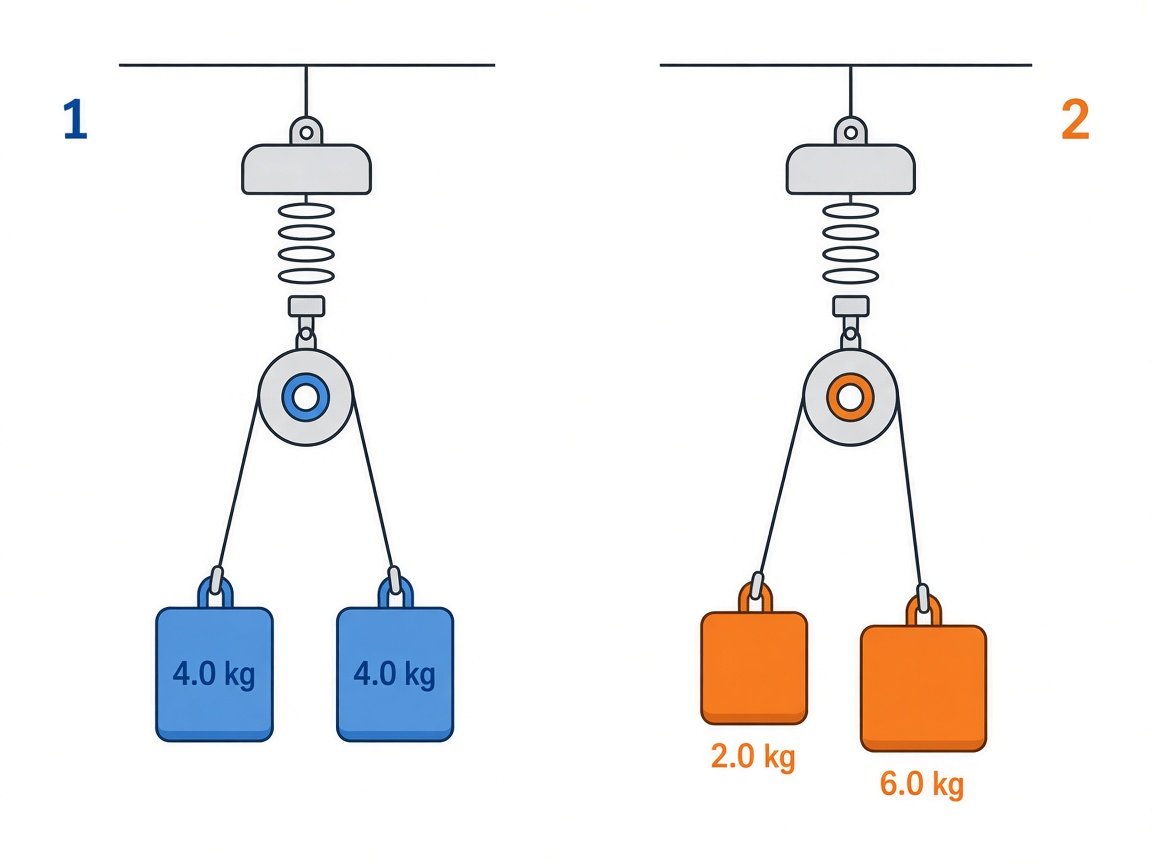
Two setups hang from identical spring scales fixed to a ceiling, each using an ideal string over an ideal massless pulley. Setup 1 has $4.0\,\mathrm{kg}$ on each side. Setup 2 has $2.0\,\mathrm{kg}$ on one side and $6.0\,\mathrm{kg}$ on the other. Take $g=10\,\mathrm{m/s^2}$. The scales read

Two spring-scale pulley systems have equal masses in one and unequal masses in the other.
  1. A. $80\,\mathrm{N}$ for setup 1 and $60\,\mathrm{N}$ for setup 2
  2. B. $80\,\mathrm{N}$ for both, since each setup holds $8.0\,\mathrm{kg}$
  3. C. $60\,\mathrm{N}$ for setup 1 and $80\,\mathrm{N}$ for setup 2
  4. D. $40\,\mathrm{N}$ for both, the tension in each string