Newton's First Law MCQ Practice

Question 1 of 10

A jet airliner cruises in a straight, level line at a constant $240\,\mathrm{m/s}$. Which relationship among the four forces on the airplane must hold?

  1. A. Thrust exceeds drag, because the airplane is moving forward.
  2. B. Lift exceeds weight, because the airplane is high above the ground.
  3. C. Thrust equals drag in magnitude and lift equals weight in magnitude.
  4. D. All four forces must have the same magnitude.
Question 2 of 10

A book sits on a horizontal table inside a train car. Which pair of statements is correct?

  1. A. While the train moves at constant velocity the friction force on the book is zero; while the train speeds up, friction on the book points in the direction of the train’s acceleration.
  2. B. While the train moves at constant velocity friction must push the book forward to keep it moving; while the train speeds up friction points backward.
  3. C. Friction on the book is zero in both cases, because the book never slides on the table.
  4. D. Friction on the book equals its weight in both cases, because the book stays on the table.

Question 3 of 10

Three forces act on a block on a frictionless horizontal surface; their components are listed. A fourth force is then applied so the block moves in a straight line at constant speed. The magnitude of that fourth force is closest to

Force $F_x$ (N) $F_y$ (N)
$\vec F_1$ +9 +2
$\vec F_2$ -3 -7
$\vec F_3$ +6 +1
  1. A. $8.0\,\mathrm{N}$
  2. B. $16\,\mathrm{N}$
  3. C. $4.0\,\mathrm{N}$
  4. D. $13\,\mathrm{N}$

Question 4 of 10

An elevator descends at a constant $2.0\,\mathrm{m/s}$. A $50\,\mathrm{kg}$ rider stands on a scale inside. Take $g=9.8\,\mathrm{m/s^2}$. The scale reads

  1. A. less than $490\,\mathrm{N}$, because the elevator is going down
  2. B. exactly $490\,\mathrm{N}$
  3. C. more than $490\,\mathrm{N}$, because the floor must also stop the rider
  4. D. $100\,\mathrm{N}$, found from $ma$ with $a = 2.0\,\mathrm{m/s^2}$

Question 5 of 10

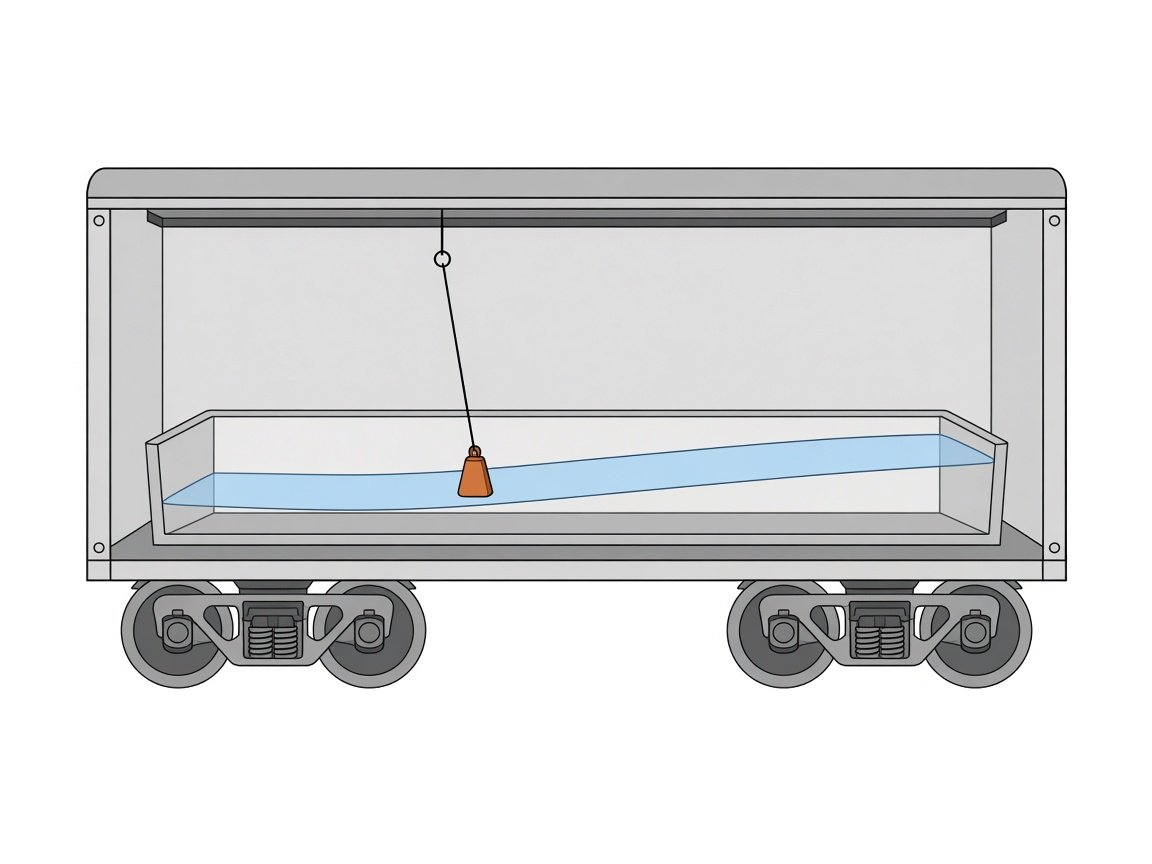
A sealed railway car contains a shallow tray of water and a plumb bob hanging from the ceiling. An observer inside notices that the water surface is tilted and the plumb bob hangs at a small angle from vertical, both steady in time. Which conclusion is best supported?

Inside a railway car, a water surface and a plumb bob are steadily tilted.
  1. A. The car must be moving at high constant speed, and the tilt measures that speed.
  2. B. The car is at rest, and the tilt is caused by the car’s weight pressing on the track.
  3. C. The car has a constant nonzero acceleration, so the car frame is non-inertial and objects at rest in it are not in equilibrium.
  4. D. The car frame is inertial, because the tilt angle is constant in time.

Question 6 of 10

A $90\,\mathrm{N}$ lamp hangs at rest from two light wires, each making an angle of $60^\circ$ above the horizontal on opposite sides. The tension in each wire is closest to

  1. A. $52\,\mathrm{N}$
  2. B. $45\,\mathrm{N}$
  3. C. $90\,\mathrm{N}$
  4. D. $78\,\mathrm{N}$

Question 7 of 10

A rope parallel to the surface pulls an $8.0\,\mathrm{kg}$ box up a ramp inclined at $20^\circ$ at constant speed. Friction on the box is $15\,\mathrm{N}$. Take $g=9.8\,\mathrm{m/s^2}$. The rope tension is closest to

  1. A. $27\,\mathrm{N}$
  2. B. $12\,\mathrm{N}$
  3. C. $42\,\mathrm{N}$
  4. D. $78\,\mathrm{N}$

Question 8 of 10

An object moves along a straight horizontal line with zero net force acting on it for $6\,\mathrm{s}$. Which graph description of its motion is consistent with the first law?

  1. A. Position constant, velocity increasing linearly
  2. B. Position increasing linearly, velocity constant and nonzero
  3. C. Position increasing linearly, velocity increasing linearly
  4. D. Position curving upward, velocity constant and nonzero

Question 9 of 10

Two of the three forces acting on a sliding puck are $5.0\,\mathrm{N}$ north and $12\,\mathrm{N}$ east. The puck moves in a straight line at constant speed. The third force is closest to

  1. A. $17\,\mathrm{N}$ directed $23^\circ$ south of west
  2. B. $13\,\mathrm{N}$ directed $23^\circ$ north of east
  3. C. $7.0\,\mathrm{N}$ directed west
  4. D. $13\,\mathrm{N}$ directed $23^\circ$ south of west

Question 10 of 10

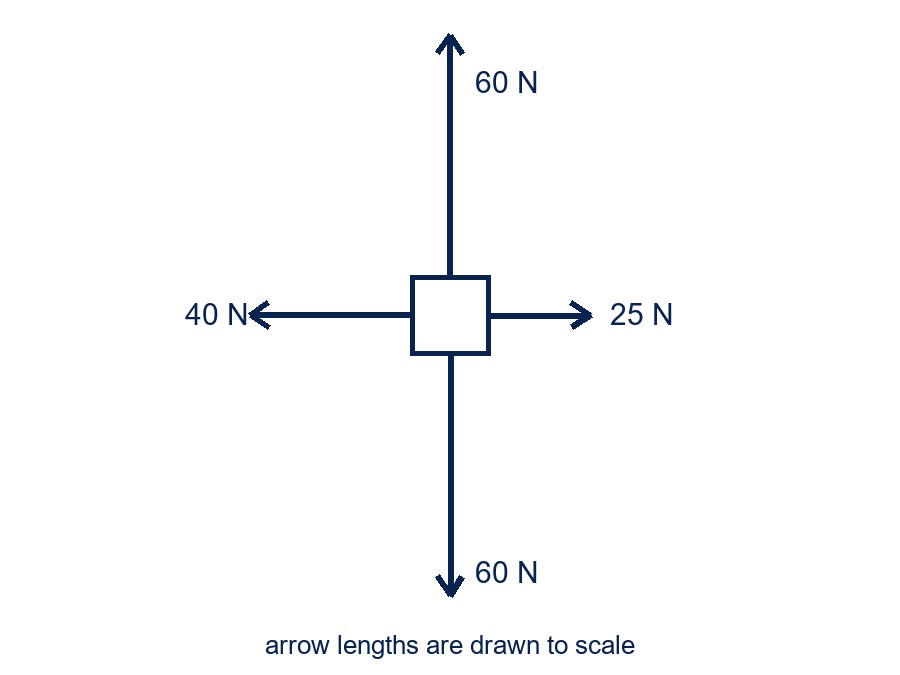
The figure shows all four forces acting on an object that is momentarily at rest. Which description of the object’s motion just after this instant is correct?

Free-body diagram of an object with a 60 N arrow up, a 60 N arrow down, a 25 N arrow right, and a 40 N arrow left.
  1. A. It begins to accelerate horizontally to the left and stays on its original horizontal line, because the vertical forces balance.
  2. B. It remains at rest, because two pairs of forces are shown.
  3. C. It begins to move diagonally down and to the left, because four forces act.
  4. D. It begins to accelerate to the right, toward the larger horizontal arrow.