Newton's First Law FRQ Practice

Responses receive AI feedback against a rubric after submission. Scores are practice estimates.

Question 1 of 5

A cargo airplane of mass $7.2\times 10^{4}\,\mathrm{kg}$ flies straight and level at a constant $210\,\mathrm{m/s}$. Take $g=9.8\,\mathrm{m/s^2}$. (a) Name the four forces on the airplane and state the two equilibrium equations that apply. (b) Determine the magnitude of the lift force. (c) The pilot increases thrust while lift stays equal to weight. Explain how the motion changes and whether the airplane is still in equilibrium.
Question 2 of 5

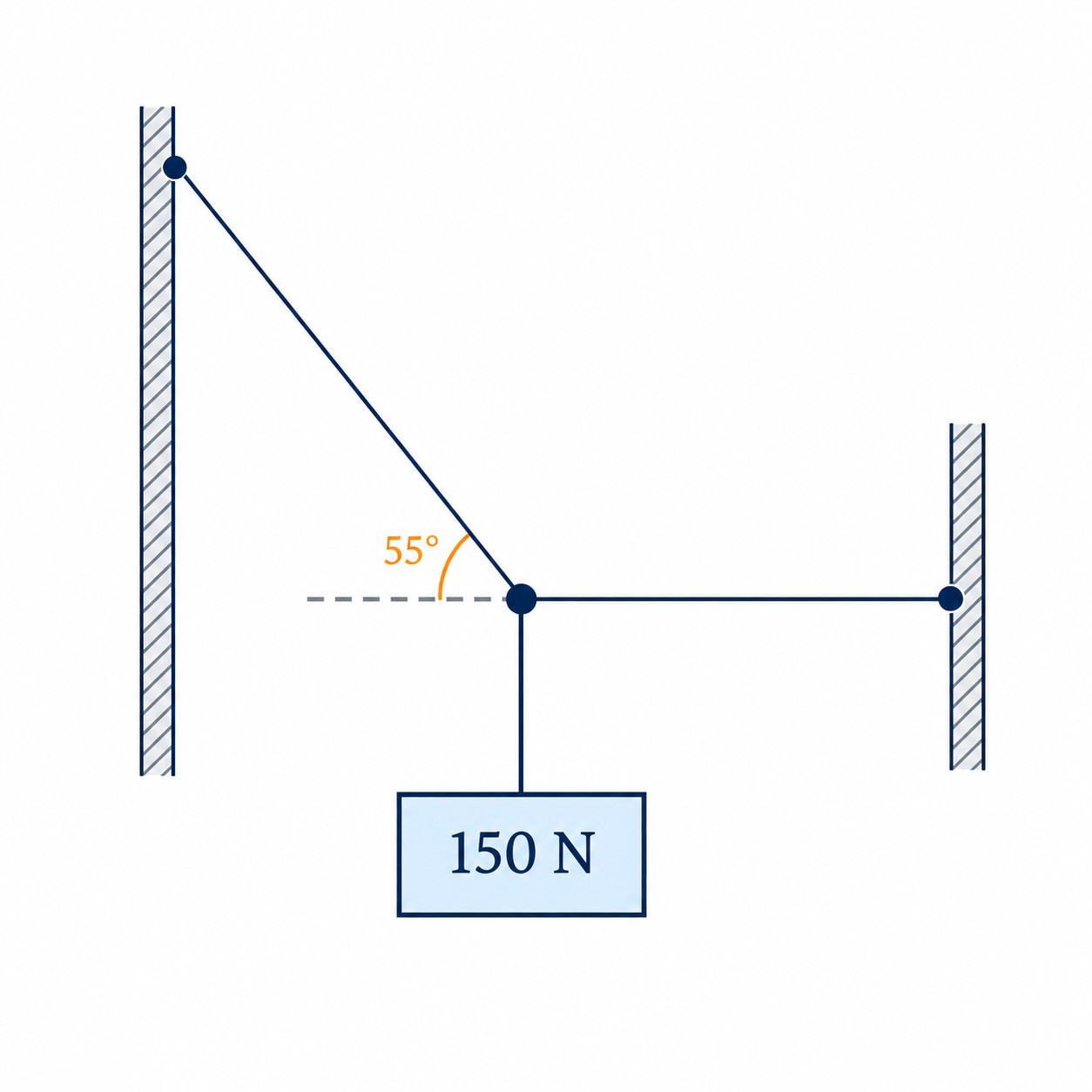
A $150\,\mathrm{N}$ sign hangs at rest from a joint. One cable runs from the joint horizontally to a wall, and a second cable runs from the joint up to the wall at $55^\circ$ above the horizontal. (a) Draw a free-body diagram of the joint. (b) Determine the tension in the angled cable. (c) Determine the tension in the horizontal cable. (d) Explain which tension is larger and why that must be so.

A sign hangs below a joint connected by one horizontal cable and one angled cable.

Question 3 of 5

A $75\,\mathrm{kg}$ rider stands on a scale in an elevator. Readings recorded at four moments are shown. Take $g=9.8\,\mathrm{m/s^2}$. (a) Determine the rider’s weight and identify the reading for which the first law applies with zero net force. (b) For readings 2 and 3, find the magnitude and direction of the acceleration. (c) A student says reading 3 proves the elevator is moving downward. Explain why that conclusion is not justified.

Reading Scale force (N) Moment in the trip
1 735 mid-trip
2 810 shortly after the doors close
3 660 shortly before arrival
4 0 cable failure

Question 4 of 5

A passenger in a car flips a coin straight up and catches it in the same hand. (a) Explain why this works when the car travels at constant velocity on a straight road. (b) Explain why the coin lands behind the passenger’s hand when the car is speeding up in a straight line. (c) State the general condition a reference frame must satisfy for the first law to hold, and classify each of the two car situations.

Question 5 of 5

A $20\,\mathrm{kg}$ sled is held at rest on a snowy hill inclined at $28^\circ$ by a rope running parallel to the hill surface. Friction between the sled and the snow is negligible. Take $g=9.8\,\mathrm{m/s^2}$. (a) Determine the rope tension. (b) Determine the normal force. (c) The rope is then used to pull the sled up the hill at a constant $0.80\,\mathrm{m/s}$. State whether the tension changes, and justify your answer with the first law.