Newton's First Law MCQ Practice

Question 1 of 10

A worker pushes a crate horizontally across a level concrete floor, and the crate slides at a steady $4.0\,\mathrm{m/s}$ in a straight line. The push is horizontal with magnitude $85\,\mathrm{N}$. Which statement about the forces on the crate is correct?

  1. A. The net force on the crate is $85\,\mathrm{N}$ forward, because a moving object must have a forward net force.
  2. B. Kinetic friction on the crate is $85\,\mathrm{N}$ backward and the normal force equals the crate’s weight.
  3. C. Kinetic friction must exceed $85\,\mathrm{N}$, because friction is what keeps the crate from speeding up.
  4. D. The normal force exceeds the crate’s weight because the worker’s push adds to the downward load.
Question 2 of 10

A hockey puck slides north across frictionless ice at $6.0\,\mathrm{m/s}$. A steady horizontal wind then begins to push the puck toward the east with a constant force. Which description of the puck’s later motion is correct?

  1. A. The puck immediately travels due east, because the only unbalanced force points east.
  2. B. The puck slows to rest and then accelerates east, because the wind must first cancel the northward motion.
  3. C. The northward velocity component stays $6.0\,\mathrm{m/s}$ while an eastward velocity component grows, so the path curves toward the east.
  4. D. The puck continues due north at constant speed, because the vertical forces are already balanced.

Question 3 of 10

Three forces act on a $4.0\,\mathrm{kg}$ puck on a frictionless horizontal table. Their $x$- and $y$-components are listed. A fourth force is added so the puck moves in a straight line at constant speed. The components of that fourth force are

Force $F_x$ (N) $F_y$ (N)
$\vec F_1$ +12 -5
$\vec F_2$ -4 +9
$\vec F_3$ 0 0
  1. A. $F_x=-8\,\mathrm{N}$, $F_y=-4\,\mathrm{N}$
  2. B. $F_x=+8\,\mathrm{N}$, $F_y=+4\,\mathrm{N}$
  3. C. $F_x=-8\,\mathrm{N}$, $F_y=+4\,\mathrm{N}$
  4. D. $F_x=0$, $F_y=0$, because constant speed already means the forces balance

Question 4 of 10

A $60\,\mathrm{kg}$ student stands on a bathroom scale inside an elevator. While the elevator is moving upward, the scale reads a steady $588\,\mathrm{N}$. Take $g=9.8\,\mathrm{m/s^2}$. The elevator must be

  1. A. moving upward at constant velocity
  2. B. speeding up as it moves upward
  3. C. slowing down as it moves upward
  4. D. in free fall

Question 5 of 10

A ball rests on the smooth floor of a van that is traveling east at constant velocity. The driver brakes hard, and a passenger sees the ball roll forward (east) relative to the van. Which analysis is correct?

  1. A. A forward force acted on the ball during braking, so the first law was obeyed in the van’s frame.
  2. B. The ball gained kinetic energy from the brakes, which is why it moved forward.
  3. C. Both the ground frame and the braking van frame are inertial, so both observers apply the first law directly.
  4. D. In the ground frame the ball keeps moving east at nearly constant velocity while the van slows beneath it; the braking van is a non-inertial frame, so the first law does not apply in it without invented forces.

Question 6 of 10

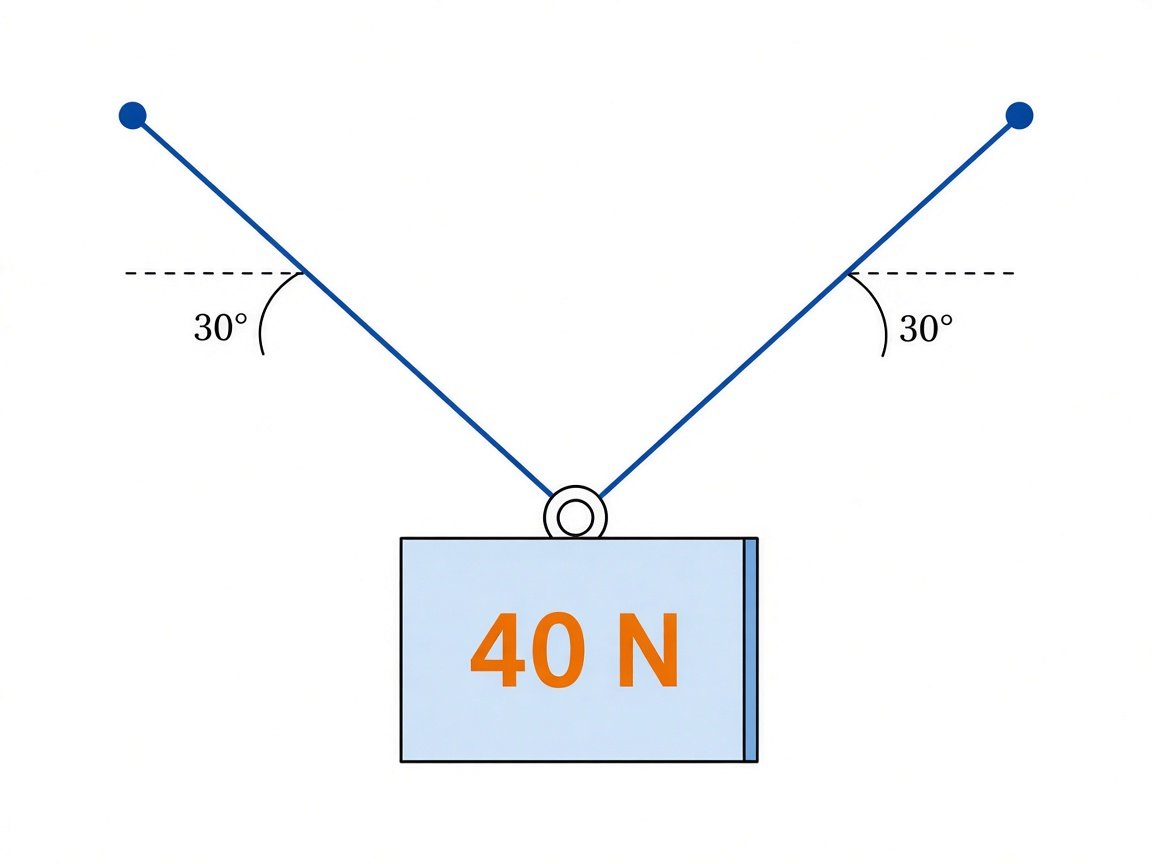
A $40\,\mathrm{N}$ sign hangs at rest from two light cables that each make an angle of $30^\circ$ above the horizontal, one going to the left and one to the right. The tension in each cable is

A 40-newton sign hangs from two symmetric cables, each 30 degrees above horizontal.
  1. A. $20\,\mathrm{N}$
  2. B. $40\,\mathrm{N}$
  3. C. $23\,\mathrm{N}$
  4. D. $80\,\mathrm{N}$

Question 7 of 10

A $5.0\,\mathrm{kg}$ block slides down a ramp inclined at $25^\circ$ above the horizontal at constant speed. Take $g=9.8\,\mathrm{m/s^2}$. The friction force and the normal force on the block are closest to

  1. A. friction $49\,\mathrm{N}$, normal $49\,\mathrm{N}$
  2. B. friction $44\,\mathrm{N}$, normal $21\,\mathrm{N}$
  3. C. friction $21\,\mathrm{N}$, normal $44\,\mathrm{N}$
  4. D. friction $0$, normal $49\,\mathrm{N}$

Question 8 of 10

Throughout a $10\,\mathrm{s}$ interval the net force on a $2.0\,\mathrm{kg}$ object is exactly zero. Which statement must be true?

  1. A. The object is at rest for the whole interval.
  2. B. The object’s speed is constant, but its direction of travel may change.
  3. C. The object’s velocity is constant, so its position may change at a steady rate.
  4. D. The object’s position is constant, but its velocity may change.

Question 9 of 10

Two of the three forces on a puck sliding on frictionless ice are $6.0\,\mathrm{N}$ directed east and $8.0\,\mathrm{N}$ directed north. The puck travels in a straight line at constant speed. The third force is

  1. A. $10\,\mathrm{N}$ directed $53^\circ$ north of east
  2. B. $10\,\mathrm{N}$ directed $53^\circ$ south of west
  3. C. $14\,\mathrm{N}$ directed southwest
  4. D. $2.0\,\mathrm{N}$ directed south

Question 10 of 10

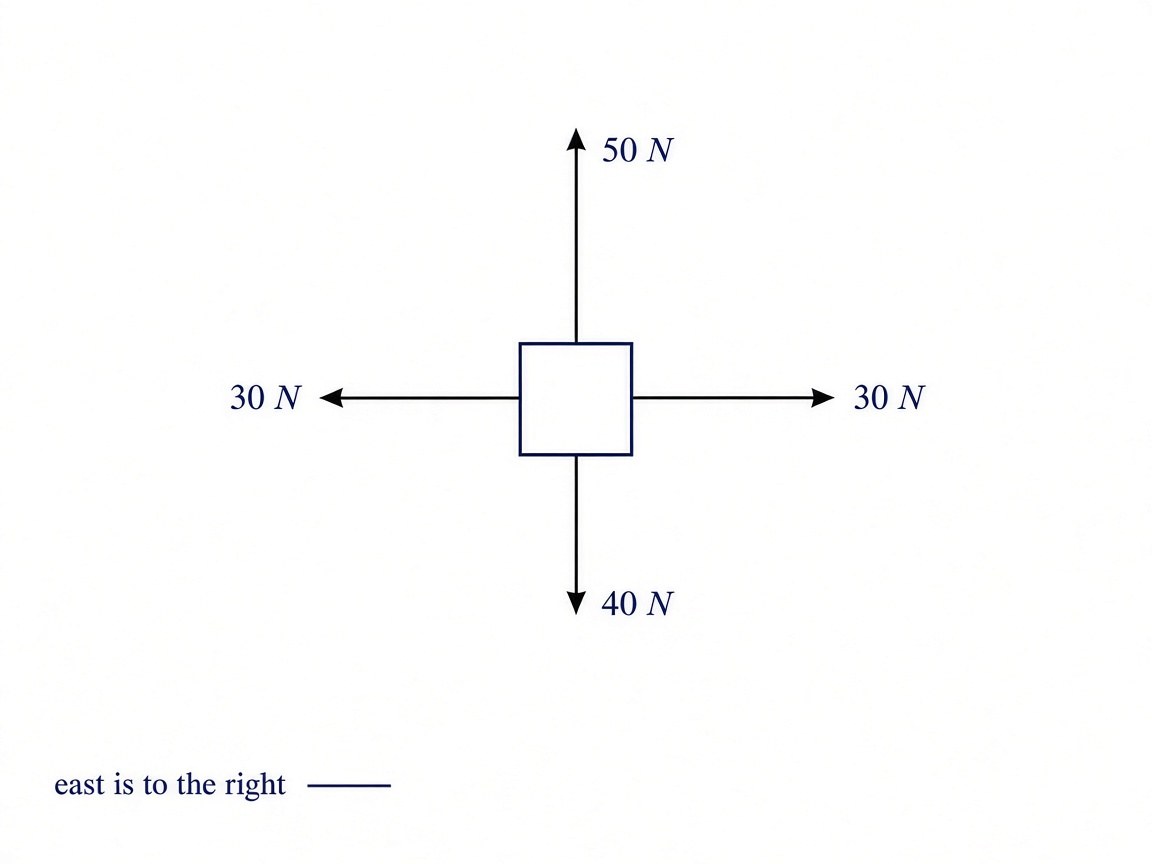
The figure shows all four forces acting on an object that is, at this instant, moving east at $3.0\,\mathrm{m/s}$. Which description of the object’s motion just after this instant is correct?

Free-body diagram of an object with a 50 N arrow up, a 40 N arrow down, a 30 N arrow right, and a 30 N arrow left.
  1. A. It stays in equilibrium, because the horizontal forces cancel.
  2. B. Its eastward speed decreases while it rises, because part of the upward force opposes the motion.
  3. C. It moves straight up, because the only unbalanced force is vertical.
  4. D. It keeps moving east at $3.0\,\mathrm{m/s}$ while gaining upward speed, so its path curves upward.