Newton's Second Law FRQ Practice

Responses receive AI feedback against a rubric after submission. Scores are practice estimates.

Question 1 of 5

A $6.0\,\mathrm{kg}$ box slides to the east along a horizontal floor. Three horizontal forces act on it: $34\,\mathrm{N}$ east, $10\,\mathrm{N}$ west, and kinetic friction of $6.0\,\mathrm{N}$. (a) Determine the magnitude and direction of the box’s acceleration. (b) The $34\,\mathrm{N}$ force is then reduced until the box moves at constant velocity. Determine the reduced value and justify which law you used. (c) Explain why reducing the force below that value makes the box slow down rather than immediately reverse.
Question 2 of 5

A block of mass $m$ on a frictionless ramp inclined at $\theta$ is pushed by a horizontal force $F$ directed into the ramp so that the block accelerates up the slope. (a) Draw a free-body diagram. (b) Write the second law along an axis parallel to the ramp and solve for the acceleration in terms of $F$, $m$, $g$, and $\theta$. (c) Determine the value of $F$ that makes the acceleration zero. (d) Describe what happens to that required force as $\theta \to 90^\circ$ and explain the result physically.

Question 3 of 5

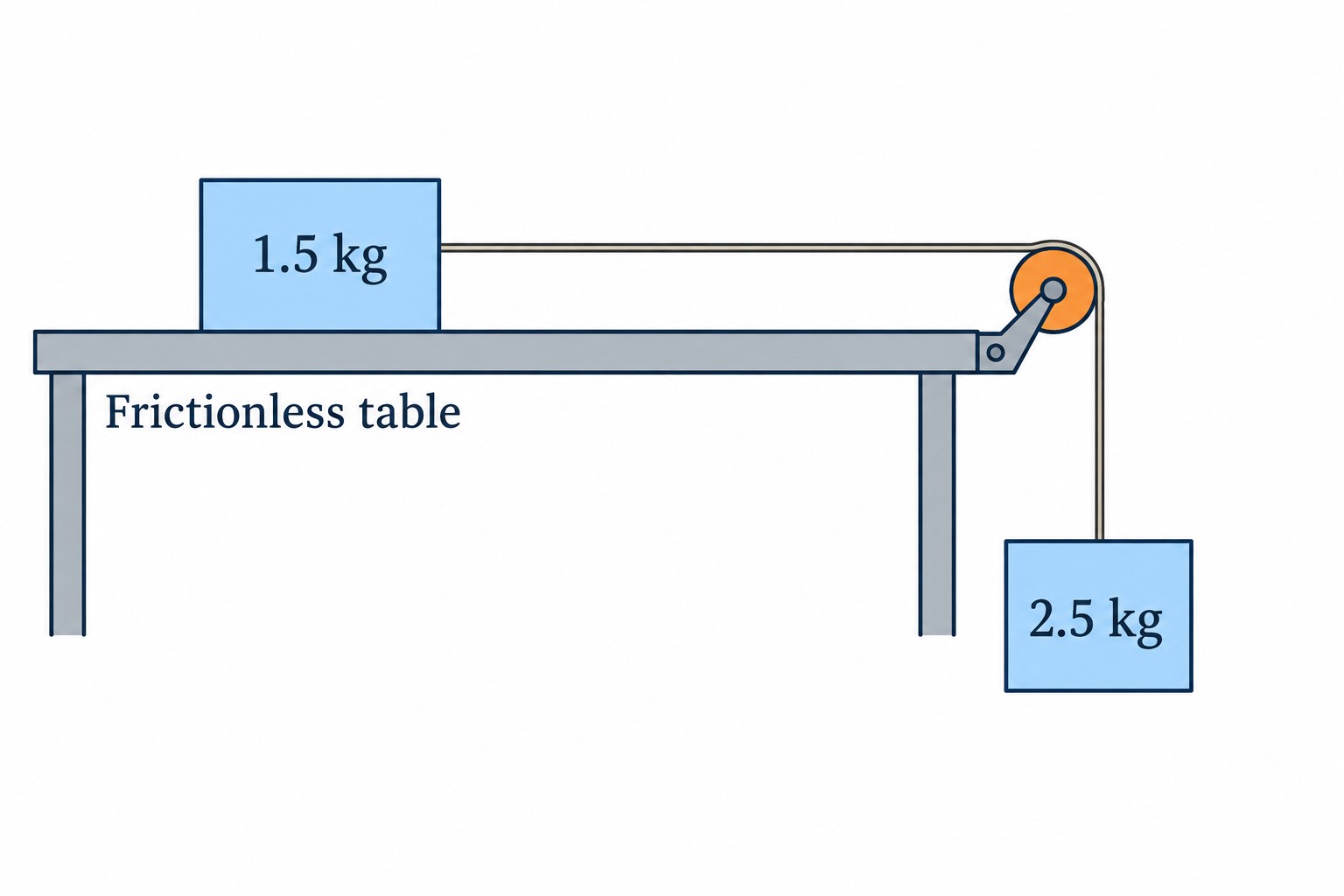
A $1.5\,\mathrm{kg}$ block on a frictionless horizontal table is connected by a light string over a light frictionless pulley at the table edge to a $2.5\,\mathrm{kg}$ hanging block. The system is released from rest. Take $g=9.8\,\mathrm{m/s^2}$. (a) Write the second law for each block separately, using consistent positive directions. (b) Determine the acceleration of the system. (c) Determine the string tension. (d) Explain why the tension is less than the weight of the hanging block.

A block on a table connects over an edge pulley to a hanging block.

Question 4 of 5

A $3.0\,\mathrm{kg}$ object moves along a straight horizontal line. Velocity readings at four times are shown. (a) Determine the net force on the object during each of the three intervals. (b) Identify the interval during which the object is slowing while still moving in the positive direction, and justify your answer. (c) Explain how the data show that a large velocity does not require a large net force.

Time (s) Velocity (m/s)
0 3.0
3.0 9.0
6.0 9.0
9.0 3.0

Question 5 of 5

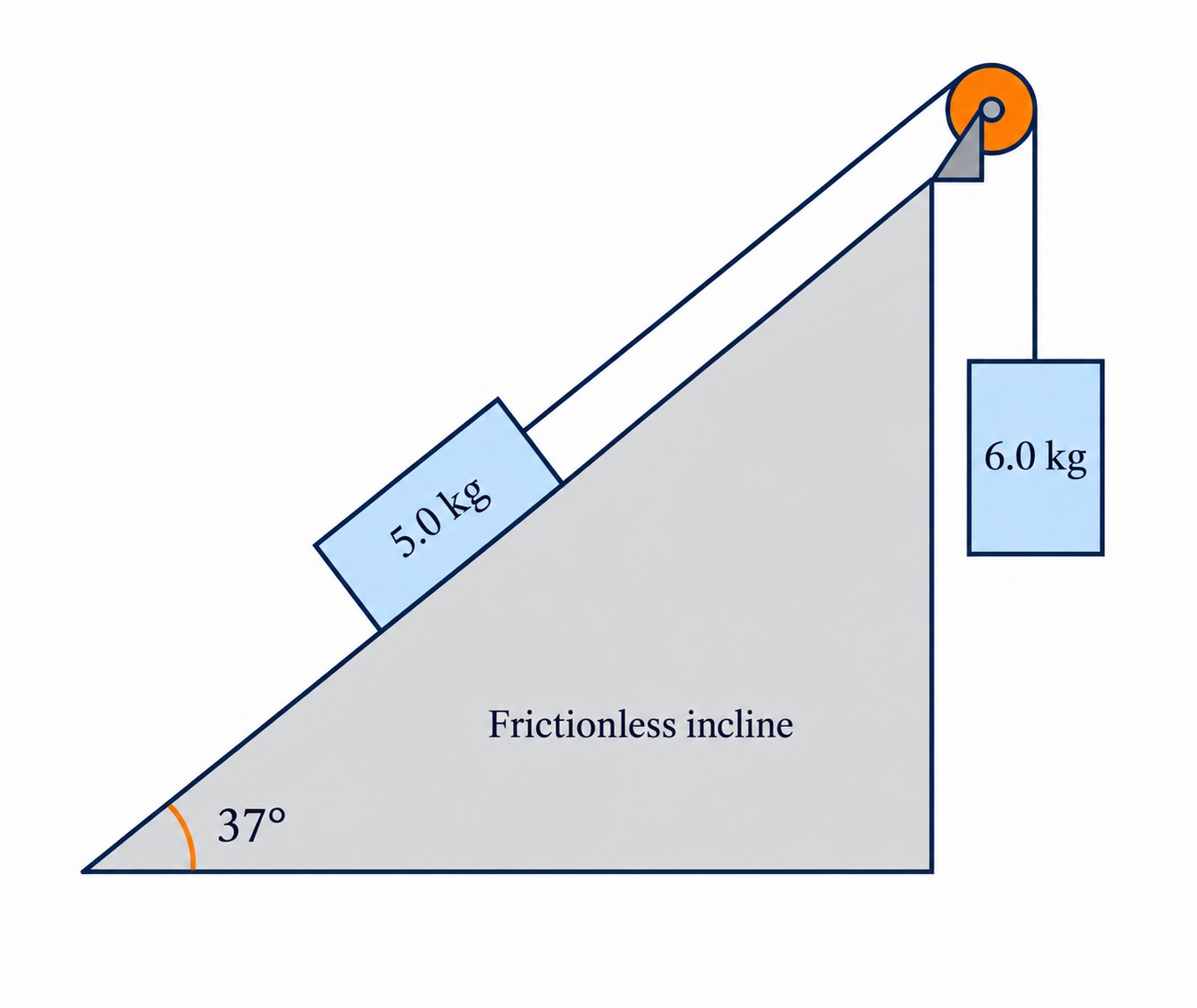
A $5.0\,\mathrm{kg}$ block rests on a frictionless incline of angle $37^\circ$ and is connected by a light string running over a light frictionless pulley at the top of the incline to a $6.0\,\mathrm{kg}$ block hanging vertically. The system is released from rest. Use $g=9.8\,\mathrm{m/s^2}$ and $\sin37^\circ = 0.60$. (a) Write the second law along the incline for the $5.0\,\mathrm{kg}$ block and vertically for the hanging block, using a consistent positive direction for the system. (b) Determine the acceleration. (c) Determine the string tension, and verify it with the equation you did not use to find it. (d) Determine the hanging mass that would hold the system at rest with the incline block unchanged, and describe the motion for any smaller hanging mass.

A block on an incline connects over a pulley to a hanging block.