Gravitational Force FRQ Practice

Responses receive AI feedback against a rubric after submission. Scores are practice estimates.

Question 1 of 5

A moon has mass $7.3\times 10^{22}\,\mathrm{kg}$ and radius $1.7\times 10^{6}\,\mathrm{m}$. Use $G = 6.67\times 10^{-11}\,\mathrm{N\,m^2/kg^2}$. (a) Determine the gravitational field strength at the moon’s surface. (b) Determine the weight of a $90\,\mathrm{kg}$ astronaut plus equipment on the surface, and state the corresponding mass. (c) Determine the field strength at a distance of $4$ moon radii from the moon’s center, and state the factor by which it has decreased.
Question 2 of 5

A $80\,\mathrm{kg}$ rider stands on a scale in an elevator. Four moments in one trip are described. Take $g = 9.8\,\mathrm{m/s^2}$. (a) Determine the scale reading at each moment. (b) Explain why moments 2 and 3 give the same reading even though the elevator is moving in opposite directions. (c) State whether the gravitational force on the rider differs among the four moments, and justify your answer.

Moment Elevator motion Acceleration
1 at rest between floors $0$
2 moving upward and speeding up $1.5\,\mathrm{m/s^2}$ upward
3 moving downward and slowing down $1.5\,\mathrm{m/s^2}$ upward
4 cable broken, air resistance negligible $9.8\,\mathrm{m/s^2}$ downward

Question 3 of 5

Two spheres of masses $M$ and $3M$ are held a distance $d$ apart and released from rest in deep space, where no other bodies matter. (a) Compare the magnitudes of the gravitational forces on the two spheres and justify your answer. (b) Compare the magnitudes of their accelerations. (c) The experiment is repeated with the same masses but a separation of $2d$. Determine the factor by which each force changes. (d) Explain why the center of mass of the two-sphere system does not accelerate.

Question 4 of 5

At a point in space a $0.25\,\mathrm{kg}$ probe experiences a gravitational force of $1.5\,\mathrm{N}$ directed toward a star. (a) Determine the gravitational field strength at that point, with units and direction. (b) Determine the force on a $40\,\mathrm{kg}$ satellite placed at the same point. (c) A student says that because the satellite feels a much larger force, it must be in a stronger field. Explain what is wrong with that statement and what quantity actually characterizes the location.

Question 5 of 5

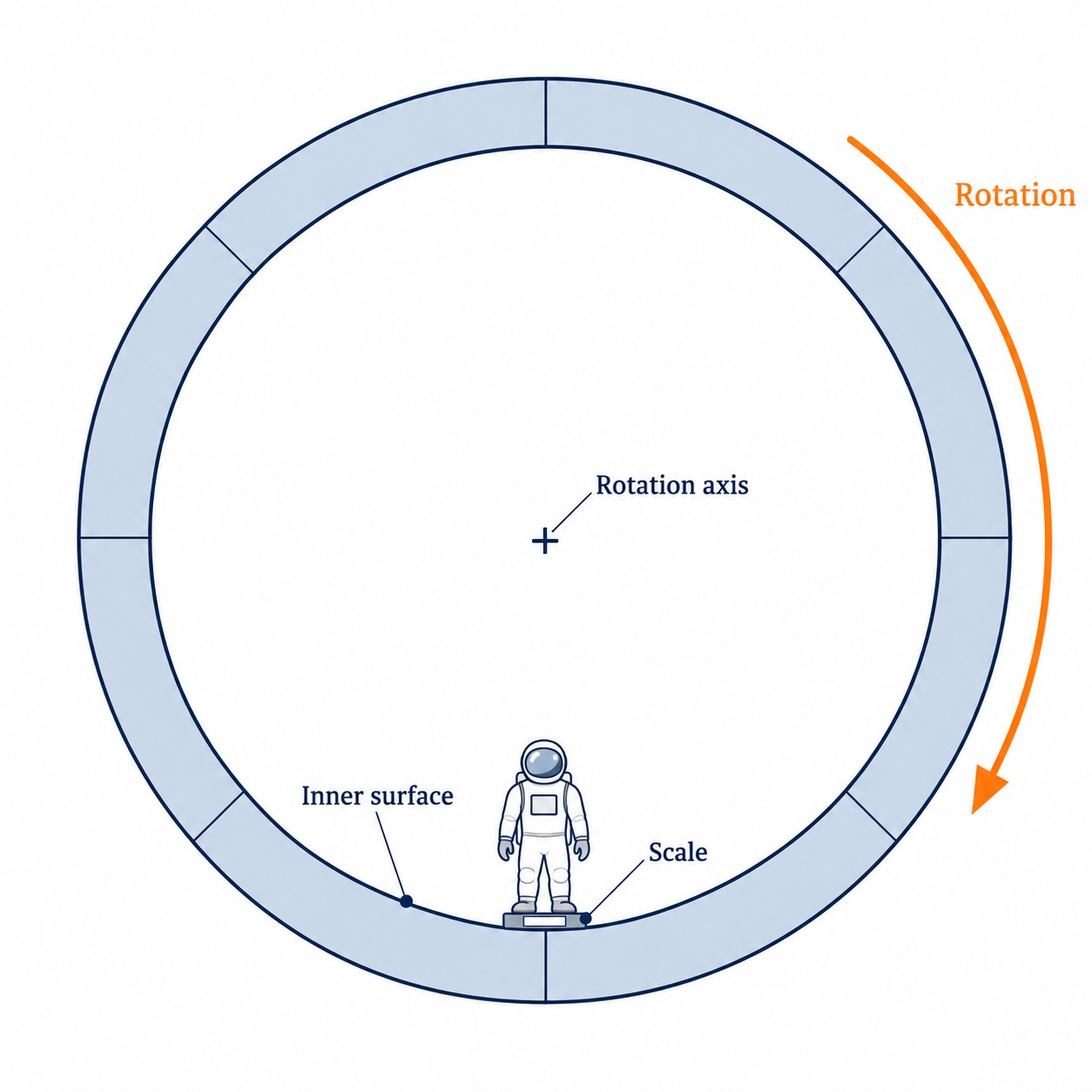
An engineer designs a rotating space station so that astronauts on the inner surface of the outer rim feel an apparent weight equal to what they would feel standing on Earth. (a) Explain what quantity a bathroom scale actually measures, and use that to explain how the rotating station can produce a reading of $mg$ with no nearby planet. (b) Explain the sense in which the astronauts’ experience is equivalent to standing on Earth. (c) Describe one measurement inside the station that would reveal the station is rotating rather than resting on a planet.

An astronaut stands on the inner surface of a rotating circular space station.