Newton's Third Law MCQ Practice

Question 1 of 10

A $2000\,\mathrm{kg}$ truck collides head-on with a $1000\,\mathrm{kg}$ car. Which statement about the collision is correct?

  1. A. The truck exerts a larger force on the car than the car exerts on the truck.
  2. B. The forces are equal in magnitude and opposite in direction, but the car’s acceleration has twice the magnitude of the truck’s.
  3. C. The car exerts no force on the truck, since the truck does all the damage.
  4. D. The forces are equal in magnitude, so the two accelerations are equal in magnitude.
Question 2 of 10

A book lies at rest on a horizontal table. Which two forces form a Newton’s third law pair?

  1. A. The gravitational force of Earth on the book and the normal force of the table on the book
  2. B. The gravitational force of Earth on the book and the gravitational force of the book on the table
  3. C. The weight of the book and the weight of the table
  4. D. The normal force of the table on the book and the normal force of the book on the table

Question 3 of 10

A horse pulls a loaded cart forward and both speed up. The cart pulls backward on the horse with exactly the same magnitude of force. Why does the system accelerate?

  1. A. The horse’s pull happens first, so it acts before the cart can pull back.
  2. B. In practice the horse pulls slightly harder than the cart pulls back.
  3. C. The two forces act on different objects, so they cannot cancel on either one; the system accelerates because of the forward friction the ground exerts on the horse’s hooves.
  4. D. Newton’s third law does not apply once the objects are accelerating.

Question 4 of 10

A $3.0\,\mathrm{kg}$ block and a $5.0\,\mathrm{kg}$ block hang from the two ends of an ideal string over an ideal pulley and are released. Take $g=10\,\mathrm{m/s^2}$. The tension in the string is

  1. A. $37.5\,\mathrm{N}$ throughout the string, more than the smaller weight and less than the larger weight
  2. B. $30\,\mathrm{N}$ on the $3.0\,\mathrm{kg}$ side and $50\,\mathrm{N}$ on the $5.0\,\mathrm{kg}$ side
  3. C. $40\,\mathrm{N}$ throughout, the average of the two weights
  4. D. $80\,\mathrm{N}$ throughout, since the string supports both blocks

Question 5 of 10

Why may the tension be taken as the same at every point of an ideal string running over an ideal pulley?

  1. A. Because Newton’s third law requires the forces at the two ends of the string to be equal and opposite
  2. B. Because a massless string segment would need an infinite acceleration for any net force, and a massless frictionless pulley exerts no force along the string
  3. C. Because the string does not stretch
  4. D. Because the two hanging objects have the same mass

Question 6 of 10

A worker pulls a $10\,\mathrm{kg}$ box across a frictionless floor using a uniform rope of mass $2.0\,\mathrm{kg}$, applying a horizontal $36\,\mathrm{N}$ force to the free end. Which statement about the tension in the rope is correct?

  1. A. The tension is $36\,\mathrm{N}$ everywhere in the rope.
  2. B. The tension is $30\,\mathrm{N}$ at the worker’s hand and $36\,\mathrm{N}$ at the box.
  3. C. The tension is $36\,\mathrm{N}$ at the worker’s hand and $30\,\mathrm{N}$ at the box.
  4. D. The tension is $30\,\mathrm{N}$ everywhere, since the box’s mass sets the tension.

Question 7 of 10

Blocks $P$ ($2.0\,\mathrm{kg}$) and $Q$ ($4.0\,\mathrm{kg}$) are in contact on a frictionless floor. A constant horizontal $18\,\mathrm{N}$ force pushes on $Q$, which presses against $P$. The contact forces between the blocks are

  1. A. $12\,\mathrm{N}$ forward on $P$ and $12\,\mathrm{N}$ backward on $Q$
  2. B. $18\,\mathrm{N}$ forward on $P$ and $6.0\,\mathrm{N}$ backward on $Q$
  3. C. $6.0\,\mathrm{N}$ forward on $P$ and $18\,\mathrm{N}$ backward on $Q$
  4. D. $6.0\,\mathrm{N}$ forward on $P$ and $6.0\,\mathrm{N}$ backward on $Q$

Question 8 of 10

Two astronauts of mass $60\,\mathrm{kg}$ and $90\,\mathrm{kg}$ float at rest in deep space and push off each other. Which statement is correct?

  1. A. The $60\,\mathrm{kg}$ astronaut experiences the larger force, because she has less mass.
  2. B. The pushes have equal magnitudes, the $60\,\mathrm{kg}$ astronaut ends with $1.5$ times the speed of the other, and the pair’s center of mass stays at rest.
  3. C. The $90\,\mathrm{kg}$ astronaut ends with the larger speed, because she pushes harder.
  4. D. The pushes are internal, so neither astronaut moves.

Question 9 of 10

A dropped ball accelerates toward Earth. Which statement about the gravitational interaction is correct?

  1. A. The ball pulls Earth upward with an equal-magnitude force, but Earth’s acceleration is undetectably small because of its enormous mass.
  2. B. Earth pulls the ball down with a larger force than the ball pulls Earth up.
  3. C. The ball exerts no gravitational force on Earth.
  4. D. The ball and Earth both accelerate at $9.8\,\mathrm{m/s^2}$.

Question 10 of 10

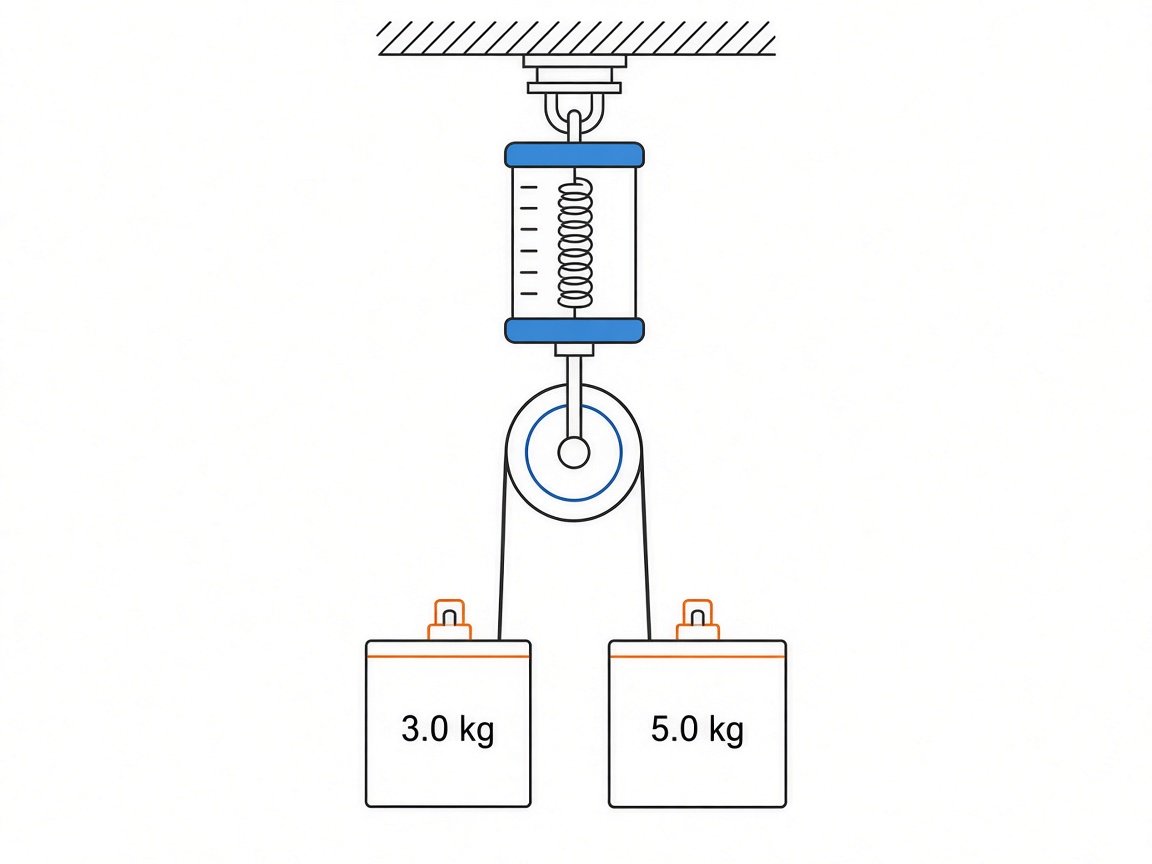
A $3.0\,\mathrm{kg}$ block and a $5.0\,\mathrm{kg}$ block hang from an ideal string over an ideal pulley of negligible mass, and the pulley hangs from a spring scale attached to the ceiling. Take $g=10\,\mathrm{m/s^2}$. While the blocks accelerate, the scale reads

A spring scale supports a pulley with 3-kilogram and 5-kilogram hanging blocks.
  1. A. $80\,\mathrm{N}$, the total weight of the blocks
  2. B. $37.5\,\mathrm{N}$, the tension in the string
  3. C. $75\,\mathrm{N}$, less than the $80\,\mathrm{N}$ total weight because the system’s center of mass accelerates downward
  4. D. $20\,\mathrm{N}$, the difference between the two weights