Forces and Free-Body Diagrams MCQ Practice

Question 1 of 10

A skydiver falls straight down at constant speed with her parachute open. Which forces belong on her free-body diagram?

  1. A. The gravitational force downward and the drag force upward, equal in magnitude
  2. B. The gravitational force downward, the drag force upward, and a downward force of motion
  3. C. Only the drag force, because gravity is balanced and therefore no longer acts
  4. D. The gravitational force downward and an upward normal force exerted by the air
Question 2 of 10

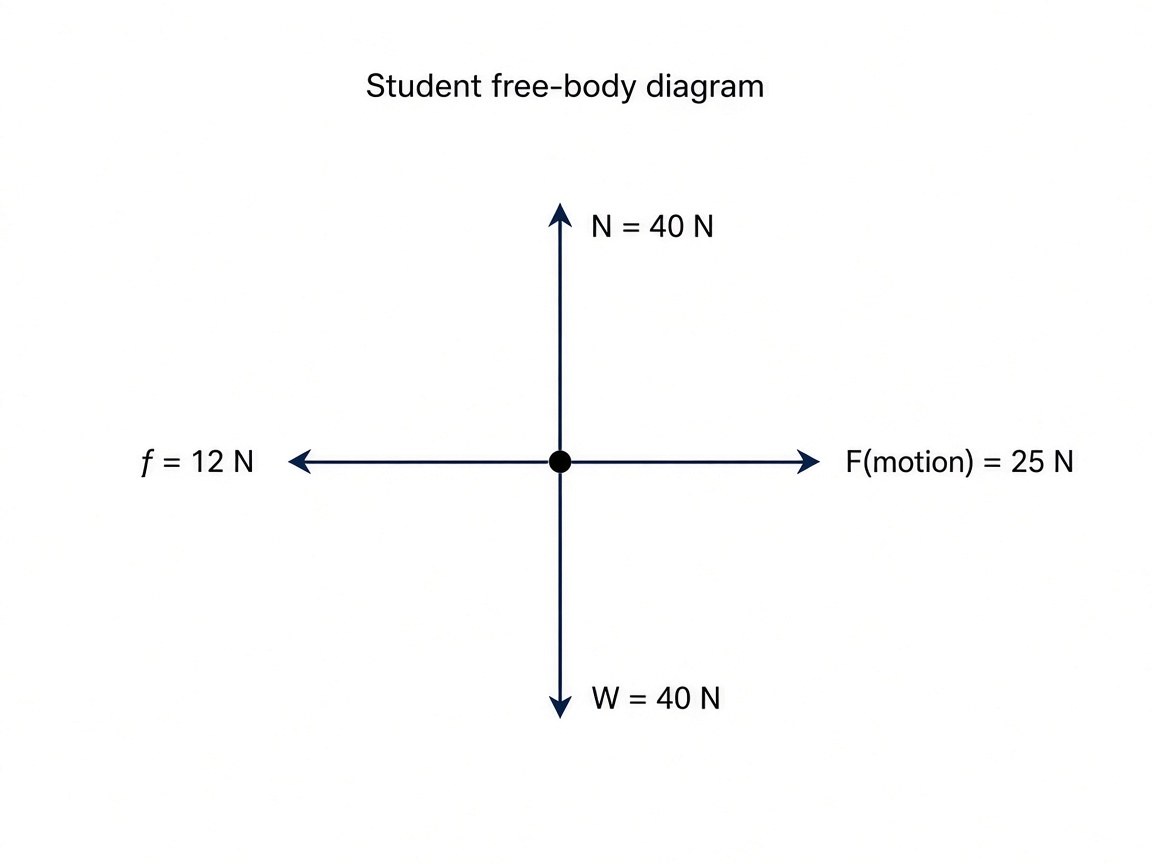
A block slides to the right across a rough, level floor with nothing pushing it, and it is slowing down. The figure shows a student’s free-body diagram for the block. Which single change makes the diagram correct?

Free-body diagram drawn by a student: a dot with a 40 N arrow up labeled N, a 40 N arrow down labeled W, a 12 N arrow left labeled f, and a 25 N arrow right labeled F(motion).
  1. A. Reverse the friction arrow so that it points to the right, along the direction of motion.
  2. B. Lengthen the upward arrow to $52\,\mathrm{N}$ so that all four arrows balance.
  3. C. Add a downward arrow representing the block’s inertia.
  4. D. Delete the rightward $25\,\mathrm{N}$ arrow, because no object exerts a forward force on the block.

Question 3 of 10

A $4.0\,\mathrm{kg}$ block is released from rest on a frictionless incline that makes a $30^\circ$ angle with the horizontal. Take $g=10\,\mathrm{m/s^2}$ and choose axes parallel and perpendicular to the incline surface. Which statement is correct?

  1. A. $F_N=40\,\mathrm{N}$, because the surface must balance the entire gravitational force.
  2. B. $F_N=40\cos 30^\circ=35\,\mathrm{N}$, and the net force is $20\,\mathrm{N}$ down the incline.
  3. C. $F_N=40\sin 30^\circ=20\,\mathrm{N}$, and the net force is $35\,\mathrm{N}$ down the incline.
  4. D. $F_N=40/\cos 30^\circ=46\,\mathrm{N}$, because the incline must also supply the sliding force.

Question 4 of 10

For a block on an incline, a student’s free-body diagram shows the normal force, the friction force, an arrow of length $mg$ pointing straight down, and two extra arrows labeled $mg\sin\theta$ and $mg\cos\theta$. What is wrong with the diagram?

  1. A. Nothing is wrong; the components simply add useful information.
  2. B. The arrow labeled $mg\sin\theta$ should point up the incline rather than down it.
  3. C. The components must replace the $mg$ arrow rather than be added to it, or the gravitational interaction is counted twice.
  4. D. The diagram is missing an arrow for the net force on the block.

Question 5 of 10

A book rests at rest on a table that stands on the floor. The table lists four force entries a student wrote while preparing the free-body diagram of the book. Which entries must be deleted from that diagram?

Entry Type of force Exerted by Exerted on
1 Gravitational Earth Book
2 Normal Table Book
3 Normal Book Table
4 Normal Table legs Floor
  1. A. Entry 3 only
  2. B. Entries 3 and 4
  3. C. Entry 4 only
  4. D. Entries 1 and 3

Question 6 of 10

A $70\,\mathrm{kg}$ passenger stands on a bathroom scale in an elevator, and the scale reads $630\,\mathrm{N}$. Take $g=10\,\mathrm{m/s^2}$. Which statement is correct?

  1. A. The passenger’s weight has decreased to $630\,\mathrm{N}$.
  2. B. The elevator must be moving downward at constant speed.
  3. C. The acceleration is $1.0\,\mathrm{m/s^2}$ downward, so the elevator is moving up and slowing or moving down and speeding up.
  4. D. The acceleration is $1.0\,\mathrm{m/s^2}$ upward.

Question 7 of 10

A $3.0\,\mathrm{kg}$ block rests on top of a $5.0\,\mathrm{kg}$ block, which rests on the floor. Take $g=10\,\mathrm{m/s^2}$. Which set of forces is the correct free-body diagram for the upper block?

  1. A. A $30\,\mathrm{N}$ gravitational force down and a $30\,\mathrm{N}$ normal force up from the lower block
  2. B. A $30\,\mathrm{N}$ gravitational force down, a $30\,\mathrm{N}$ normal force up from the lower block, and an $80\,\mathrm{N}$ normal force up from the floor
  3. C. A $50\,\mathrm{N}$ gravitational force down and a $50\,\mathrm{N}$ normal force up from the lower block
  4. D. A $30\,\mathrm{N}$ gravitational force down, a $30\,\mathrm{N}$ normal force up, and a $50\,\mathrm{N}$ downward force from the weight of the lower block

Question 8 of 10

A $2.0\,\mathrm{kg}$ block is held against a vertical wall by a horizontal $30\,\mathrm{N}$ push directed into the wall, and it slides down the wall at constant speed. Take $g=10\,\mathrm{m/s^2}$. Which set of forces is the correct free-body diagram?

  1. A. Push $30\,\mathrm{N}$ into the wall, normal $20\,\mathrm{N}$ away from the wall, gravitational $20\,\mathrm{N}$ down, friction $30\,\mathrm{N}$ up
  2. B. Push $30\,\mathrm{N}$ into the wall, gravitational $20\,\mathrm{N}$ down, friction $20\,\mathrm{N}$ down
  3. C. Normal $30\,\mathrm{N}$ away from the wall, gravitational $20\,\mathrm{N}$ down, friction $20\,\mathrm{N}$ up, with no push shown because the push acts on the wall
  4. D. Push $30\,\mathrm{N}$ into the wall, normal $30\,\mathrm{N}$ away from the wall, gravitational $20\,\mathrm{N}$ down, friction $20\,\mathrm{N}$ up

Question 9 of 10

A steel ball is released inside a sealed, evacuated glass tube and falls. What does the correct free-body diagram of the ball show?

  1. A. A single downward gravitational force, a long-range interaction that requires no contact
  2. B. No forces at all, because no object touches the ball
  3. C. A downward gravitational force and an upward drag force
  4. D. A downward gravitational force plus an additional downward force of falling

Question 10 of 10

A $6.0\,\mathrm{kg}$ crate slides down a rough incline at $37^\circ$ above the horizontal. You choose $x$ pointing down the slope and $y$ perpendicular to the surface. Take $g=10\,\mathrm{m/s^2}$, $\sin 37^\circ=0.60$, $\cos 37^\circ=0.80$. Which statement about this axis choice is correct?

  1. A. The normal force must be resolved into components of $48\,\mathrm{N}$ and $36\,\mathrm{N}$.
  2. B. Only the gravitational force needs components: $36\,\mathrm{N}$ down the slope and $48\,\mathrm{N}$ into the surface.
  3. C. Both the normal force and the friction force need components, but the gravitational force does not.
  4. D. Only the gravitational force needs components: $48\,\mathrm{N}$ down the slope and $36\,\mathrm{N}$ into the surface.