Vectors and Motion in Two Dimensions MCQ Practice

Question 1 of 10

A hiker walks $8.0\,\mathrm{km}$ east, then $6.0\,\mathrm{km}$ north, then $3.0\,\mathrm{km}$ west. What is the magnitude of the hiker’s displacement?

  1. A. $7.8\,\mathrm{km}$
  2. B. $11\,\mathrm{km}$
  3. C. $17\,\mathrm{km}$
  4. D. $5.0\,\mathrm{km}$

Question 2 of 10

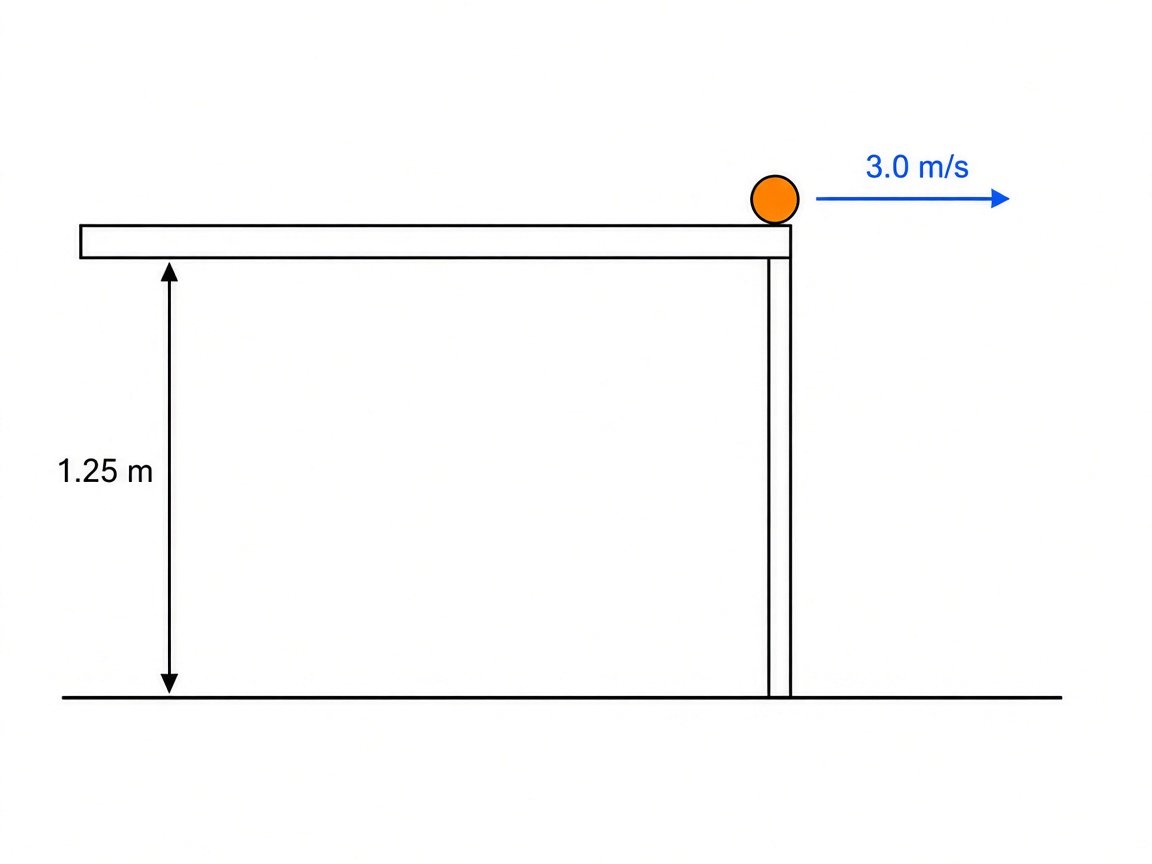
A ball rolls off the edge of a table $1.25\,\mathrm{m}$ high with a horizontal velocity of $3.0\,\mathrm{m/s}$. Take $g=10\,\mathrm{m/s^2}$ and ignore air resistance. What is the ball’s speed just before it hits the floor?

A ball leaves a 1.25-meter-high table horizontally at 3.0 meters per second.
  1. A. $3.0\,\mathrm{m/s}$
  2. B. $5.0\,\mathrm{m/s}$
  3. C. $8.0\,\mathrm{m/s}$
  4. D. $5.8\,\mathrm{m/s}$

Question 3 of 10

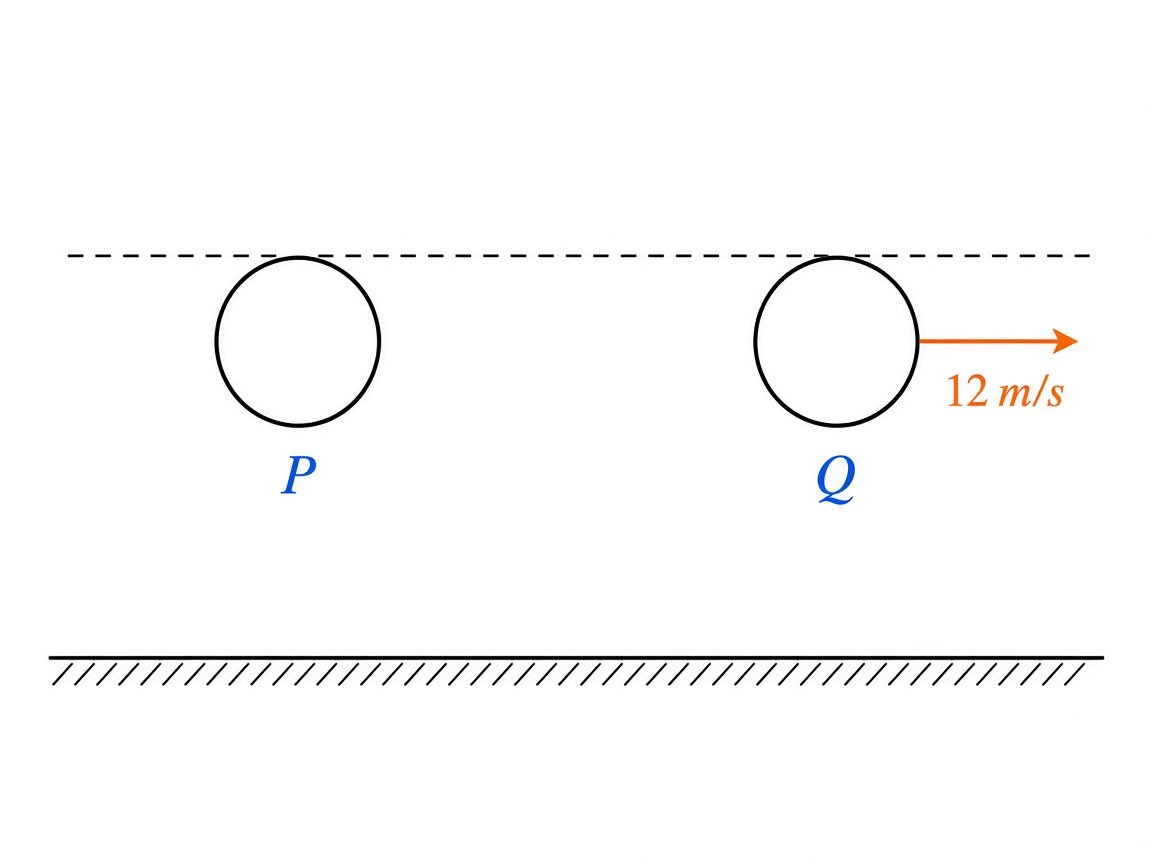
From the same height above level ground and at the same instant, one ball is dropped from rest and a second ball is launched horizontally at $12\,\mathrm{m/s}$. Air resistance is negligible. Which statement is correct?

Two balls begin at the same height; one is dropped and the other is launched horizontally.
  1. A. The dropped ball lands first, because it travels a shorter path.
  2. B. The launched ball lands first, because it has more speed.
  3. C. They land at the same instant, and the launched ball lands with the greater speed.
  4. D. They land at the same instant with equal landing speeds, since gravity acts equally on both.

Question 4 of 10

A projectile is launched from level ground at $25\,\mathrm{m/s}$ at $53^\circ$ above the horizontal. Use $\sin 53^\circ=0.80$, $\cos 53^\circ=0.60$, and $g=10\,\mathrm{m/s^2}$. What is the maximum height above the launch point?

  1. A. $10\,\mathrm{m}$
  2. B. $20\,\mathrm{m}$
  3. C. $31\,\mathrm{m}$
  4. D. $40\,\mathrm{m}$

Question 5 of 10

A projectile is launched at $20\,\mathrm{m/s}$ at $30^\circ$ above the horizontal from level ground. Take $g=10\,\mathrm{m/s^2}$. What is its speed at $t=1.5\,\mathrm{s}$ after launch?

  1. A. $12\,\mathrm{m/s}$
  2. B. $17\,\mathrm{m/s}$
  3. C. $18\,\mathrm{m/s}$
  4. D. $20\,\mathrm{m/s}$

Question 6 of 10

A ball is launched horizontally from the top of a building. The table lists its position, with $x$ measured horizontally from the launch point and $y$ measured upward from the ground. Take $g=10\,\mathrm{m/s^2}$. What is the ball’s speed at $t=1.0\,\mathrm{s}$?

$t$ (s) $x$ (m) $y$ (m)
0 0 20.0
0.50 4.0 18.75
1.00 8.0 15.0
1.50 12.0 8.75
2.00 16.0 0
  1. A. $8.0\,\mathrm{m/s}$
  2. B. $10\,\mathrm{m/s}$
  3. C. $12.8\,\mathrm{m/s}$
  4. D. $18\,\mathrm{m/s}$

Question 7 of 10

A projectile follows a parabolic path over level ground with negligible air resistance. Take $g=10\,\mathrm{m/s^2}$. Which statement about the highest point of the path is correct?

  1. A. The speed is a minimum there and equals the horizontal component of the launch velocity, while the acceleration is $10\,\mathrm{m/s^2}$ downward.
  2. B. Both the velocity and the acceleration are zero there.
  3. C. The velocity is zero there, but the acceleration is $10\,\mathrm{m/s^2}$ downward.
  4. D. The acceleration is zero there, but the velocity is horizontal.

Question 8 of 10

Two identical balls are launched from level ground with the same speed of $30\,\mathrm{m/s}$, one at $30^\circ$ and the other at $60^\circ$ above the horizontal. Air resistance is negligible. Which comparison is correct?

  1. A. The $30^\circ$ launch has the greater range and the longer flight time.
  2. B. The $60^\circ$ launch has the greater range and the shorter flight time.
  3. C. The two launches match in range, flight time, and maximum height.
  4. D. The two ranges are equal, but the $60^\circ$ launch has the longer flight time and the higher apex.

Question 9 of 10

A stone is launched horizontally from a cliff $45\,\mathrm{m}$ high and lands $60\,\mathrm{m}$ from the base. Take $g=10\,\mathrm{m/s^2}$ and ignore air resistance. What is the stone’s speed just before impact?

  1. A. $20\,\mathrm{m/s}$
  2. B. $36\,\mathrm{m/s}$
  3. C. $30\,\mathrm{m/s}$
  4. D. $50\,\mathrm{m/s}$

Question 10 of 10

Vector $\vec A$ has magnitude $12$ units pointing east and vector $\vec B$ has magnitude $9$ units pointing north. A third vector $\vec C$ is added so that $\vec A+\vec B+\vec C=\vec 0$. What are the magnitude and direction of $\vec C$?

  1. A. $15$ units, $37^\circ$ south of west
  2. B. $15$ units, $37^\circ$ north of east
  3. C. $21$ units, directed southwest
  4. D. $3.0$ units, directed west