Vectors and Motion in Two Dimensions FRQ Practice

Responses receive AI feedback against a rubric after submission. Scores are practice estimates.

Question 1 of 5

A ball is launched at $25\,\mathrm{m/s}$ at $53^\circ$ above the horizontal from the edge of a cliff $30\,\mathrm{m}$ above level ground. Use $\sin 53^\circ=0.80$, $\cos 53^\circ=0.60$, $g=10\,\mathrm{m/s^2}$, and ignore air resistance. (a) Determine the components of the launch velocity. (b) Determine the maximum height reached above the ground. (c) Determine the time from launch until the ball strikes the ground. (d) Determine the ball’s speed just before impact.
Question 2 of 5

Students roll a ball off the edge of a level table at several speeds and measure the horizontal distance $R$ from the table edge to the landing point. Their data are in the table. Take $g=10\,\mathrm{m/s^2}$ and ignore air resistance. (a) Explain why the data show $R$ proportional to the launch speed. (b) Determine the time the ball spends in the air. (c) Determine the height of the tabletop. (d) Explain why rolling the ball faster does not change your answer to (b).

Launch speed $v_0$ (m/s) Range $R$ (m)
1.00 0.45
1.50 0.68
2.00 0.90
2.50 1.13

Question 3 of 5

A student claims, “At the top of its arc a projectile is momentarily not moving up or down, so its acceleration there must be zero.” Take $g=10\,\mathrm{m/s^2}$ and ignore air resistance. (a) State whether the claim is correct and identify the specific error in the reasoning. (b) State the velocity and the acceleration of the projectile at the apex. (c) Use the behavior of $v_y$ just before and just after the apex to support your answer. (d) Describe the path the projectile would follow after the apex if the acceleration really were zero there.

Question 4 of 5

A drone flies $100\,\mathrm{m}$ in a direction $30^\circ$ north of east, then $80\,\mathrm{m}$ in a direction $60^\circ$ north of east. (a) Determine the east and north components of each leg. (b) Determine the components of the total displacement. (c) Determine the magnitude of the total displacement. (d) Determine its direction relative to east, and explain why the answer is not simply the average of $30^\circ$ and $60^\circ$.

Question 5 of 5

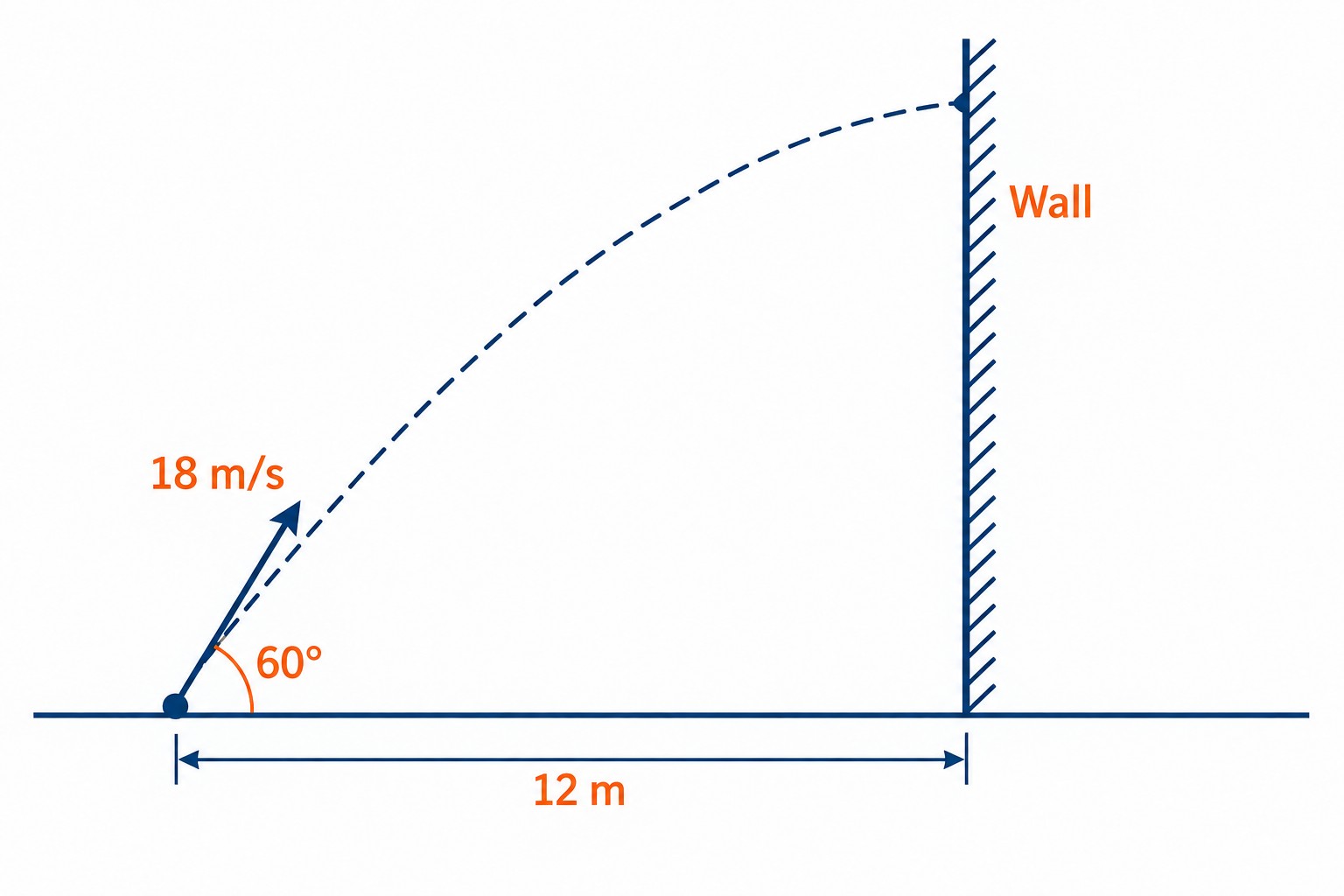
A ball is launched from ground level at $18\,\mathrm{m/s}$ at $60^\circ$ above the horizontal, aimed at a vertical wall $12\,\mathrm{m}$ away. Take $g=10\,\mathrm{m/s^2}$ and ignore air resistance. (a) Determine the components of the launch velocity. (b) Determine the time at which the ball reaches the wall. (c) Determine the height at which the ball strikes the wall. (d) State whether the ball is still rising when it strikes, and justify your answer with a calculation.

A ball launches at 18 meters per second and 60 degrees toward a wall 12 meters away.