Reference Frames and Relative Motion FRQ Practice

Responses receive AI feedback against a rubric after submission. Scores are practice estimates.

Question 1 of 5

A boat crosses a river $150\,\mathrm{m}$ wide. The current is $1.5\,\mathrm{m/s}$ and the boat moves at $2.5\,\mathrm{m/s}$ relative to the water with its bow pointed straight across. (a) Determine the crossing time. (b) Determine the downstream drift. (c) Determine the boat’s speed relative to the ground. (d) Determine the length of the boat’s path over the ground and show that it is consistent with your answers to (a) and (c).
Question 2 of 5

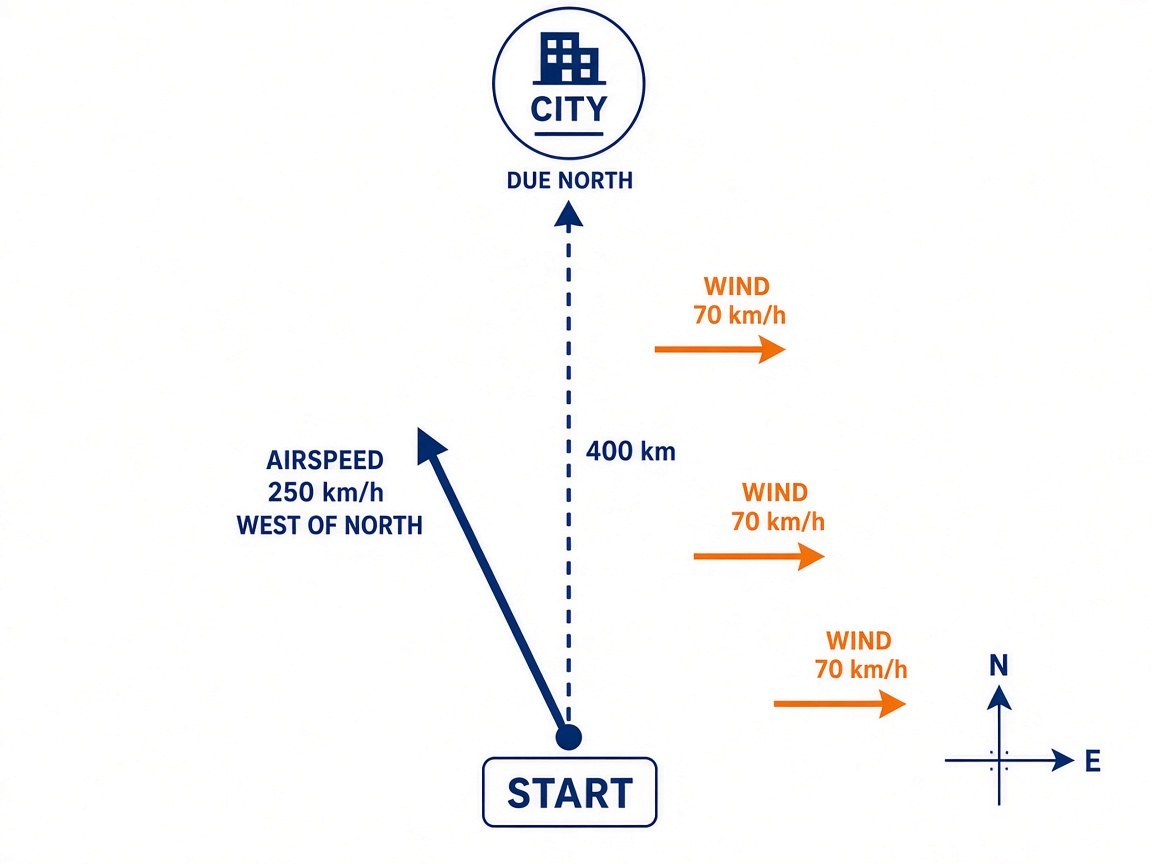
A plane with an airspeed of $250\,\mathrm{km/h}$ must reach a city $400\,\mathrm{km}$ due north. A steady wind blows from the west at $70\,\mathrm{km/h}$. (a) Explain why the pilot cannot simply point the plane due north. (b) Determine the heading angle measured from due north. (c) Determine the ground speed on that heading. (d) Determine the flight time.

An airplane points west of north toward a city directly north while wind pushes east.

Question 3 of 5

A moving walkway is $72\,\mathrm{m}$ long and moves at $0.90\,\mathrm{m/s}$ toward the far end. (a) Determine the travel time for a passenger who stands still on it. (b) Determine the travel time for a passenger who walks toward the far end at $1.35\,\mathrm{m/s}$ relative to the walkway. (c) A third passenger is $18\,\mathrm{m}$ from the near entrance and walks toward that entrance at $1.20\,\mathrm{m/s}$ relative to the walkway. Determine that passenger’s velocity relative to the ground and the time required to reach the entrance. (d) State the sign convention you used and explain how it determines the signs in part (c).

Question 4 of 5

The table gives a cart’s velocity in the ground frame, with $+x$ east. A student rides a second cart east at a constant $4.0\,\mathrm{m/s}$ and measures the first cart’s motion. (a) Determine the first cart’s velocity in the student’s frame at each listed time. (b) Determine the cart’s acceleration in the ground frame and in the student’s frame. (c) Explain why the two accelerations agree. (d) Identify one measurable quantity that the two frames disagree about, and support your choice with a value from your table.

$t$ (s) $v$ in ground frame (m/s)
0 +2.0
1.0 +5.0
2.0 +8.0
3.0 +11.0

Question 5 of 5

Airplane $A$ flies due east at $300\,\mathrm{km/h}$ and airplane $B$ flies due north at $400\,\mathrm{km/h}$, both measured relative to the ground. (a) Determine the components, magnitude, and direction of the velocity of $A$ relative to $B$. (b) Determine the velocity of $B$ relative to $A$. (c) State the general relationship between $\vec v_{AB}$ and $\vec v_{BA}$ and explain why it must hold.