TOPIC 2.8 · STUDY
Mechanisms of Transport
Active transport spends metabolic energy, usually from ATP, and it requires membrane proteins. That work builds and maintains electrochemical gradients, which are differences in both concentration and charge. The sodium-potassium pump is an ATPase that helps hold the membrane potential.
2.8.A
Active transport and electrochemical gradients
Channels let ions run downhill. To move ions and other molecules against a gradient, or to replace a gradient that leakage is erasing, the cell spends metabolic energy. ATP is the usual source. A membrane protein does the carrying. Without that protein, ATP sitting in the cytosol cannot ferry an ion across the hydrophobic core.
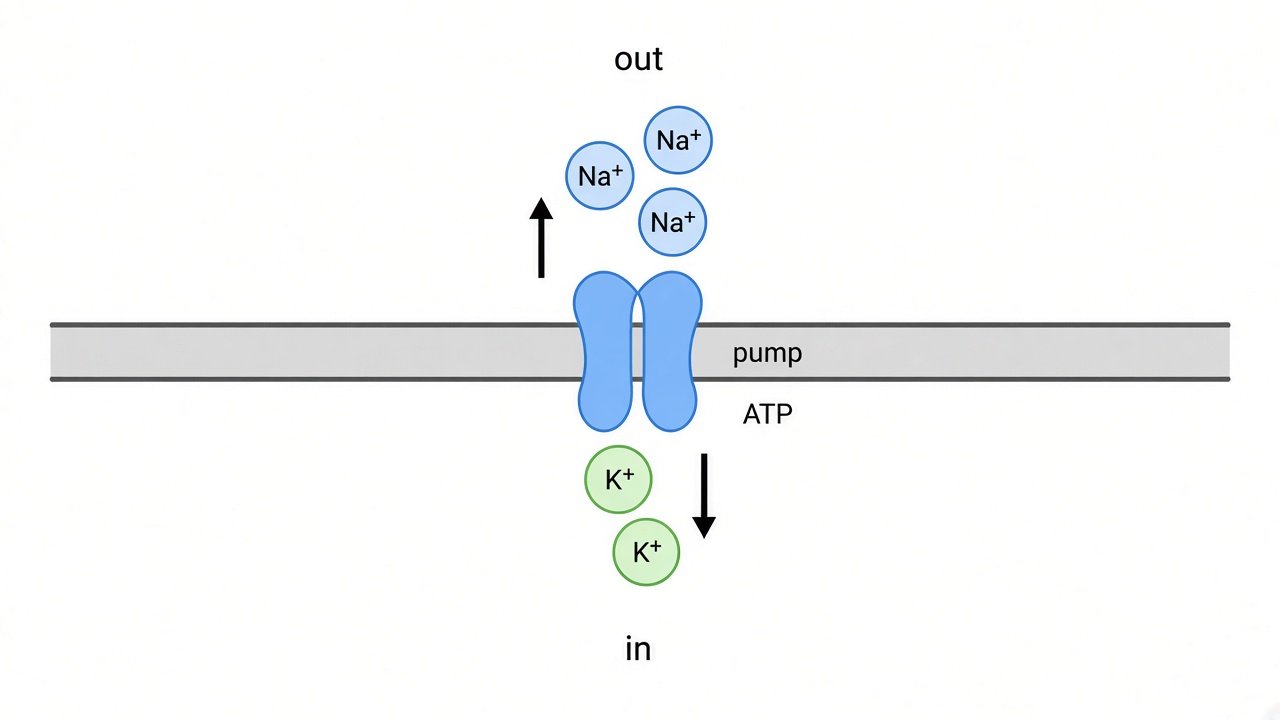
The pump uses ATP. Three Na+ move out of the cell and two K+ move in.
An electrochemical gradient is two differences at once: a higher concentration of an ion on one side, and a charge difference across the membrane. Active transport establishes that gradient and keeps it. The gradient stores a difference the cell can later let run back downhill through a channel. The downhill step is facilitated diffusion. The uphill step is active transport and is the one that costs ATP.
The sodium-potassium pump is a membrane ATPase, a protein that hydrolyzes ATP to do transport work. In one cycle it moves three $\mathrm{Na^+}$ ions out of the cell and two $\mathrm{K^+}$ ions in. Sodium is usually more concentrated outside, and potassium is usually more concentrated inside, so both legs of that cycle are uphill. Three positive charges leave and only two come back, so the cytoplasm becomes more negative relative to the outside. That charge difference is part of the membrane potential. The pump and its ATPase activity help maintain the potential. If ATP is depleted, pumping stops quickly, and the gradients begin to collapse as ions leak through channels.
Key points
- Active transport of molecules and ions requires metabolic energy, such as ATP, and a membrane protein.
- It establishes and maintains electrochemical gradients of both concentration and charge.
- The sodium-potassium pump moves three $\mathrm{Na^+}$ out and two $\mathrm{K^+}$ in for each cycle that uses ATP.
- Because more positive charge leaves than returns, the pump helps maintain the membrane potential.
- The pump is an ATPase: it uses the breakdown of ATP to drive uphill transport.
- Facilitated diffusion lets ions run down a gradient. Active transport builds the gradient.
- When ATP runs out, sodium-potassium pumping stops and the gradients start to leak away.
Membrane potential in this topic means the charge difference maintained by ion pumping and ion channels. The full pattern of a nerve impulse is not part of this topic.