Question 1 of 5
(a) Define active transport. (b) State two CED points about proteins and the Na+/K+ pump. (c) Explain electrochemical gradient in one sentence.
Responses receive AI feedback against a rubric after submission. Scores are practice estimates.
(a) Define active transport. (b) State two CED points about proteins and the Na+/K+ pump. (c) Explain electrochemical gradient in one sentence.
Interpret the pump diagram for a student. (a) Identify substrates/products of the energy step. (b) Quantitatively describe classic Na+/K+ stoichiometry shown. (c) Connect to membrane potential.
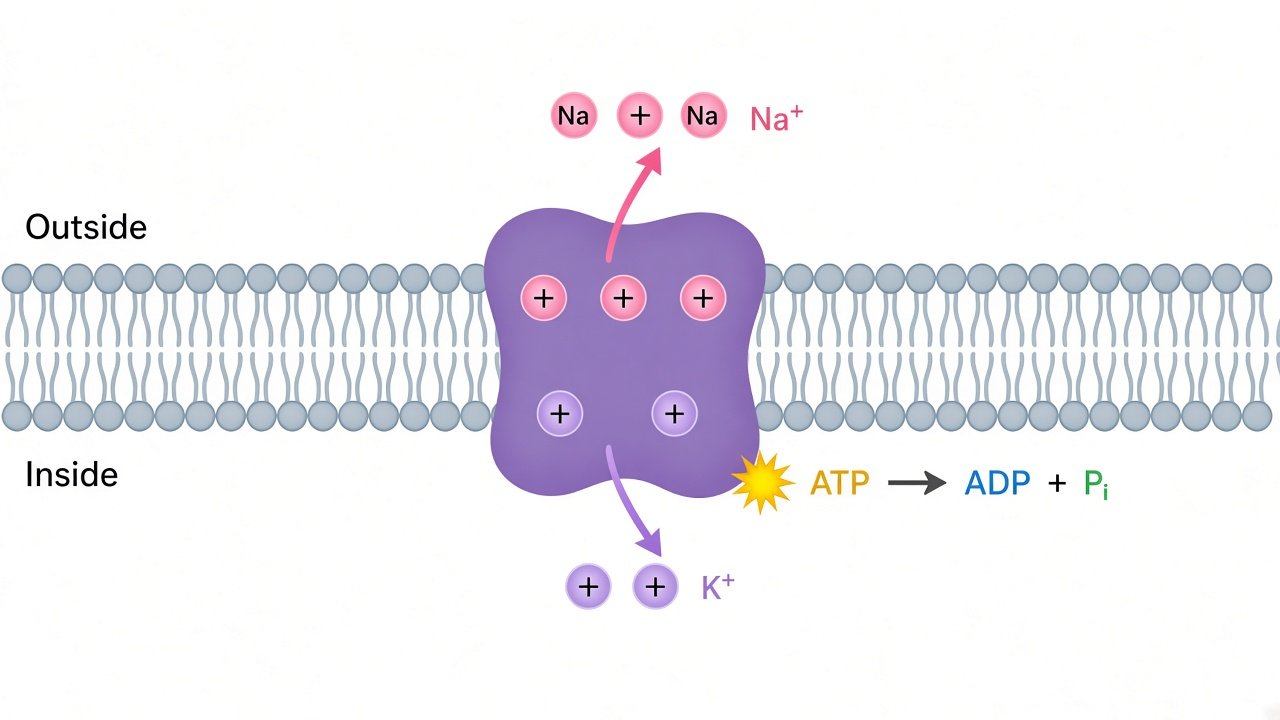
Why must cells continually spend energy on pumps even after gradients exist? (a) Mention leaks. (b) Mention gradient maintenance. (c) Mention membrane potential.
Design a comparison table in words between facilitated K+ efflux and Na+/K+ pumping. (a) Energy. (b) Typical direction relative to K+ and Na+ gradients. (c) Effect on long-term gradient persistence.
A student says membrane potential is caused only by DNA charge. Using CED 2.8, (a) reject or refine the claim, (b) cite the pump/ATPase, and (c) explain ions’ role in electrochemical gradients.