Question 1 of 5
(a) State why active transport needs metabolic energy. (b) Identify the role of membrane proteins. (c) Name the pump highlighted in the CED for membrane potential.
Responses receive AI feedback against a rubric after submission. Scores are practice estimates.
(a) State why active transport needs metabolic energy. (b) Identify the role of membrane proteins. (c) Name the pump highlighted in the CED for membrane potential.
Using the pump figure, (a) state directions of Na+ and K+ transport shown, (b) identify the energy source, and (c) explain how unequal ion exchange can contribute to membrane potential.
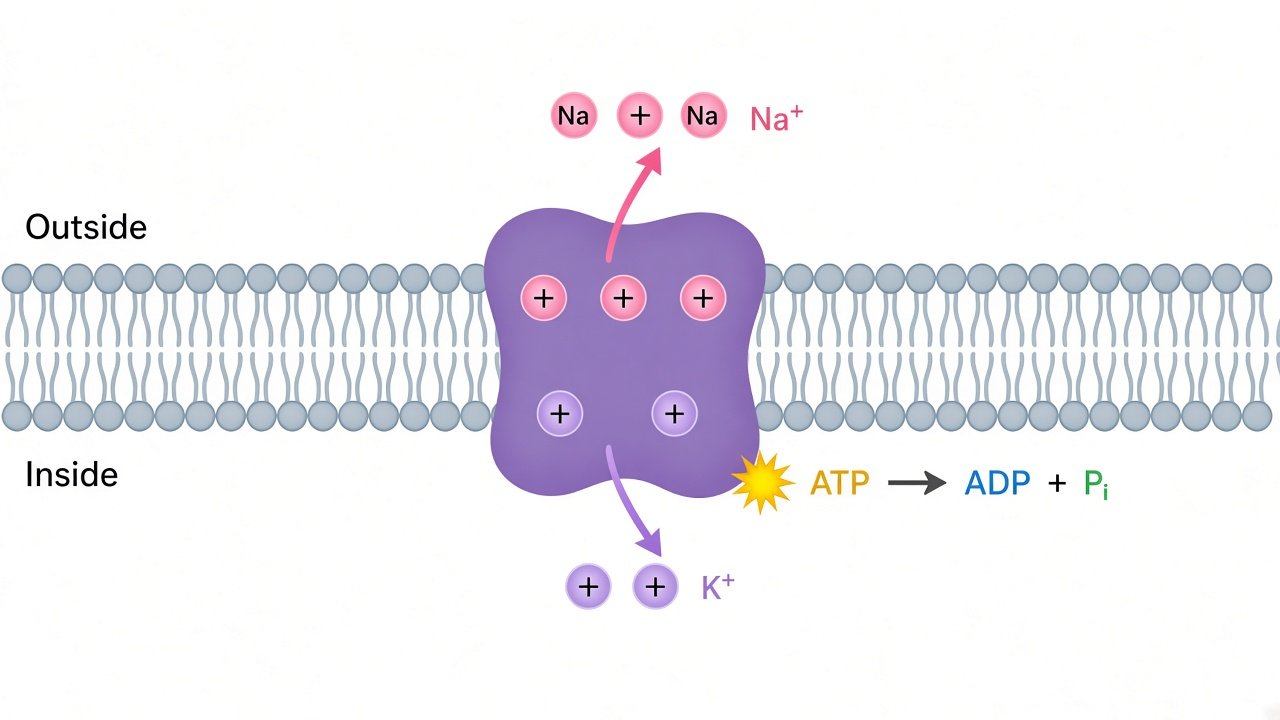
Contrast active transport with facilitated diffusion of ions. (a) Energy. (b) Gradient direction. (c) Shared reliance on membrane proteins.
A neuron maintains low cytosolic Na+ relative to outside. (a) Identify the process that builds this gradient. (b) Explain what would happen to the gradient if only leak channels remained and pumps stopped. (c) Relate pumps to membrane potential maintenance.
Claim: “Electrochemical gradients form spontaneously without cellular energy and last forever.” Critique using CED 2.8. (a) Energy requirement. (b) Role of proteins. (c) Why gradients would run down without continual active transport.