Mechanisms of Transport MCQ Practice

Question 1 of 10

Active transport of molecules and ions across membranes requires

  1. A. no metabolic energy
  2. B. metabolic energy such as that from ATP
  3. C. only random diffusion through tails
  4. D. removal of all membrane proteins

Question 2 of 10

Membrane proteins are necessary for

  1. A. active transport
  2. B. eliminating the need for ATP in all cases
  3. C. replacing the bilayer with cellulose in animals
  4. D. stopping all ion movement forever

Question 3 of 10

The Na+/K+ pump and ATPase contribute to

  1. A. photosynthesis in the stroma only
  2. B. replication of mitochondrial DNA only
  3. C. maintenance of the membrane potential
  4. D. formation of the cell wall in animals

Question 4 of 10

Establishing and maintaining electrochemical gradients typically requires

  1. A. passive diffusion alone with no pumps
  2. B. exocytosis of ATP out of the cell only
  3. C. deletion of all channels
  4. D. active transport using metabolic energy

Question 5 of 10

In the pump figure, ATP is shown near the pump because
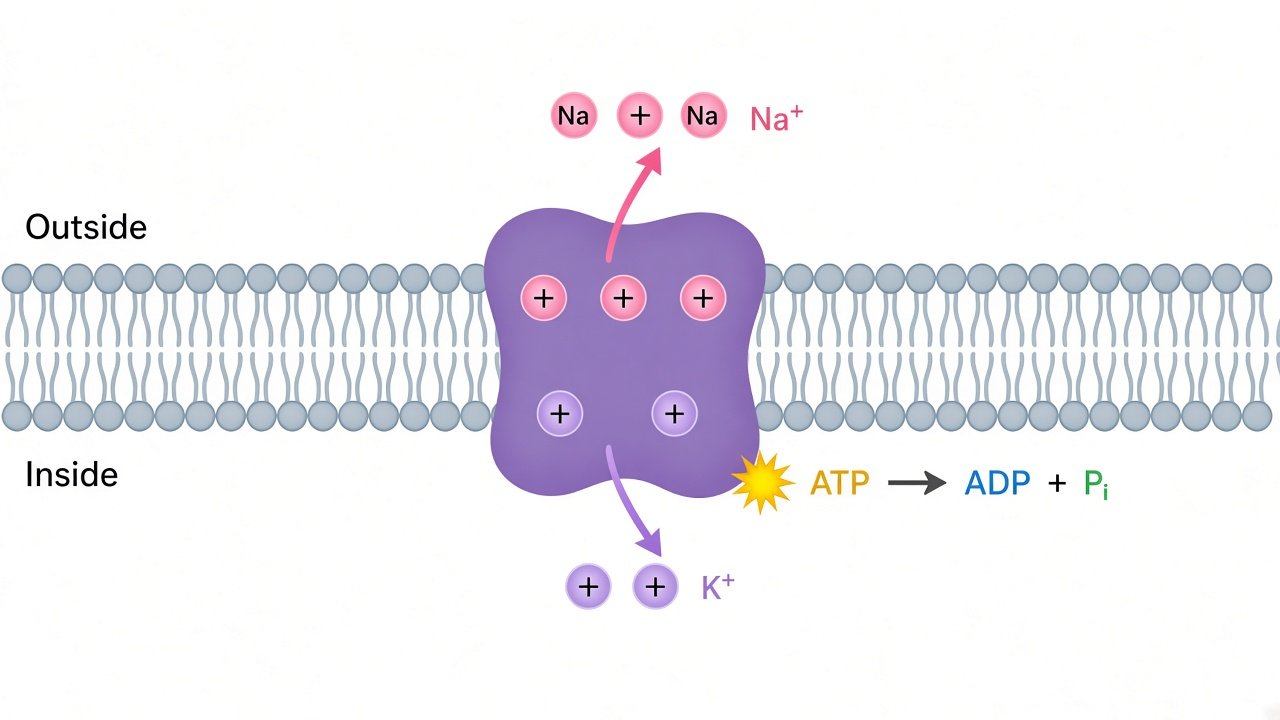
Na+/K+ pump in a membrane moving 3 Na+ out and 2 K+ in with ATP to ADP.
  1. A. metabolic energy from ATP powers active transport
  2. B. ATP freely diffuses Na+ through fatty acid tails
  3. C. ATP is the ion being pumped
  4. D. ATP blocks all K+ movement permanently

Question 6 of 10

Compared with facilitated diffusion of K+ down its gradient, Na+/K+ pumping

  1. A. never uses membrane proteins
  2. B. requires ATP and can move ions against their gradients
  3. C. is always passive
  4. D. occurs only in cell walls

Question 7 of 10

Electrochemical gradients include differences in

  1. A. only temperature across galaxies
  2. B. only cellulose thickness
  3. C. ion concentration and charge across the membrane
  4. D. only nuclear pore number

Question 8 of 10

If ATP is depleted, which outcome is most immediate for Na+/K+ pumping?

  1. A. Active maintenance of Na+ and K+ gradients slows or stops
  2. B. O2 diffusion through the bilayer stops
  3. C. Aquaporins begin synthesizing ATP
  4. D. The membrane becomes a cell wall

Question 9 of 10

The table lists processes. Which requires metabolic energy?

Process Energy from ATP?
O2 diffusion No
Na+/K+ pumping Yes
Aquaporin water flux No
CO2 diffusion No
  1. A. O2 diffusion down its gradient
  2. B. Na+ export against its gradient by the Na+/K+ pump
  3. C. Water through aquaporins down water potential
  4. D. CO2 diffusion into the cell down its gradient

Question 10 of 10

ATPase activity associated with the Na+/K+ pump

  1. A. converts the membrane into starch
  2. B. removes the need for membrane proteins
  3. C. only builds cell walls
  4. D. helps couple ATP hydrolysis to ion transport that maintains membrane potential