TOPIC 9.3 · STUDY
Thermal Energy Transfer and Equilibrium
Thermal energy moves by conduction through contacting particles in a material, by convection when a fluid circulates, and by radiation as electromagnetic waves that can cross empty space. Thermal contact means any of those paths can operate. Net energy flows spontaneously from higher temperature to lower temperature until equilibrium, when the net thermal transfer is zero even if microscopic exchanges continue.
9.3.A
Thermal energy transfer
Three thermal processes move energy between systems. Conduction is particle-to-particle contact through a material: neighboring atoms or molecules jostle and pass energy along. Convection needs a fluid that can circulate and carry energy with the moving matter. Radiation is electromagnetic transfer; it does not require a material medium and therefore works across a vacuum.
Thermal contact means energy can move between systems by any of those processes. Two objects that face each other across empty space are still in thermal contact because radiation can cross the gap. A solid metal bar supports conduction from end to end, but not convection, because no fluid is circulating through the bar. A vacuum gap has neither conduction nor convection: there is no material for particle-to-particle contact and no fluid to circulate.
Heating means energy enters a system by a thermal process. Cooling means energy leaves that way. When a cold spoon sits in hot soup, the spoon is being heated: thermal energy enters the spoon. From the soup's point of view the same transfer is cooling of the soup.
Net energy flows spontaneously from higher temperature to lower temperature. At the microscopic level, individual atomic collisions can send energy either way. Higher-energy atoms are more likely to give energy to lower-energy atoms, so the net flow is from the hotter object toward the colder one.
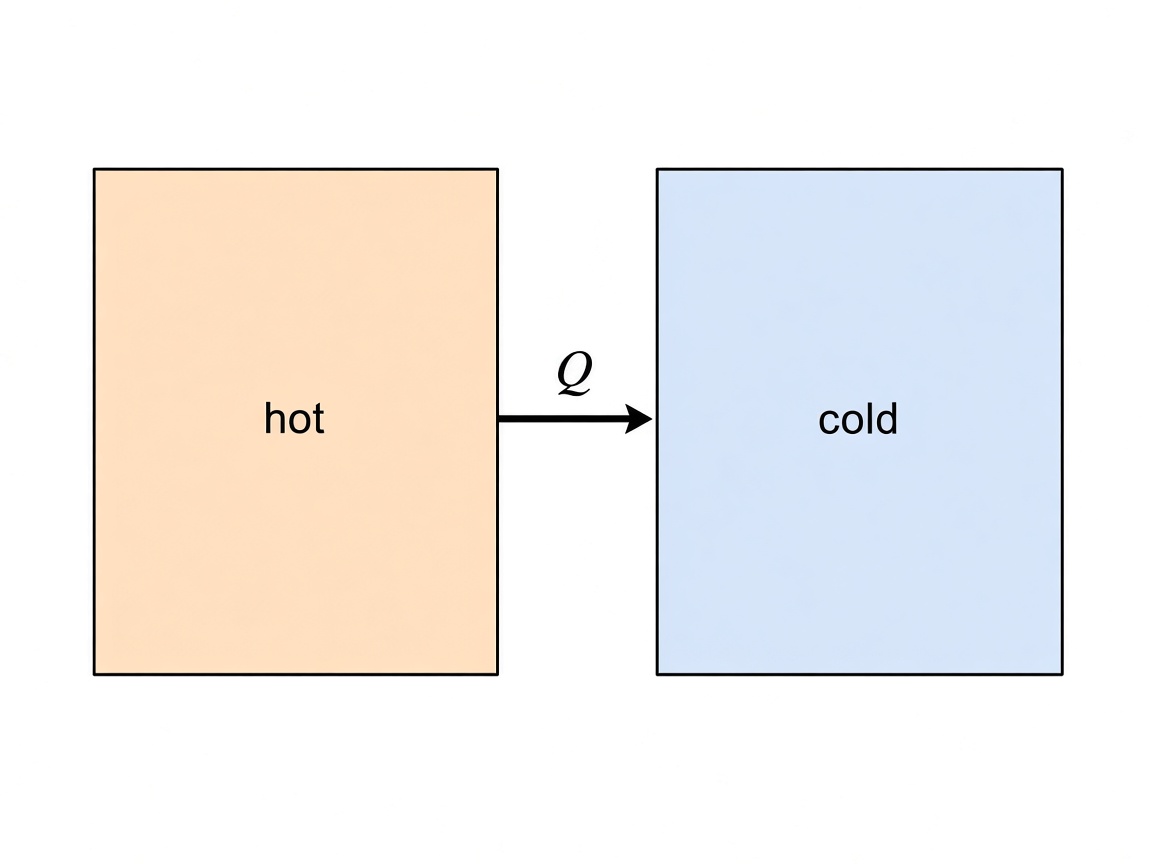
Spontaneous net energy transfer is from higher temperature to lower temperature. The objects need not be touching if radiation can cross the gap.
The figure shows a gap between the blocks; radiation can still carry energy across that gap. The transfer rate is larger when the temperature difference is larger, and it is also larger when the contact area is larger. A thicker conduction path or a different material changes the rate as well, but the detailed conductivity relation is left for a later topic.
Thermal equilibrium means no net energy is transferred by thermal processes. Microscopic exchanges can continue and cancel on average. Equilibrium is the most probable state: two objects in thermal contact approach one common temperature. Atoms at the interface do not stop colliding when equilibrium is reached; only the net transfer drops to zero.
Key points
- Conduction needs particle-to-particle contact through a material; convection needs a circulating fluid; radiation is electromagnetic and works across vacuum.
- Thermal contact means energy can move by any of those processes, including radiation across a vacuum gap.
- A solid bar supports conduction, not convection; a vacuum gap has neither conduction nor convection.
- Heating is energy entering a system by a thermal process; cooling is energy leaving that way.
- Net energy flows spontaneously from higher temperature to lower temperature, even though single collisions can go either way.
- A larger temperature difference or a larger contact area increases the transfer rate.
- Thermal equilibrium means zero net thermal transfer while microscopic exchanges may still cancel; the objects share one common temperature.
Equilibrium means no net thermal energy transfer, not an end to every collision.