Thermal Energy Transfer and Equilibrium FRQ Practice

Responses receive AI feedback against a rubric after submission. Scores are practice estimates.

Question 1 of 5

Two metal blocks touch as shown. Initially $T_A>T_B$. The surrounding air is evacuated so that only contact at the shared face matters. (a) Identify the thermal process that transfers energy from A to B, and explain why convection cannot operate. (b) Explain, in terms of atomic collisions at the interface, why net energy flows from A to B. (c) Describe what thermal equilibrium means for the blocks, including whether microscopic energy exchanges must stop.
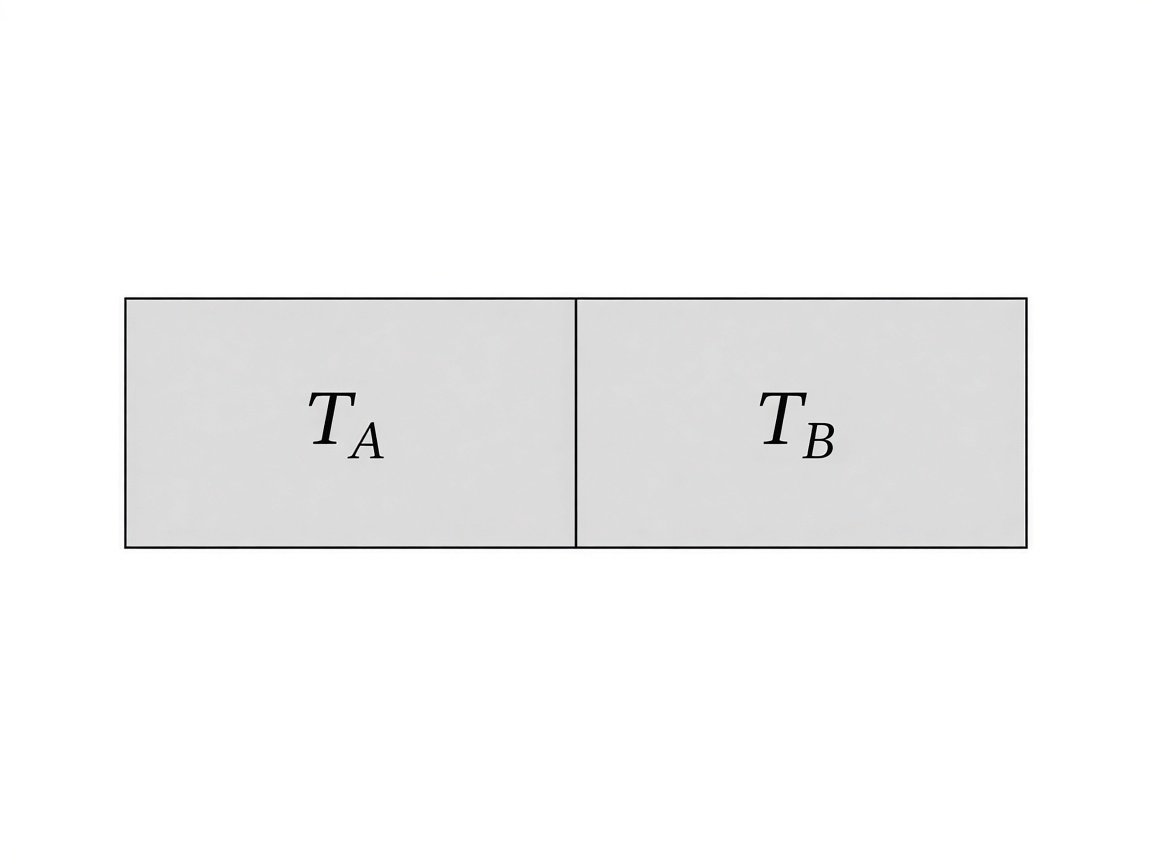
Two blocks in contact labeled $T_A$ and $T_B$.

Question 2 of 5

A student compares two otherwise identical conduction paths between reservoirs at $100^\circ\mathrm{C}$ and $20^\circ\mathrm{C}$. Path 1 has contact area $A$; path 2 has contact area $2A$. (a) Rank the energy-transfer rates of the two paths and justify the ranking without using a conductivity formula. (b) The cold reservoir for path 1 is then replaced by one at $0^\circ\mathrm{C}$, keeping path 1’s area $A$. Qualitatively compare the new path-1 rate with the original path-1 rate. (c) State whether either change alters which direction is spontaneous for net thermal transfer.

Question 3 of 5

A spacecraft exterior panel faces deep space. There is vacuum outside the panel. A heater keeps the panel warmer than the surrounding blackbody radiation temperature of space. (a) Identify which of conduction, convection, and radiation can remove energy from the panel to space, and justify each decision. (b) Taking the panel as the system, state whether the panel is being heated or cooled by its interaction with space, and define the term you use. (c) Suppose the heater is switched off and the panel eventually stops changing temperature. What does that imply about net thermal transfer between the panel and its surroundings?

Question 4 of 5

A classroom demonstration places a hot brick and a cold brick a short distance apart in ordinary air. (a) List all thermal processes that can transfer energy from the hot brick to the cold brick in this arrangement. (b) Sketch or describe a before-and-after temperature diagram for the two bricks after a long wait, assuming they remain isolated from other objects. (c) Explain why the final shared temperature is the most probable macroscopic state after many atomic collisions between the systems and the intervening air.

Question 5 of 5

A student asserts: “If two systems are in thermal equilibrium, atoms at the interface no longer exchange energy.” (a) Critique the assertion using the definition of thermal equilibrium. (b) Give a concrete microscopic example of energy exchange that is allowed at equilibrium. (c) State the condition under which one of the systems would instead be described as being heated.