The First Law of Thermodynamics FRQ Practice

Responses receive AI feedback against a rubric after submission. Scores are practice estimates.

Question 1 of 5

A monatomic ideal gas has $n=1.50\,\mathrm{mol}$ at $T=280\,\mathrm{K}$. Use $R=8.31\,\mathrm{J/(mol\cdot K)}$. (a) Calculate the internal energy $U$. (b) The gas is cooled at constant volume until $T=200\,\mathrm{K}$. Calculate $\Delta U$. (c) Explain why the ideal-gas model assigns no internal potential energy to this sample.
Question 2 of 5

A rigid closed canister of ideal gas rests motionless on a horizontal surface. A heater transfers energy to the gas, raising its temperature, while the canister remains at rest. (a) Identify what kind of microscopic energy change accounts for the increase in internal energy. (b) State whether the kinetic energy associated with the motion of the system's center of mass changes, and justify your answer. (c) A student claims that any increase in internal energy must accelerate the canister. Critique that claim using the distinction between internal energy and center-of-mass motion.

Question 3 of 5

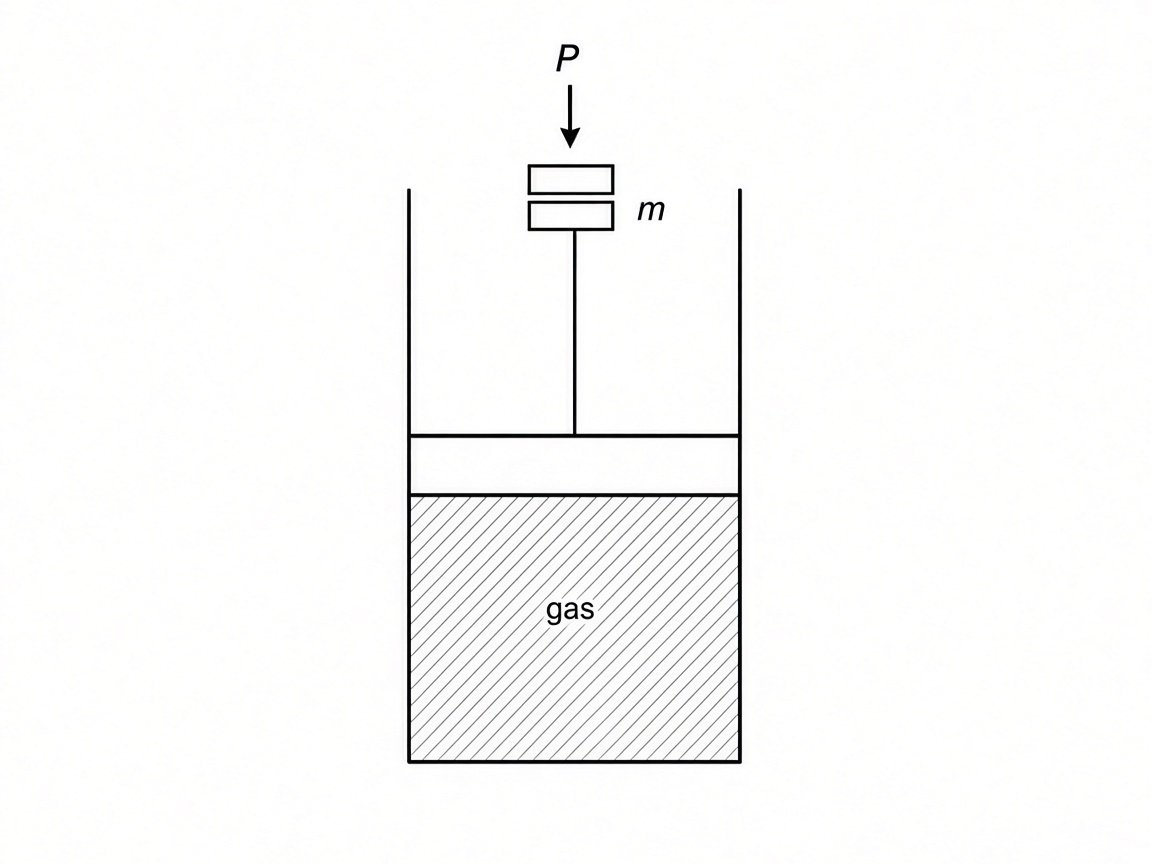
The figure shows a cylinder of ideal monatomic gas sealed by a movable piston. A constant weight on the piston keeps the external pressure at $P=2.00\times 10^{5}\,\mathrm{Pa}$. The expansion is slow, so the gas pressure stays equal to this external pressure while the volume changes from $V_i=0.0200\,\mathrm{m}^{3}$ to $V_f=0.0500\,\mathrm{m}^{3}$. (a) Calculate the work $W$ done on the gas. (b) Calculate $\Delta U$ for the monatomic gas. (c) Calculate $Q$.

Cylinder with movable piston and stacked masses above the piston, gas below the piston.

Question 4 of 5

An ideal gas follows the straight-line path on the $P$–$V$ diagram from point i $(0.010\,\mathrm{m}^{3},\,1.0\times 10^{5}\,\mathrm{Pa})$ to point f $(0.040\,\mathrm{m}^{3},\,3.0\times 10^{5}\,\mathrm{Pa})$. (a) Calculate the work $W$ done on the gas along this path. (b) If the gas is monatomic, write an expression for $\Delta U$ in terms of $n$, $R$, $T_i$, and $T_f$. (c) Explain how the area under the path relates to $|W|$.

Straight PV path sloping up to the right from i to f.

Question 5 of 5

The table lists $Q$ and $W$ (work on the system) for three processes on the same ideal gas. Use $\Delta U=Q+W$.

Process Q (J) W (J)
X +800 -300
Y 0 -500
Z -200 +700

(a) Calculate $\Delta U$ for each process. (b) Identify which process could be adiabatic and justify. (c) Identify which process must decrease the temperature of a monatomic ideal gas, and justify using $\Delta U$.