Thermal Energy Transfer and Equilibrium MCQ Practice

Question 1 of 10

Two metal plates face each other across a vacuum gap. One plate is held at a higher temperature than the other. Which thermal process can transfer energy from the hotter plate to the colder plate?
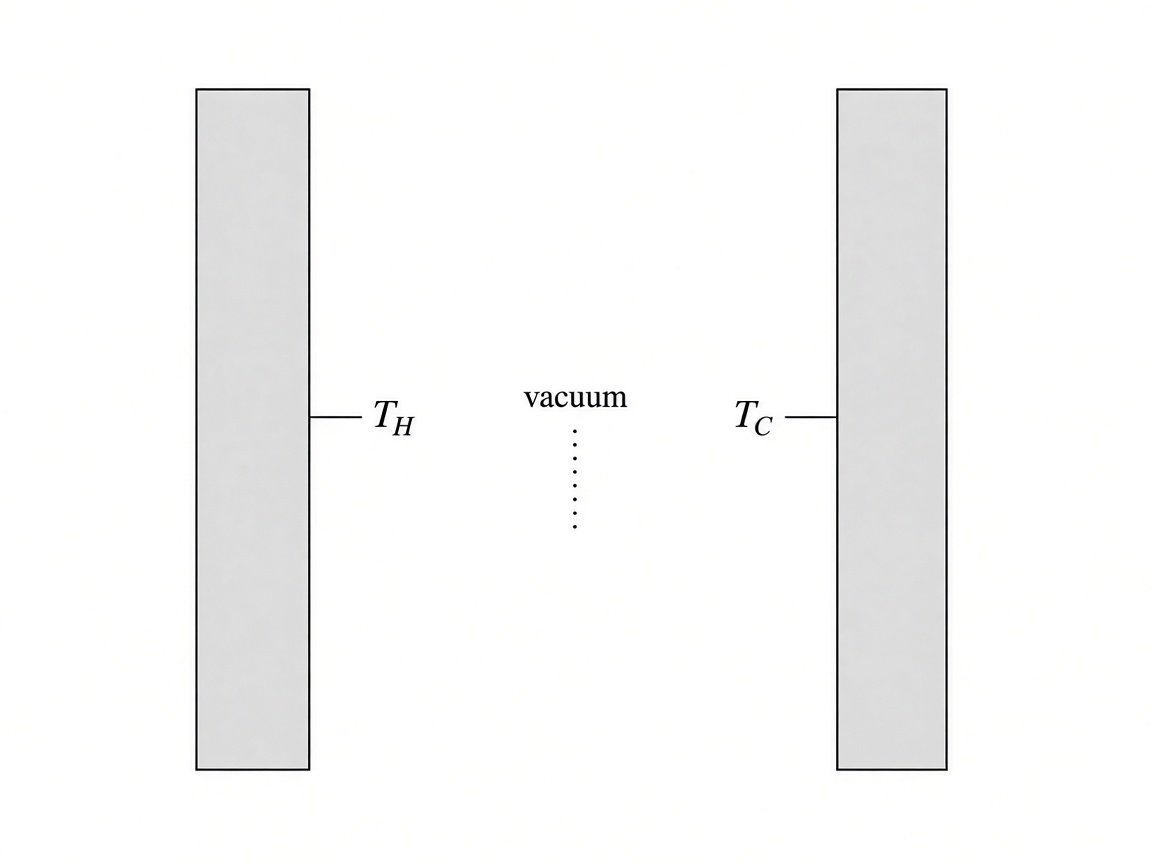
Two facing plates labeled $T_H$ and $T_C$ with a vacuum gap between them.
  1. A. Conduction only, because the plates are solids
  2. B. Convection only, because energy must be carried by fluid motion
  3. C. Radiation only, because conduction and convection require matter in the gap
  4. D. Conduction and radiation together, because both can act across empty space

Question 2 of 10

Block A is hotter than block B. At the contact surface, an atom from A with higher kinetic energy collides with an atom from B with lower kinetic energy. Which outcome is most probable for that single collision?

  1. A. Energy is equally likely to go either way, because collisions are random
  2. B. Energy is most likely transferred from the higher-energy atom to the lower-energy atom
  3. C. Energy is most likely transferred from the lower-energy atom to the higher-energy atom
  4. D. No energy can be exchanged until the blocks reach the same temperature

Question 3 of 10

Two objects in thermal contact have been at the same temperature for a long time. A student claims that atoms at the interface no longer exchange energy. Which evaluation is correct?

  1. A. The claim is correct: thermal equilibrium means all atomic collisions stop.
  2. B. The claim is correct: energy can leave each object only when temperatures differ.
  3. C. The claim is incorrect: equilibrium requires continuous net heating of the colder object.
  4. D. The claim is incorrect: equilibrium means zero net transfer, while equal-and-opposite microscopic transfers can still occur.

Question 4 of 10

Two identical copper rods connect the same pair of reservoirs, one at $90^\circ\mathrm{C}$ and one at $10^\circ\mathrm{C}$. Rod X has twice the cross-sectional area of rod Y. Both rods have the same length. Qualitatively comparing conduction through the rods, which statement is correct?

  1. A. The energy-transfer rate through X is greater because the contact area is larger.
  2. B. The energy-transfer rate through Y is greater because a thinner rod forces a steeper temperature gradient.
  3. C. The rates are equal because both rods connect the same temperatures.
  4. D. Neither rod transfers energy, because the reservoirs are already at fixed temperatures.

Question 5 of 10

A sealed glass tube contains only solid copper filings from end to end; there is no free fluid. One end is heated. Which mechanism cannot operate as energy moves toward the cold end?

  1. A. Conduction through contacting copper grains
  2. B. Convection by bulk fluid flow
  3. C. Radiation between warmer and cooler regions
  4. D. Thermal contact between neighboring grains

Question 6 of 10

A cold metal spoon is placed in hot soup. Focusing on the spoon as the system, which description is correct while the spoon’s temperature is rising?

  1. A. The spoon is cooling, because thermal energy leaves the soup.
  2. B. The spoon and soup are not in thermal contact until they reach the same temperature.
  3. C. The spoon is being heated: energy enters the spoon by thermal processes.
  4. D. The spoon is being heated only if work is done on the spoon by the soup.

Question 7 of 10

Object P is at $40^\circ\mathrm{C}$ and object Q is at $70^\circ\mathrm{C}$. The objects are placed in thermal contact in an otherwise insulated environment. Which claim about the spontaneous energy transfer is correct?

  1. A. Net thermal energy flows from Q to P until the most probable shared temperature is reached.
  2. B. Net thermal energy flows from P to Q because P has a lower temperature and must absorb energy first.
  3. C. No net transfer occurs until a third object mediates the exchange.
  4. D. Energy flows only by radiation, because conduction cannot act between objects below $100^\circ\mathrm{C}$.

Question 8 of 10

The table describes three laboratory setups that begin with a hot object and a cold object. Which setup allows energy transfer by convection but not by conduction through a solid wall between the objects?

Setup Arrangement
1 Hot and cold copper blocks pressed face to face in vacuum
2 Hot and cold air masses circulating freely in one open room
3 Hot and cold plates separated by vacuum with no fluid present
  1. A. Setup 1 only
  2. B. Setup 3 only
  3. C. Setups 1 and 3
  4. D. Setup 2 only

Question 9 of 10

Two objects in thermal contact have temperatures that change with time as shown. Which statement is best supported by the graph?

Temperature versus time for objects A and B. Curve A falls from 80 to about 40. Curve B rises from 20 to about 40. The curves approach a common temperature.
  1. A. Object A is heated throughout, and object B is cooled throughout.
  2. B. Net thermal energy flows from A to B, and the systems approach thermal equilibrium near $40^\circ\mathrm{C}$.
  3. C. The objects never enter thermal contact, because their temperatures change.
  4. D. After $t=2\,\mathrm{min}$, no energy is transferred in either direction.

Question 10 of 10

A hot filament and a cold sensor face each other inside an evacuated chamber. They do not touch. Are the filament and sensor in thermal contact?

  1. A. No, because thermal contact requires a solid bridge between the objects.
  2. B. No, because thermal contact requires a circulating fluid.
  3. C. Yes, because energy can still transfer between them by radiation.
  4. D. Yes, but only after their temperatures become equal.