Thermal Energy Transfer and Equilibrium FRQ Practice

Responses receive AI feedback against a rubric after submission. Scores are practice estimates.

Question 1 of 5

Two facing plates are separated by vacuum as shown, with $T_H>T_C$. (a) For each of conduction, convection, and radiation, state whether it can transfer energy from the hot plate to the cold plate and justify. (b) Taking the cold plate as the system, state whether it is being heated or cooled, and define the term. (c) After a long time with the plates isolated from other objects, describe the temperatures and the net thermal transfer between the plates.
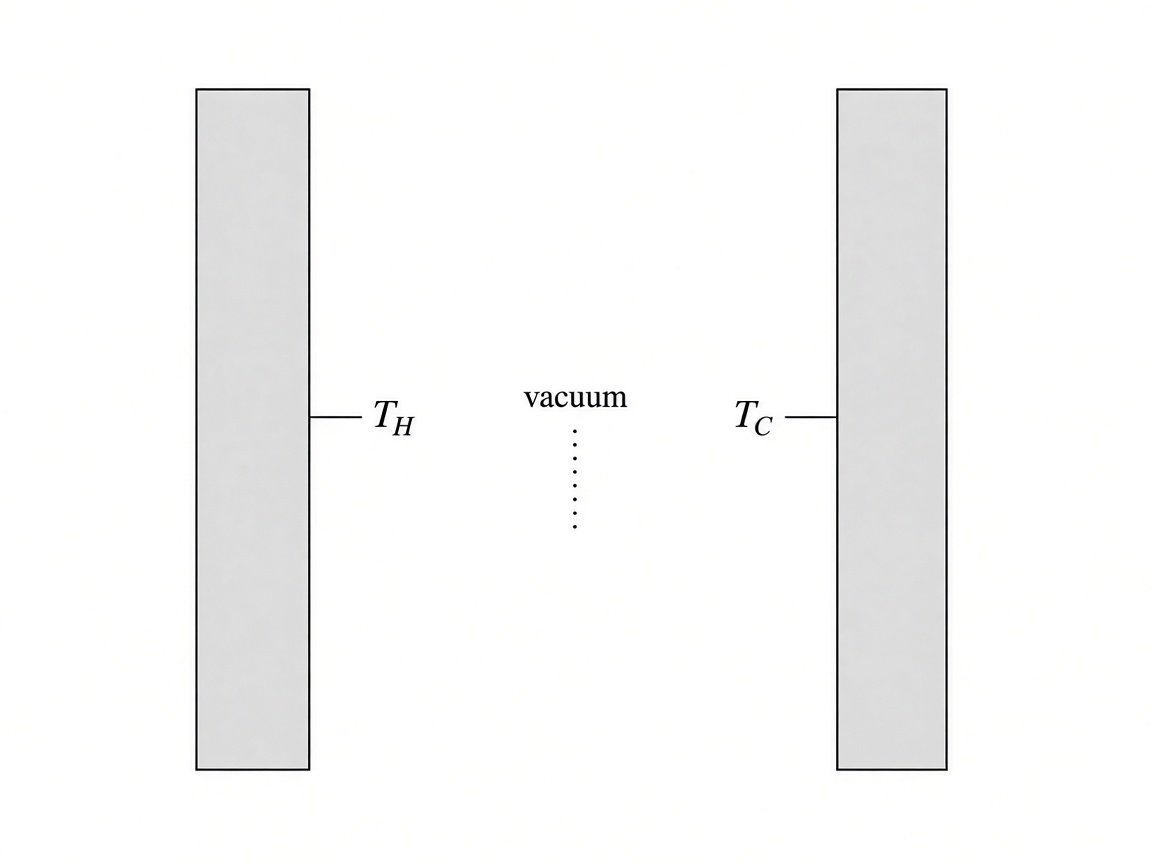
Two facing plates labeled $T_H$ and $T_C$ with a vacuum gap between them.

Question 2 of 5

A hot aluminum cube is placed on a cold aluminum cube so the faces touch. (a) Explain why the cubes are in thermal contact. (b) Using the atomic-collision picture, explain the most probable direction of energy transfer in a collision between a high-energy atom from the hot cube and a low-energy atom from the cold cube. (c) Explain why, after many such collisions, equal temperature is the most probable macroscopic outcome.

Question 3 of 5

A laboratory oven and a sample inside it are at the same steady temperature. A student says equilibrium means “no energy crosses the sample’s surface.” (a) Rewrite the student’s statement so it matches the definition of thermal equilibrium. (b) Describe one allowed microscopic process at the sample surface that is consistent with equilibrium. (c) The oven is then set hotter than the sample. Identify whether the sample is heated or cooled during the subsequent approach to a new equilibrium, and justify using temperature difference.

Question 4 of 5

Design a qualitative comparison of two conduction contacts between the same hot and cold reservoirs. Contact 1 has area $A$; contact 2 has area $3A$. Both contacts have the same length and material. (a) Construct a brief table ranking the two contacts by energy-transfer rate and listing the one controlled variable that differs. (b) Justify the ranking without writing a conductivity equation. (c) State what would happen to the ranking if contact 2’s area were reduced to $A$ while its temperature difference were made larger than contact 1’s.

Question 5 of 5

Consider three setups: Setup F is a pot of water heated from below so warmer water rises; Setup S is energy traveling end-to-end through a continuous solid copper rod with no fluid path; Setup V is a vacuum chamber containing only a warm plate and a cold plate facing each other. (a) For each setup, identify the thermal process that is the primary available mechanism for transferring energy as described. (b) State whether convection can operate in each setup, with a one-phrase reason. (c) Explain why Setup V’s plates are still in thermal contact despite the vacuum.