TOPIC 9.4 · STUDY
The First Law of Thermodynamics
The first law is Delta U = Q + W with W the work done on the gas. For an ideal monatomic gas U depends only on temperature, so isochoric, isothermal, isobaric, and adiabatic processes fix how Q and W share the energy change.
9.4.A
The first law
The first law of thermodynamics for a closed system is $$\Delta U=Q+W,$$ where $Q$ is energy transferred to the gas by heating and $W$ is the work done on the gas. When the gas expands against a constant pressure $P$, $$W=-P\Delta V.$$ Expansion ($\Delta V>0$) makes $W$ negative. Compression ($\Delta V<0$) makes $W$ positive.
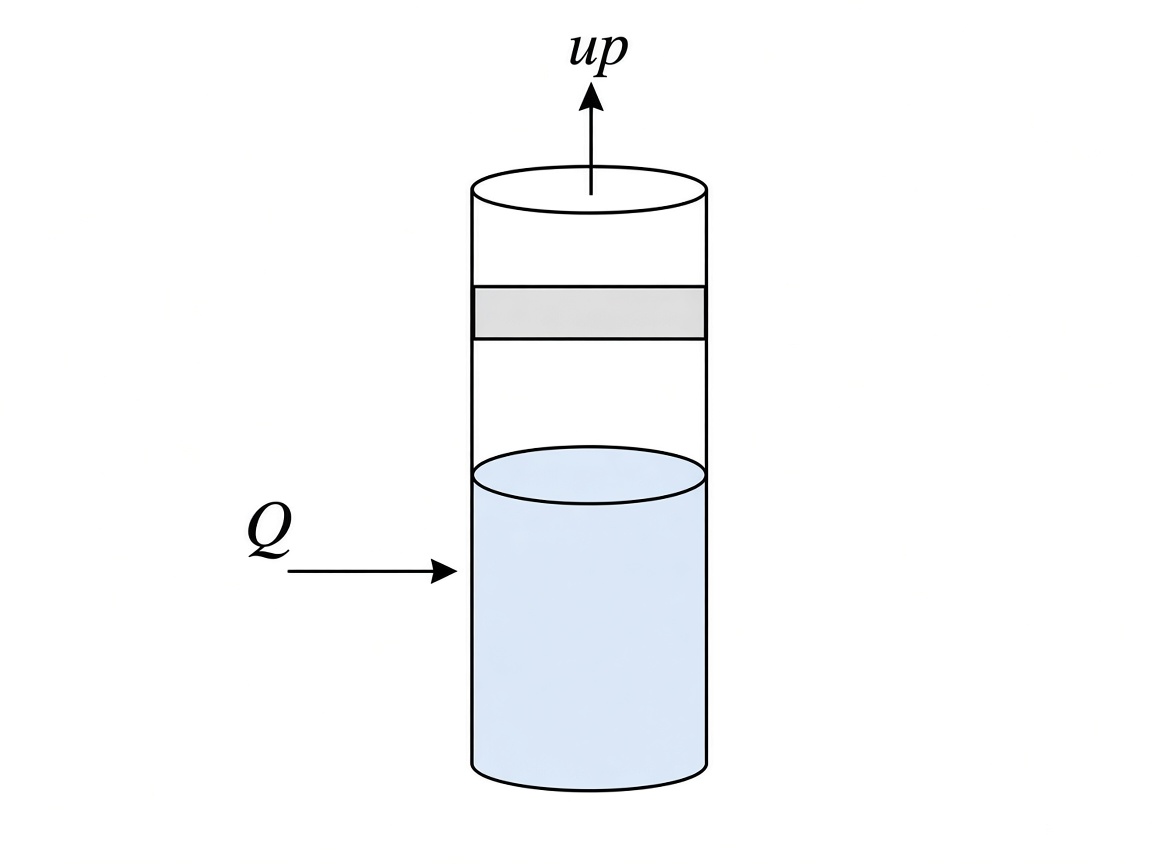
Q is energy entering by heating. When the piston rises, the volume increases and the work done on the gas is negative.
For an ideal monatomic gas the internal energy is $$U=\tfrac32 nRT=\tfrac32 NkT.$$ There is no potential energy in the model: $U$ is the total microscopic kinetic energy of the atoms, not the center-of-mass kinetic energy of the container. A sample sitting at rest on a table can still have a large $U$ because the atoms keep moving randomly inside.
Example: $n=1.00\,\mathrm{mol}$ at $T=300\,\mathrm{K}$ has $$U=\tfrac32(1.00)(8.31)(300)=3.74\times 10^{3}\,\mathrm{J}.$$ Use $R=8.31\,\mathrm{J/(mol\cdot K)}$.
Isochoric process (rigid container): $\Delta V=0$, so $W=-P\Delta V=0$ and $\Delta U=Q$. If energy $Q=+1.50\times 10^{3}\,\mathrm{J}$ enters by heating, then $\Delta U=+1.50\times 10^{3}\,\mathrm{J}$.
Isothermal ideal gas: $U$ depends only on $T$, so $\Delta U=0$ and therefore $Q=-W$. For an expansion with $|W|=2.00\times 10^{3}\,\mathrm{J}$, the work on the gas is $W=-2.00\times 10^{3}\,\mathrm{J}$ and $Q=+2.00\times 10^{3}\,\mathrm{J}$.
Isobaric expansion at $P=1.00\times 10^{5}\,\mathrm{Pa}$ with $\Delta V=+0.0200\,\mathrm{m}^{3}$ gives $$W=-P\Delta V=-(1.00\times 10^{5})(0.0200)=-2.00\times 10^{3}\,\mathrm{J}.$$ From $PV=nRT$ at constant $P$, $P\Delta V=nR\Delta T$. For a monatomic gas $\Delta U=\tfrac32 nR\Delta T$, so $$\Delta U=\tfrac32 P\Delta V=+3.00\times 10^{3}\,\mathrm{J}.$$ Then $$Q=\Delta U-W=+3.00\times 10^{3}-(-2.00\times 10^{3})=+5.00\times 10^{3}\,\mathrm{J}.$$
Adiabatic process: $Q=0$, so $\Delta U=W$. A quick compression does positive work on the gas ($W>0$), raises $U$, and therefore raises the temperature.
The magnitude of the work done on the gas during a volume change equals the area under the path on a $P$-$V$ graph. Expansion makes that work negative. Internal energy $U$ is a state function, so $\Delta U$ depends only on the endpoints. Both $W$ and $Q$ depend on the path taken between those endpoints. A cycle that returns to the start has $\Delta U=0$ for the full loop.
Key points
- First law $\Delta U=Q+W$ with $W$ the work on the gas; $W=-P\Delta V$ at constant pressure.
- Expansion: $W<0$. Compression: $W>0$.
- Monatomic ideal gas: $U=\tfrac32 nRT=\tfrac32 NkT$; no potential energy in the model; $U$ is microscopic kinetic energy.
- Isochoric (fixed volume): $W=0$ and $\Delta U=Q$.
- Isothermal ideal gas: $\Delta U=0$, so $Q=-W$.
- Isobaric monatomic: $\Delta U=\tfrac32 P\Delta V$ and $Q=\Delta U-W$.
- Adiabatic: $Q=0$ so $\Delta U=W$; compression raises $T$.
- The magnitude $|W|$ equals the area under the $P$-$V$ path; $U$ is a state function; a closed cycle has $\Delta U=0$.
$W$ in $\Delta U=Q+W$ is the work done on the gas, so expansion gives negative $W$.