Rolling MCQ Practice

Question 1 of 10

A uniform solid cylinder rolls without slipping at center speed v. Its mass is M and I_cm=MR²/2. What is its total kinetic energy?

  1. A. $Mv^2$
  2. B. $Mv^2/4$
  3. C. $3Mv^2/4$
  4. D. $Mv^2/2$

Question 2 of 10

A thin hoop rolls without slipping. Given I_cm=MR², what fraction of its total kinetic energy is rotational?

  1. A. 1/3
  2. B. 2/3
  3. C. 1
  4. D. 1/2

Question 3 of 10

A solid sphere rolls without slipping from rest through vertical center-of-mass drop h. Given I_cm=2MR²/5 and no energy loss, what is its final speed?

  1. A. $\sqrt{10gh/7}$
  2. B. $\sqrt{2gh}$
  3. C. $\sqrt{gh}$
  4. D. $\sqrt{5gh/7}$

Question 4 of 10

A rolling object has translational energy 12 J and rotational energy 8 J. What is its total kinetic energy?

  1. A. 96 J
  2. B. 20 J
  3. C. 12 J
  4. D. 4 J

Question 5 of 10

A wheel of radius 0.25 m rolls without slipping on a stationary floor at center speed 2 m/s. What is its angular speed?

  1. A. 2 rad/s
  2. B. 4 rad/s
  3. C. 8 rad/s
  4. D. 0.5 rad/s

Question 6 of 10

An ideal rigid wheel rolls without slipping on a stationary floor. What is the instantaneous speed of its contact point relative to the floor?

  1. A. Equal to the center speed
  2. B. Twice the center speed
  3. C. Equal to angular speed divided by radius
  4. D. Zero

Question 7 of 10

A cylinder rolls without slipping down a fixed incline. Ideal static friction acts at the contact. Which energy statement is correct?
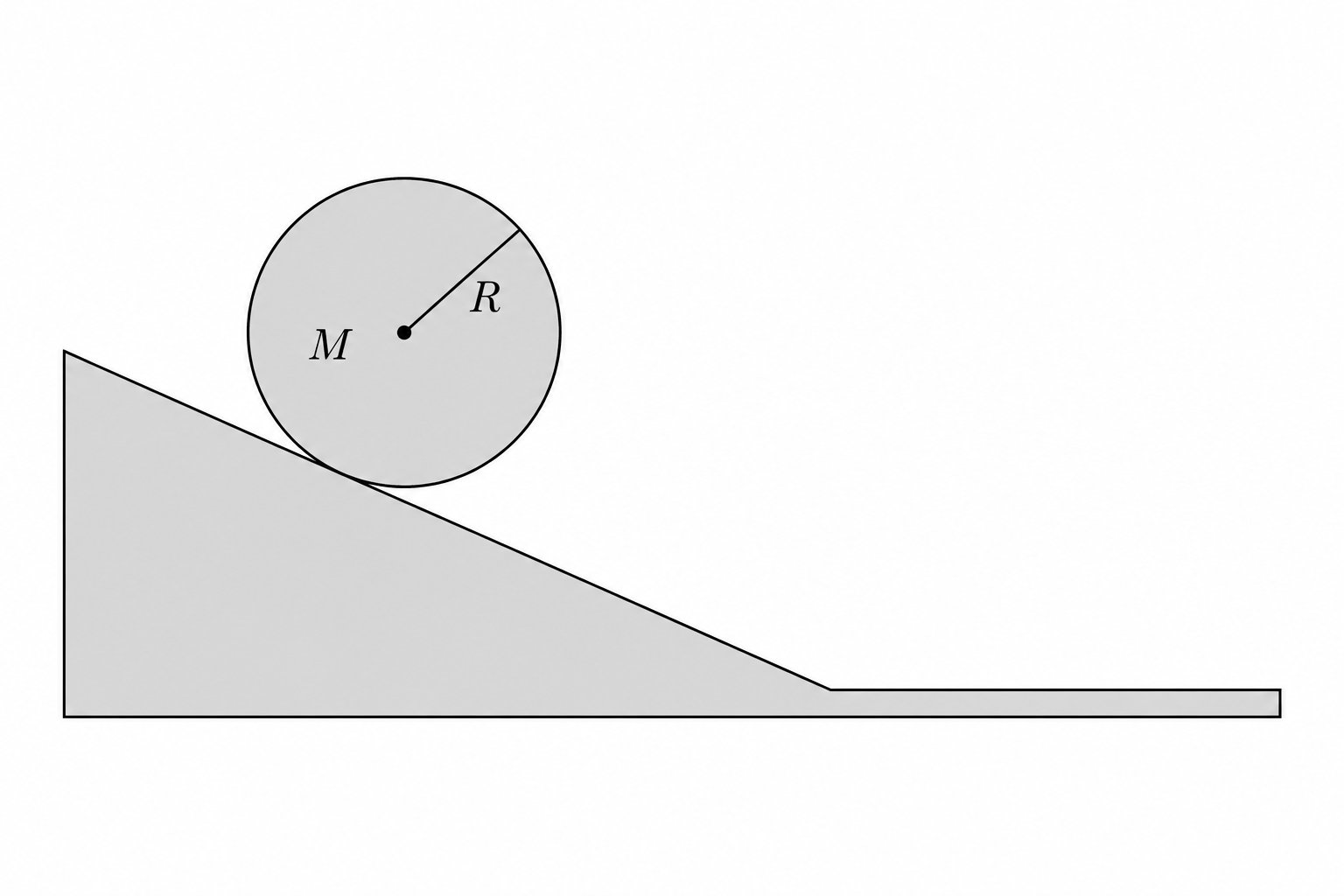
A cylinder of mass M and radius R rests on an incline descending to the right.

Schematic; dimensions and force-arrow lengths are not to scale.

  1. A. Static friction need not dissipate mechanical energy.
  2. B. Static friction must convert all rotational energy to heat.
  3. C. Any friction force removes mechanical energy.
  4. D. Gravity does no work because the cylinder rolls.

Question 8 of 10

A ball is launched rightward along a rough floor with no initial spin and initially slips. What does kinetic friction initially do?

  1. A. It cannot act until rolling without slipping begins.
  2. B. It reduces center speed and starts rotation in the rolling sense.
  3. C. It increases center speed and prevents rotation.
  4. D. It leaves center speed unchanged and stops rotation.

Question 9 of 10

A wheel is spinning clockwise with its center initially at rest when gently lowered onto a rough stationary floor and initially slips. Which statement is correct?
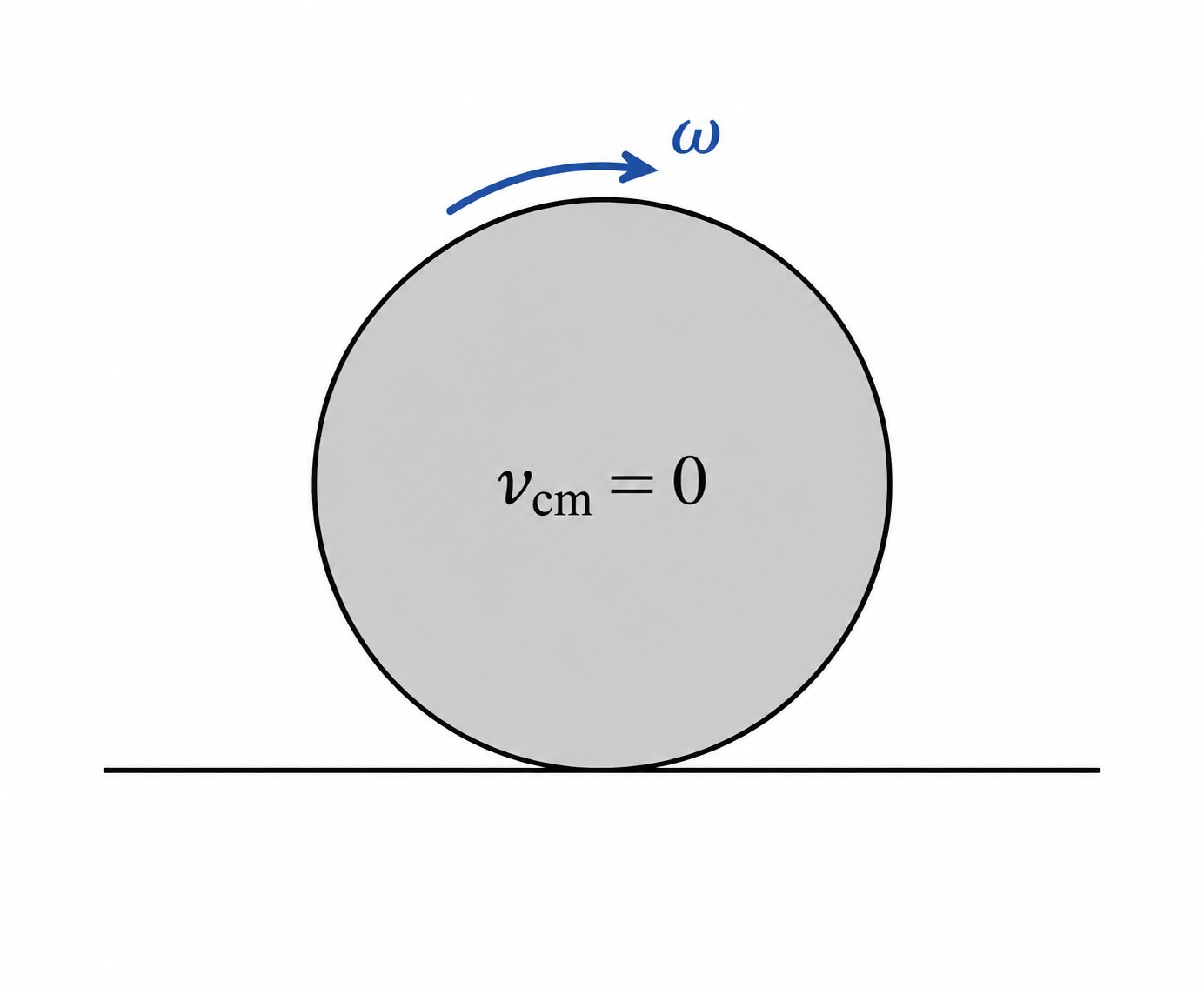
A wheel initially spins clockwise at angular speed w with its center at rest on a stationary floor.

Schematic; dimensions and force-arrow lengths are not to scale.

  1. A. The relation v_cm=Rw holds immediately.
  2. B. Its mechanical energy must increase.
  3. C. Friction can start center-of-mass motion while reducing its spin.
  4. D. Friction must leave its center stationary.

Question 10 of 10

Which observation establishes that a wheel is slipping on a stationary surface?

  1. A. Its center of mass moves.
  2. B. Its angular speed is nonzero.
  3. C. Static friction is nonzero.
  4. D. Its contact point moves relative to the surface.