Rolling FRQ Practice

Responses receive AI feedback against a rubric after submission. Scores are practice estimates.

Question 1 of 5

A uniform solid cylinder of mass M and radius R rolls from rest down a fixed ramp without slipping. Its center of mass drops by h, and I_cm=MR²/2. (a) Derive its bottom speed using energy. (b) Find the fraction of the lost gravitational energy that becomes rotational energy. (c) Explain why the mass cancels.
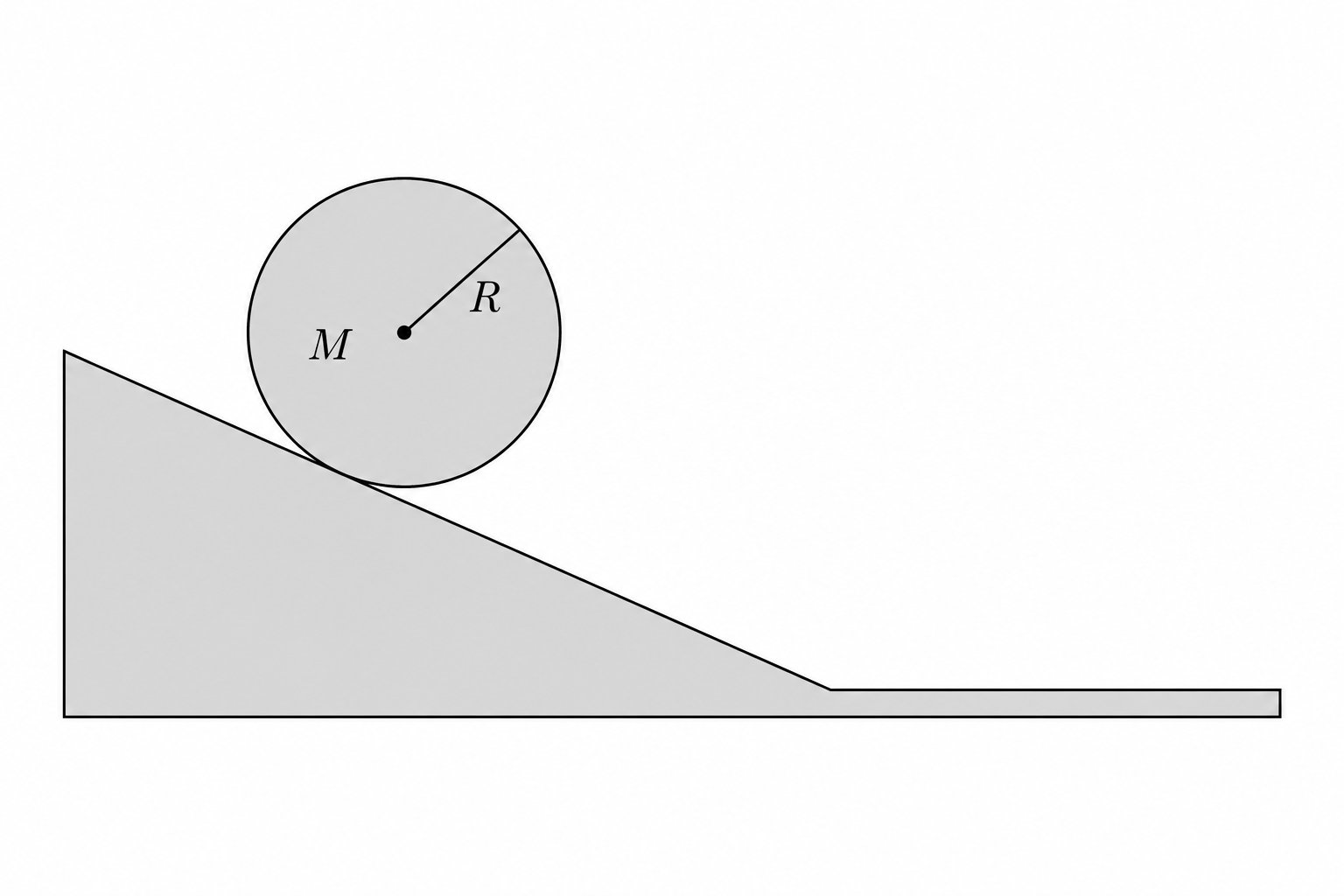
A solid cylinder labeled M and R is on a downward ramp.

Schematic; dimensions and force-arrow lengths are not to scale.
Question 2 of 5

Two objects with the same mass roll without slipping at equal center speeds. The table supplies their central inertias. (a) Express each total energy in terms of M and v. (b) Determine which requires more work to bring to rest. (c) Explain why equal translational speeds do not imply equal total kinetic energies.

Object Central rotational inertia
Thin hoop MR²
Uniform disk MR²/2

Question 3 of 5

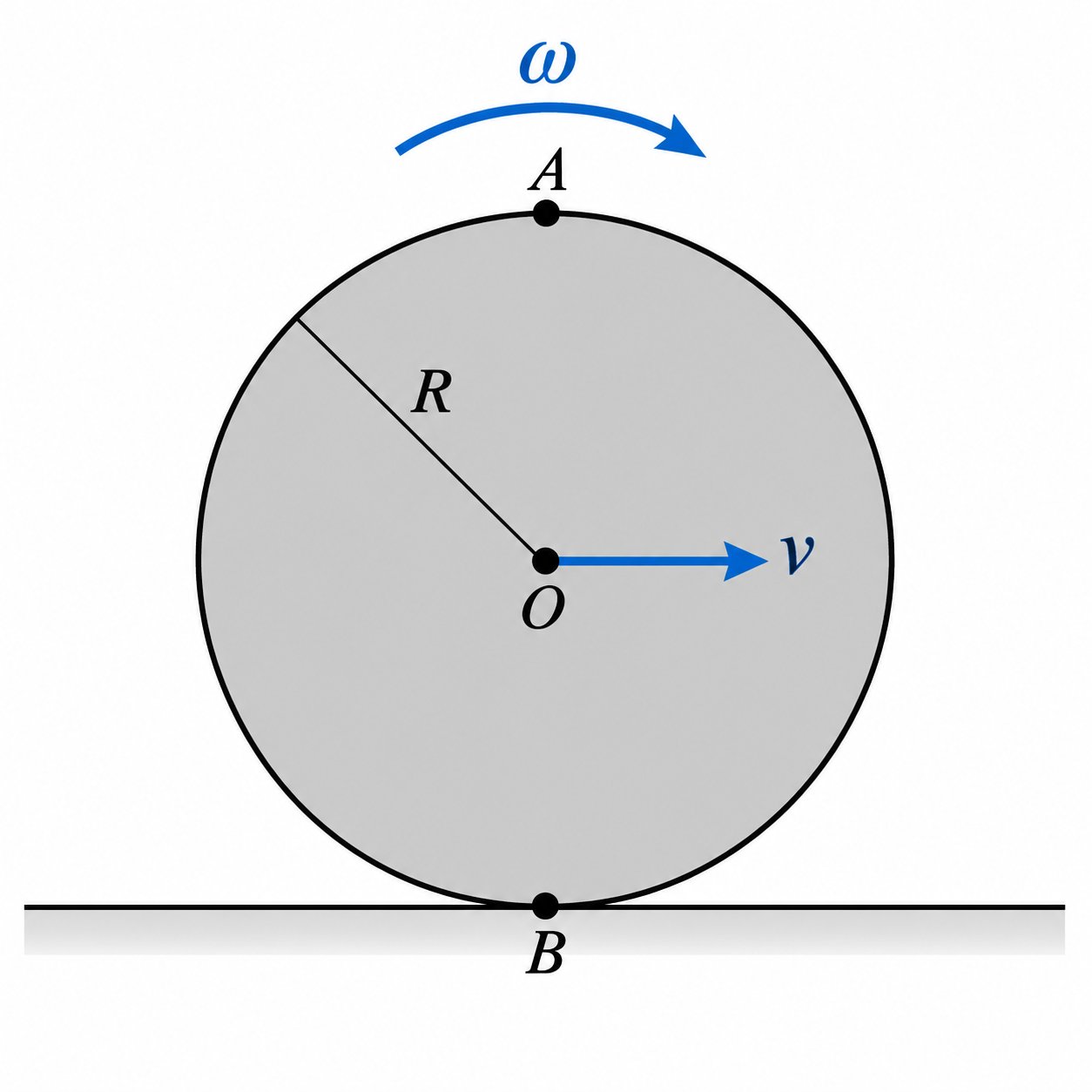
A wheel of radius R rolls right without slipping at center speed v on a fixed floor; its rotation is clockwise. The highest and lowest rim points are marked A and B. (a) Find its angular-speed magnitude. (b) Find the instantaneous speeds of its lowest and highest rim points relative to the floor. (c) Explain the difference using translation plus rotation.

A wheel of radius R rolls right with center velocity v and clockwise angular speed w; A and B mark the top and bottom rim points.

Schematic; dimensions and force-arrow lengths are not to scale.

Question 4 of 5

A marked wheel moves right along a fixed level surface while turning clockwise. A camera and meterstick are available. Design a test of whether it rolls without slipping. (a) State the independently measured linear and angular quantities. (b) State the comparison. (c) Explain why assuming v=Rw while calculating both quantities would not test the claim.

Question 5 of 5

A ball moves right across a rough horizontal floor with no initial spin. It slips at first and later rolls without slipping. Give a qualitative account only. (a) State the initial friction direction and its effects on center speed and spin. (b) Explain the energy change during slipping. (c) State the contact condition once slipping ends.