Question 1 of 5
A satellite of mass m circles a planet of mass M at orbital radius r. (a) Derive its speed. (b) Derive its kinetic energy and total mechanical energy, taking U=0 at infinity. (c) Explain the sign of total energy.
Responses receive AI feedback against a rubric after submission. Scores are practice estimates.
A satellite of mass m circles a planet of mass M at orbital radius r. (a) Derive its speed. (b) Derive its kinetic energy and total mechanical energy, taking U=0 at infinity. (c) Explain the sign of total energy.
A spacecraft moves from closest point A to farthest point B in an elliptical orbit about a much more massive planet at one focus. At these endpoints r_A=r and r_B=2r, and both velocities are perpendicular to their radial lines. (a) Relate the endpoint speeds using angular momentum. (b) Find U_B-U_A. (c) State the change in kinetic energy.
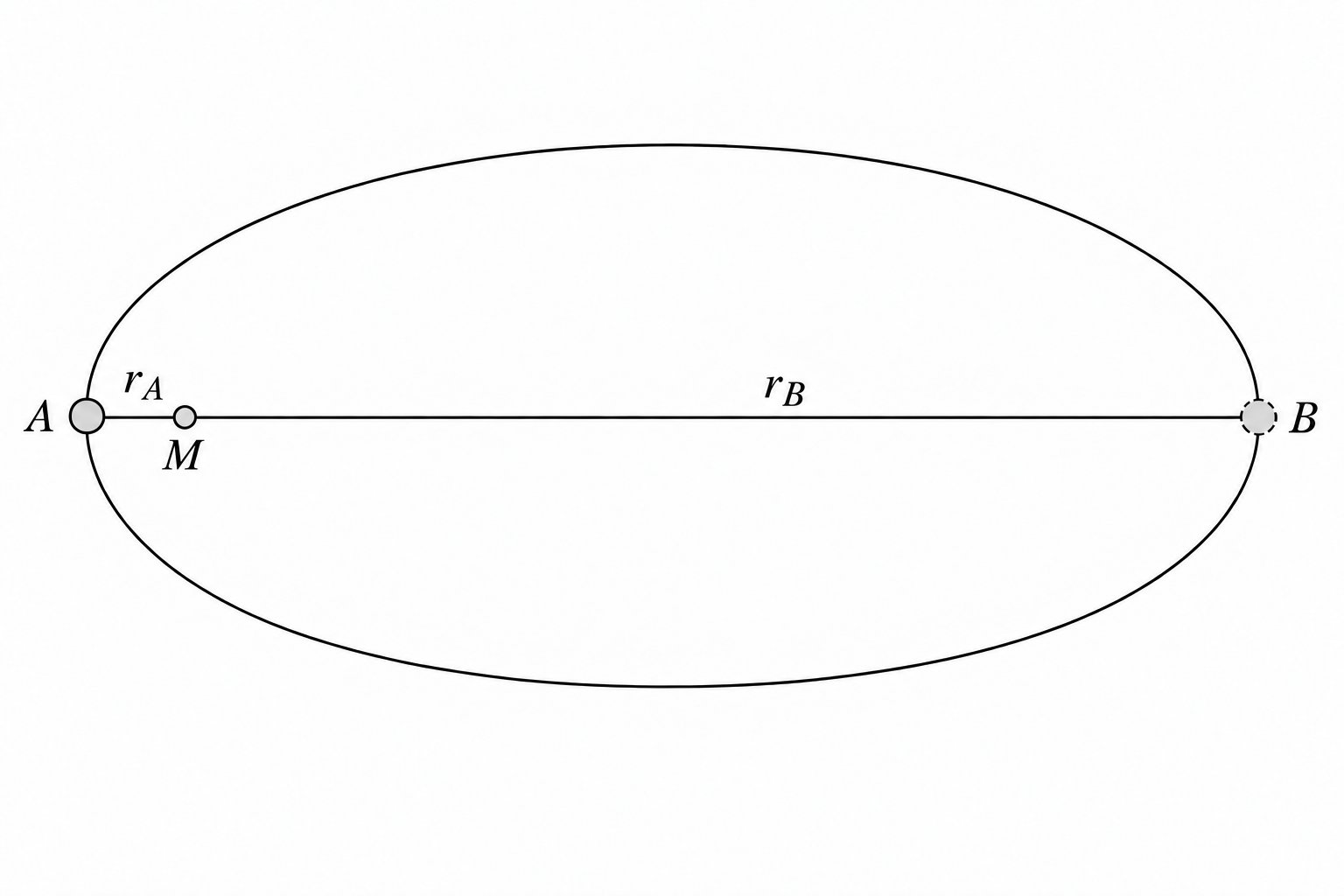
Schematic; dimensions and force-arrow lengths are not to scale.
A small object is launched outward from distance r from a nonrotating spherical planet of mass M. Neglect atmosphere and other bodies. (a) Derive the minimum escape speed. (b) Explain why the object’s mass cancels. (c) If launched faster than this speed, describe its speed infinitely far away.
The table gives gravitational potential energy and kinetic energy at three points of a spacecraft’s path. Take U=0 at infinity. (a) Determine whether the measurements are consistent with gravity-only motion. (b) Determine whether the trajectory is bound. (c) Identify the point closest to the planet and justify.
| Point | U (J) | K (J) |
|---|---|---|
| P | -20 | 12 |
| Q | -14 | 6 |
| S | -10 | 2 |
A student argues that gravity must change a satellite’s angular momentum because the gravitational force never vanishes. (a) Evaluate the argument about angular momentum measured about the planet. (b) Explain why the velocity can still change. (c) Explain why the speed can change in an elliptical orbit but not in a circular orbit.