Question 1 of 10
A satellite of mass m is distance r from the center of a planet of mass M. With gravitational potential energy zero at infinity, what is the system’s potential energy?
- A. $GMm/r$
- B. $-GMm/r^2$
- C. $0$
- D. $-GMm/r$
A satellite of mass m is distance r from the center of a planet of mass M. With gravitational potential energy zero at infinity, what is the system’s potential energy?
A satellite moves in a circular orbit of radius r about a much more massive planet M. What is its orbital speed?
A satellite follows an elliptical orbit with the planet at one focus. At A it is closest to the planet and at B it is farthest away. Where is its speed greatest?
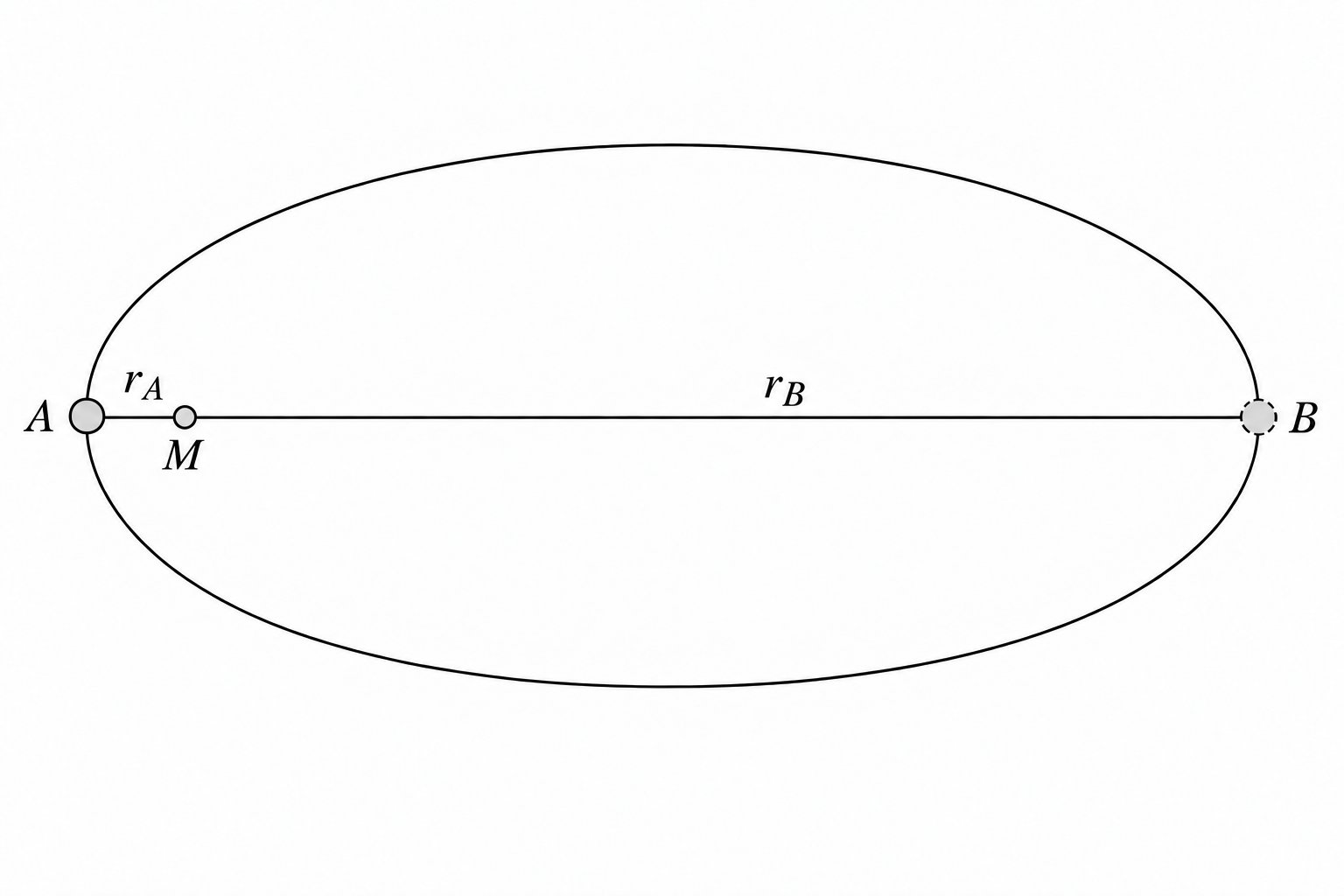
Schematic; dimensions and force-arrow lengths are not to scale.
For a satellite in an elliptical orbit under gravity alone, which pair stays constant?
The escape speed at distance r from a spherical planet’s center is v_e. What is the escape speed at distance 4r?
A satellite moves from distance r to distance 2r from a planet. How does the system’s gravitational potential energy change?
In a circular orbit under gravity alone, what work does gravity do during one quarter of a revolution?
Which initial total mechanical energy corresponds to the minimum escape speed, with U=0 at infinity?
Two satellites of different masses occupy circular orbits of the same radius around the same planet. Which quantity is equal for both?
At the closest and farthest points of an elliptical orbit, velocities are perpendicular to the radial lines. If r_B=3r_A, what is v_A/v_B?
Schematic; dimensions and force-arrow lengths are not to scale.