Rolling FRQ Practice

Responses receive AI feedback against a rubric after submission. Scores are practice estimates.

Question 1 of 5

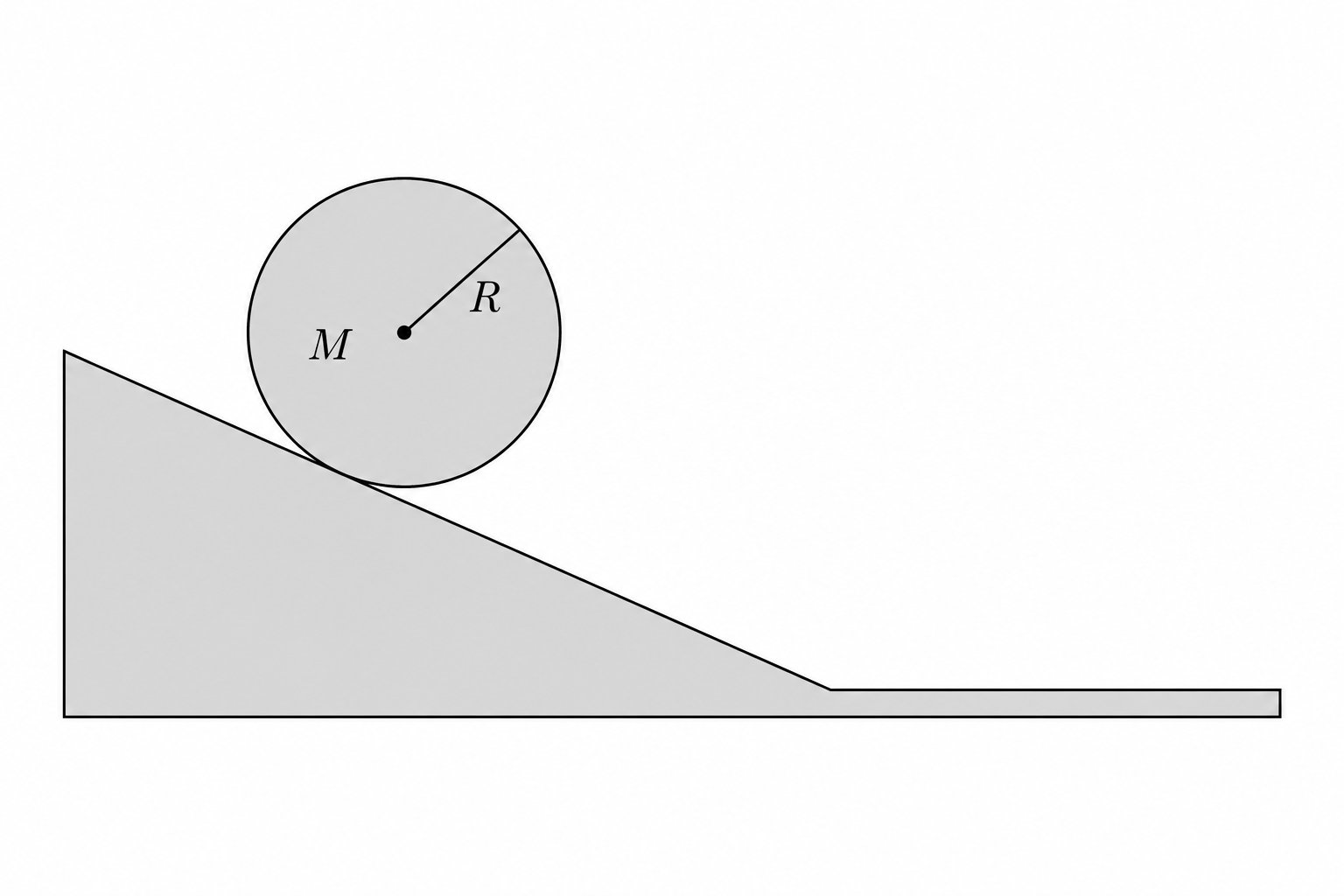
A thin hoop of mass M rolls without slipping up an incline with initial center speed v. Its inertia is MR². (a) Find its maximum vertical center-of-mass rise h. (b) Compare with a nonrotating point mass launched frictionlessly up the same incline at speed v. (c) Explain the difference.
Question 2 of 5

An unknown rigid body rolls without slipping from rest through height h. Its central inertia can be written kMR². Students independently measure its bottom speed v. (a) Derive k from h and v. (b) Explain why measuring only the travel time without knowing the ramp geometry is insufficient. (c) Identify how unaccounted mechanical-energy loss affects the inferred k.

Question 3 of 5

A disk rolls down a fixed incline without slipping. A student argues that static friction must remove energy because it points up the incline. (a) Evaluate that argument using motion of the contact point. (b) Explain how friction can still change rotational motion. (c) State an appropriate mechanical-energy equation for a center-of-mass drop h, neglecting all losses.

A disk or cylindrical body is in contact with a fixed inclined ramp.

Schematic; dimensions and force-arrow lengths are not to scale.

Question 4 of 5

The table lists independent rightward center-displacement and clockwise angular-displacement magnitudes for a wheel of radius 0.20 m moving along a straight stationary floor. (a) Identify which trial is consistent with rolling without slipping throughout if each motion is steady. (b) Explain your comparison. (c) Explain why matching total displacements would be less conclusive for a motion that changes irregularly.

Trial Center displacement (m) Angular displacement (rad)
P 1.0 5
Q 1.0 3

Question 5 of 5

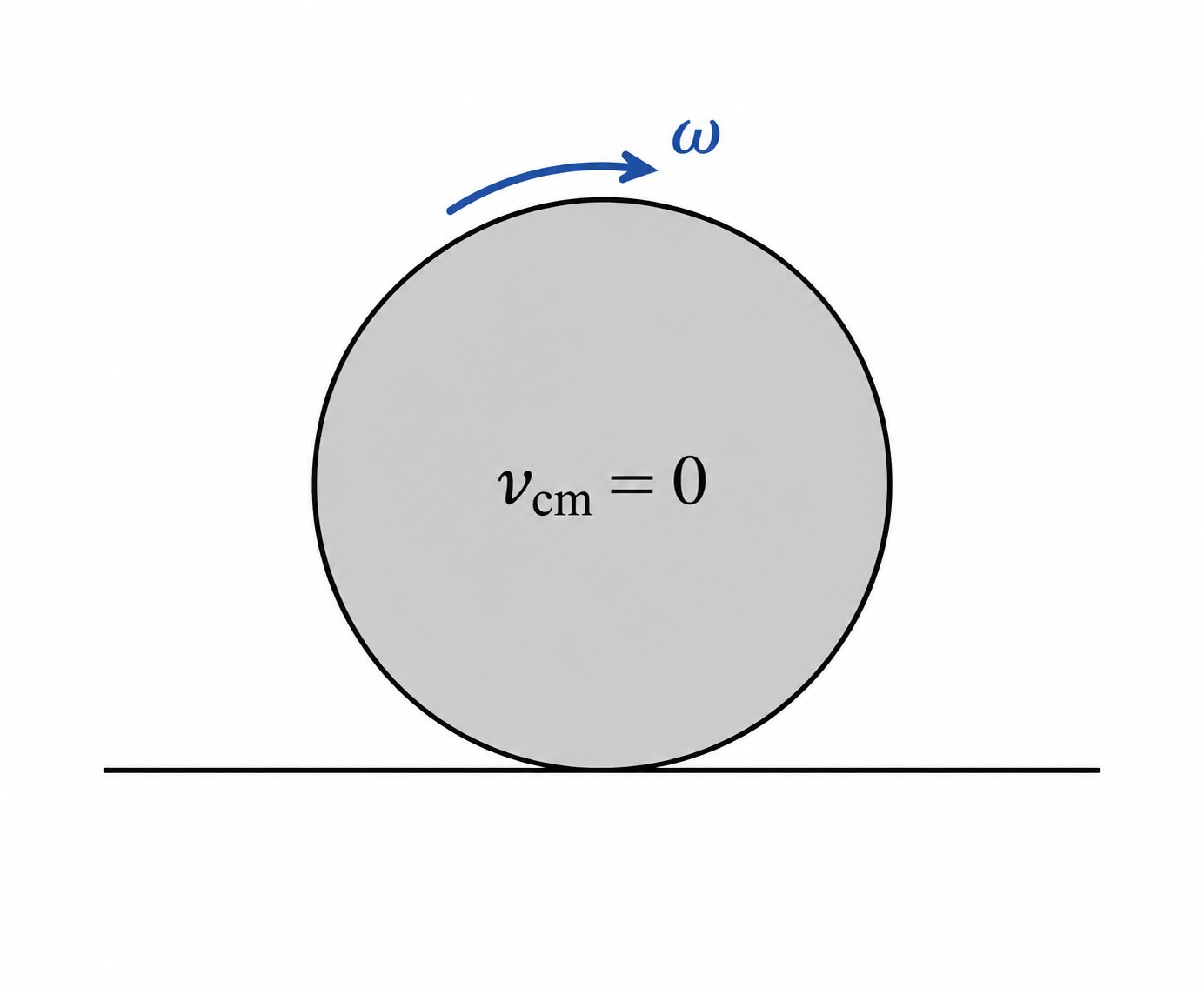
A wheel is initially spinning clockwise with its center at rest. It is lowered onto a rough horizontal stationary floor and initially slips. Discuss qualitatively. (a) Determine the initial direction of motion of its bottom point relative to the floor. (b) Determine friction direction and changes in translation and spin. (c) Explain why total mechanical energy decreases even though center-of-mass kinetic energy increases.

A wheel initially spins clockwise at angular speed w with its center at rest on a stationary floor.

Schematic; dimensions and force-arrow lengths are not to scale.