Newton's Second Law in Rotational Form FRQ Practice

Responses receive AI feedback against a rubric after submission. Scores are practice estimates.

Question 1 of 5

A light string is wrapped around a fixed-axis pulley of radius R and rotational inertia I. A mass m hangs from the vertical string at the pulley’s right side. The system is released from rest, the string does not slip, and axle friction is negligible. (a) Write the force equation for the mass and torque equation for the pulley. (b) Derive the downward acceleration. (c) Derive the string tension.
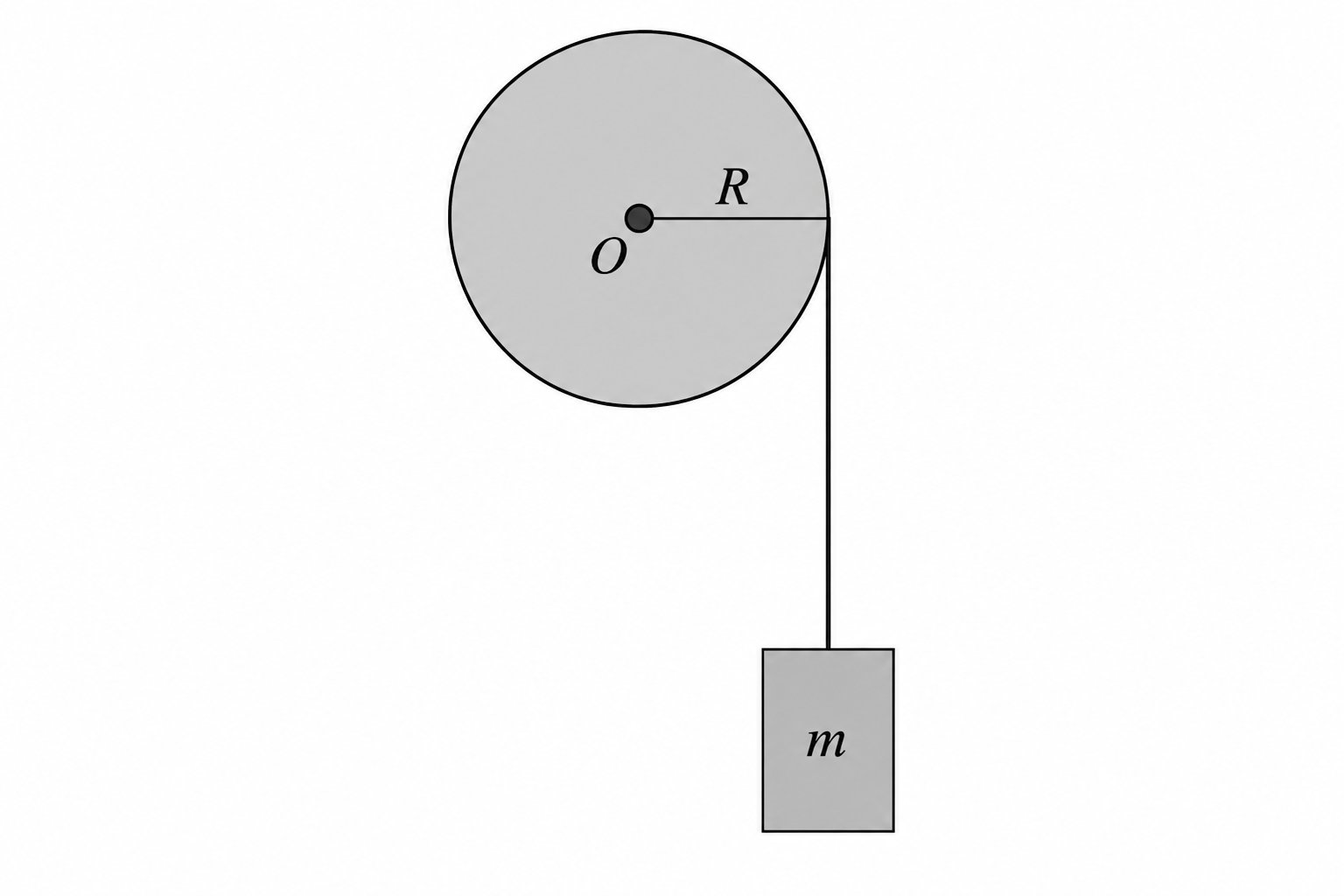
A fixed-axis pulley of radius R has a string descending from its right edge to a hanging mass m.

Schematic; dimensions and force-arrow lengths are not to scale.

Question 2 of 5

A rotor with inertia 0.50 kg m² has angular velocity +2 rad/s. A constant motor torque +3 N m and constant friction torque -1 N m act for 4 s; the rotor keeps turning positively. (a) Find the net torque and angular acceleration. (b) Find final angular velocity. (c) Find the angular displacement.

Question 3 of 5

Design a test of net torque = I alpha for a fixed-axis rotor. You have a force sensor, a string wound at known radius R, and a rotation sensor. (a) Describe independent measurements of torque and alpha. (b) Describe a graph and how to determine inertia. (c) Explain how a roughly constant bearing-friction torque appears if the graph uses applied torque rather than net torque.

Question 4 of 5

Two equal point masses m are fixed at radius r on a negligible-mass rod rotating about a fixed central axis. A tangential force F acts on one mass. Other torques are negligible. (a) Derive the angular acceleration. (b) Both masses are moved to radius 2r and the same force acts tangentially on one. Derive the new acceleration. (c) Explain why doubling the torque does not double alpha in this change.

Question 5 of 5

A wheel of inertia I rotates counterclockwise with angular speed w. A brake applies constant clockwise torque of magnitude C until the wheel stops. (a) Derive the angular acceleration. (b) Derive the stopping time. (c) Derive the angle rotated before stopping. Assume all other torques are negligible.