Newton's Second Law in Rotational Form FRQ Practice

Responses receive AI feedback against a rubric after submission. Scores are practice estimates.

Question 1 of 5

Two hanging masses m2>m1 are connected by a light string passing over a pulley of radius R and inertia I. The axle is frictionless and the string does not slip. (a) Write the two linear force equations and the pulley torque equation. (b) Derive the acceleration magnitude. (c) Explain why the tensions on the two sides differ.
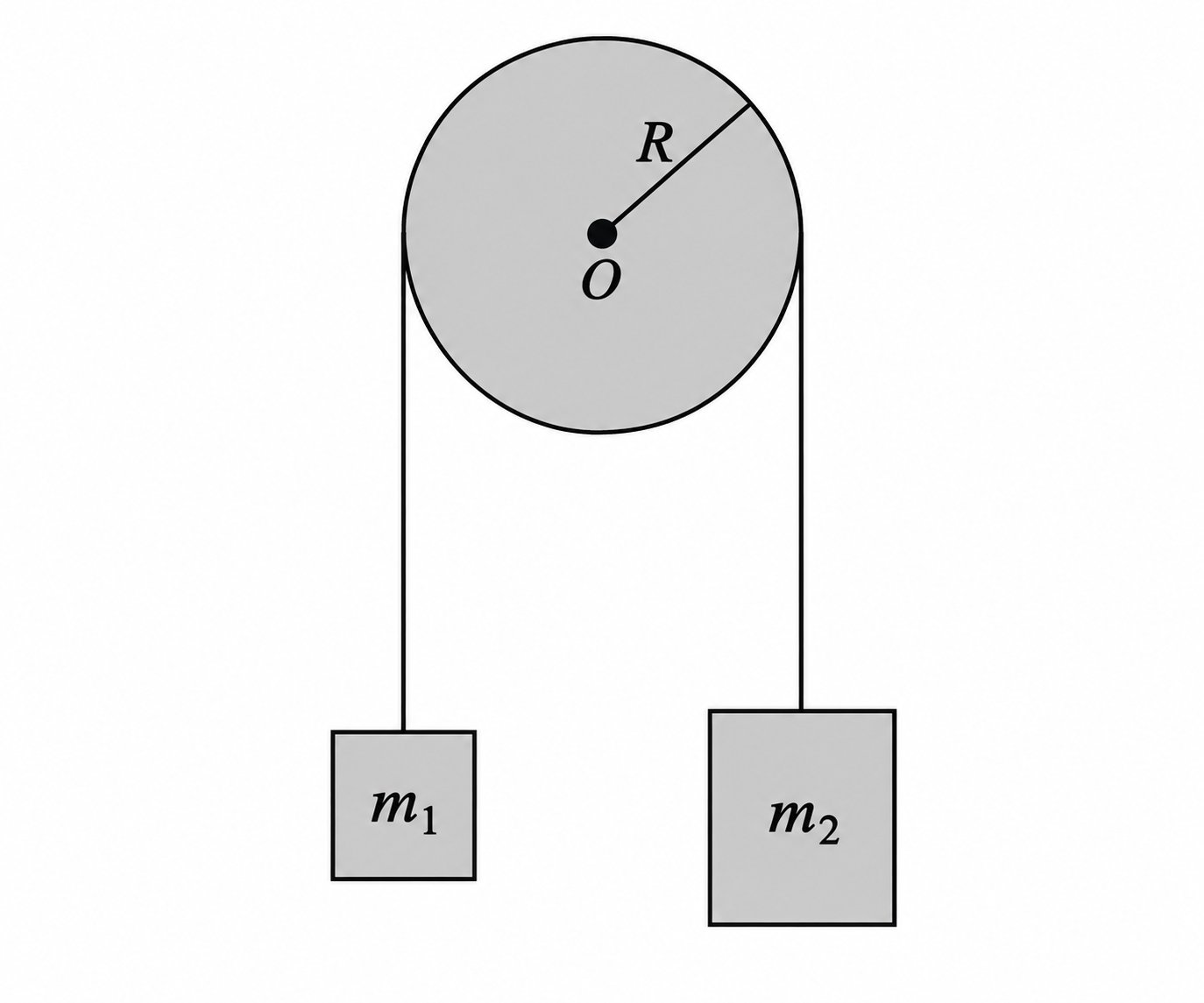
A fixed-axis pulley of radius R carries a string with hanging mass m1 on the left and heavier mass m2 on the right.

Schematic; dimensions and force-arrow lengths are not to scale.
Question 2 of 5

An experiment gives the applied torque and angular acceleration data in the table for a rotor turning in one sense. Assume constant opposing friction torque and constant inertia. (a) Determine the inertia. (b) Determine the friction torque magnitude. (c) Predict angular acceleration for an applied torque of 1.0 N m while the rotor still turns in the same sense.

Applied torque (N m) α (rad/s²)
4 1
6 2
8 3

Question 3 of 5

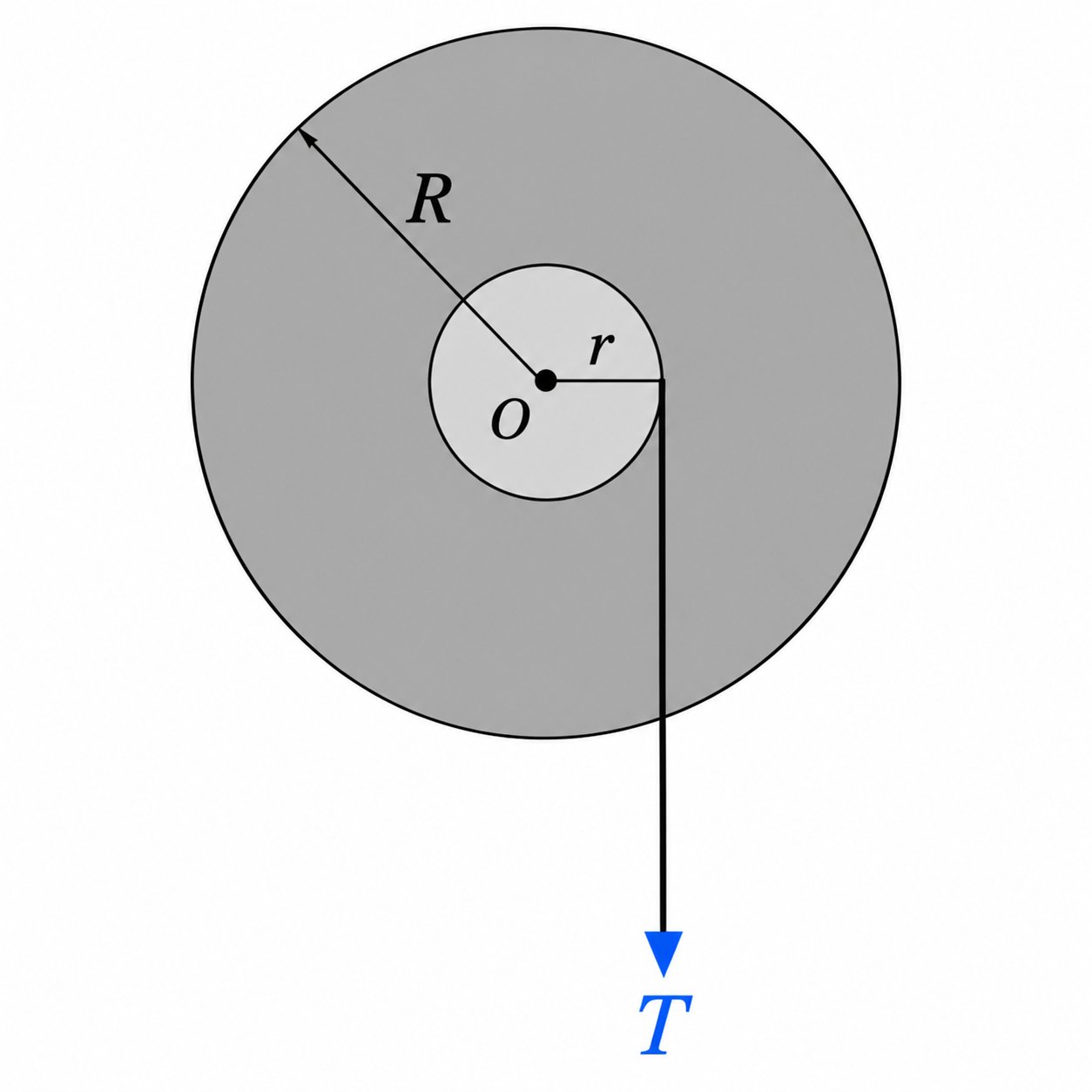
A fixed-axis disk has mass M, radius R, and inertia MR²/2. A negligible-mass hub of radius r is rigidly attached at its center. A light string wrapped around the hub descends from its right side and pulls tangentially downward with measured tension T, without slipping. Other torques are negligible. (a) Derive the angular acceleration. (b) Derive the string acceleration. (c) The hub radius is doubled while disk inertia and tension remain unchanged. Compare both accelerations.

A disk of outer radius R has a concentric hub of radius r; a string descends from the hub right edge with downward tension T.

Schematic; dimensions and force-arrow lengths are not to scale.

Question 4 of 5

A student claims that a larger torque always gives a larger angular acceleration when comparing different rotating systems. (a) Give a numerical counterexample using two positive torques and inertias. (b) Calculate both accelerations. (c) State a restriction under which the claim would be valid.

Question 5 of 5

A wheel rotates positively at 12 rad/s. Its inertia is 0.40 kg m². For 2 s a constant net torque -1.6 N m acts. (a) Find its angular acceleration. (b) Find its angular velocity at 2 s. (c) Determine whether it reverses within that interval and justify your answer.