Rotational Kinetic Energy FRQ Practice

Responses receive AI feedback against a rubric after submission. Scores are practice estimates.

Question 1 of 5

A rotor has inertia 0.40 kg m² and initially rotates at 5 rad/s. Later it rotates at 8 rad/s in the opposite sense. (a) Calculate each kinetic energy. (b) Calculate the change. (c) Explain why reversing direction does not make the final kinetic energy negative.
Question 2 of 5

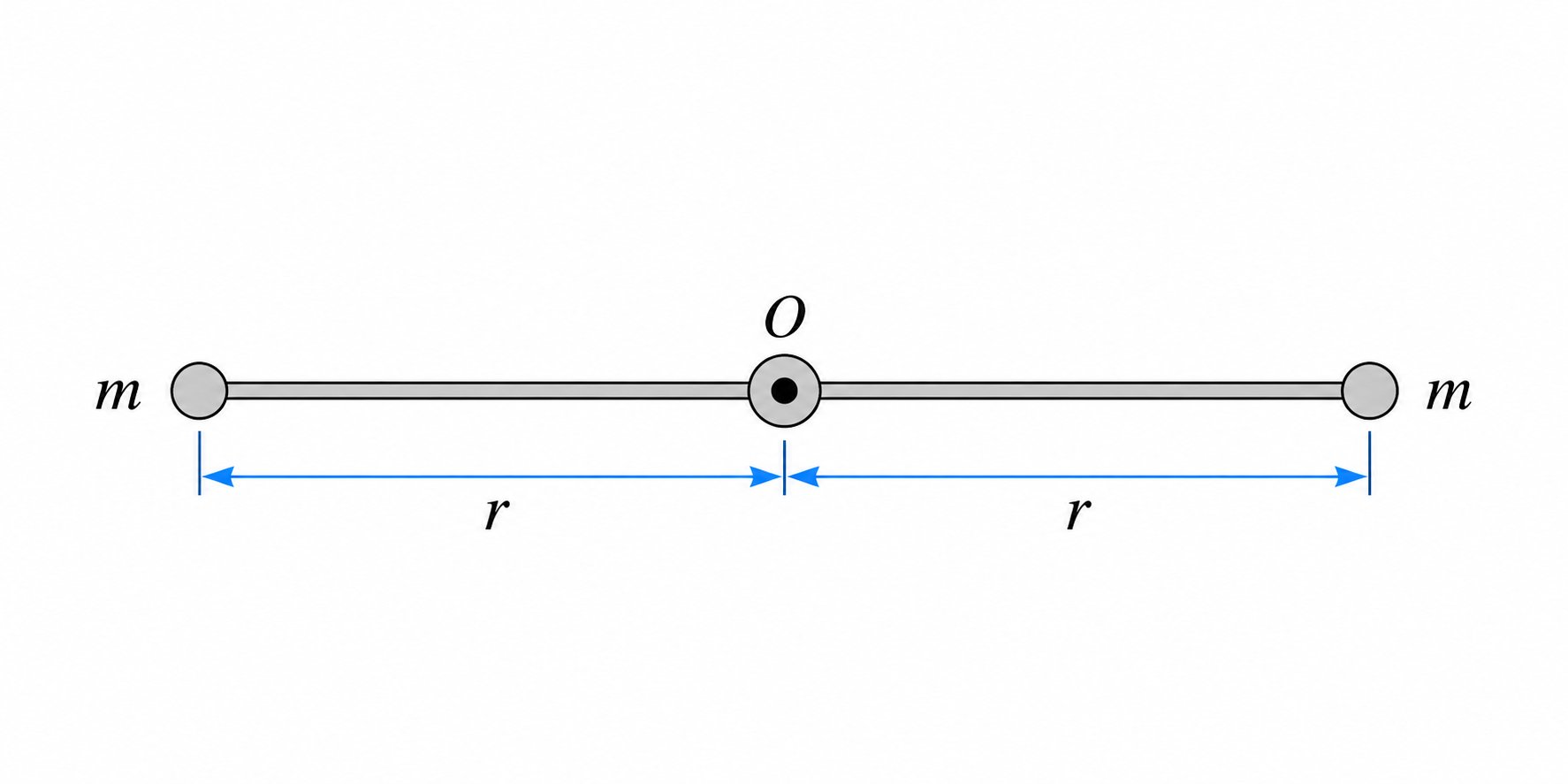
Two equal point masses m lie at opposite ends of a massless rod, each distance r from axle O. The assembly rotates at angular speed w. (a) Find each mass’s linear speed. (b) Sum their translational kinetic energies. (c) Independently use rotational inertia to find the assembly’s energy and compare.

Two point masses m each lie distance r from central axle O.

Schematic; dimensions and force-arrow lengths are not to scale.

Question 3 of 5

A freely moving rigid object has mass M, center-of-mass speed v, center-of-mass inertia I, and angular speed w. (a) Write its total kinetic energy. (b) Find the energy change if only v doubles. (c) Find the energy change if only w doubles. Explain why the two changes need not match.

Question 4 of 5

An axle-mounted rotor has independently known inertia I. A camera records a marked point and has a calibrated clock. (a) Describe how to measure its angular speed when that speed is constant. (b) Explain how to calculate its energy. (c) If the measured rotation period is 5% too large, determine whether the calculated energy is too large or too small and explain.

Question 5 of 5

Rotors A and B have equal rotational kinetic energy. Their inertias satisfy I_B=4I_A. (a) Find w_B/w_A for their angular speeds. (b) A student concludes that each point on B must move slower than each point on A. Evaluate the claim, allowing the rotors to have different radii.