Question 1 of 10
A flywheel has rotational inertia 3 kg m² and angular speed 4 rad/s about its fixed axle. What is its rotational kinetic energy?
- A. 12 J
- B. 48 J
- C. 24 J
- D. 6 J
A flywheel has rotational inertia 3 kg m² and angular speed 4 rad/s about its fixed axle. What is its rotational kinetic energy?
A rigid rotor reverses its rotation while maintaining the same angular speed and rotational inertia. How does its rotational kinetic energy change?
Rotors P and Q have equal rotational inertia. Q rotates three times as fast as P. What is K_Q/K_P?
The table describes three rotors about fixed axes. Which ranking of rotational kinetic energies is correct?
| Rotor | I (kg m²) | Angular speed (rad/s) |
|---|---|---|
| X | 4 | 2 |
| Y | 1 | 6 |
| Z | 8 | 1 |
Two point masses, each m, are fixed at opposite ends of a massless rod, each distance r from axle O. The rod rotates at angular speed w. What is the total kinetic energy?
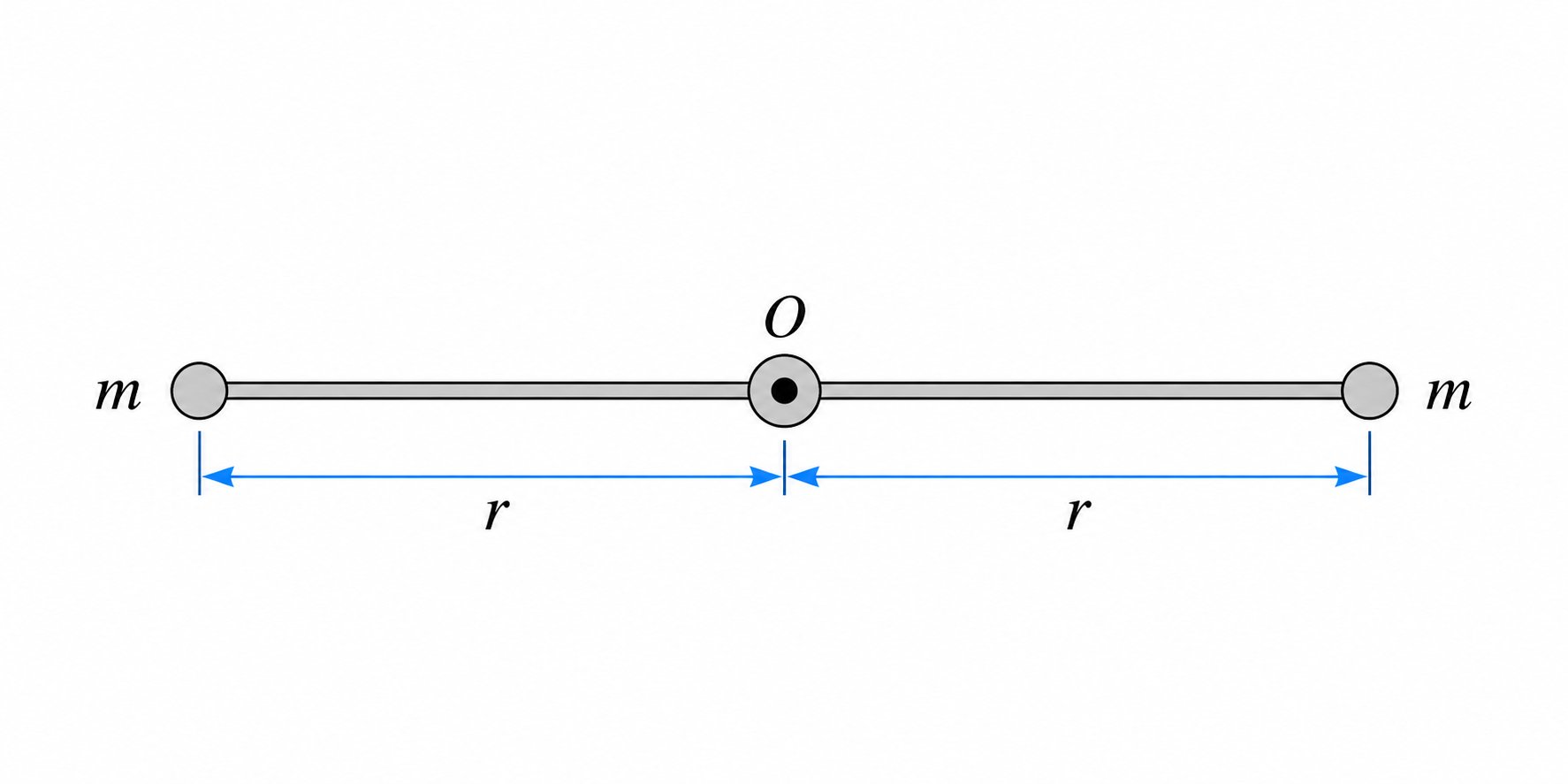
Schematic; dimensions and force-arrow lengths are not to scale.
A wheel spins about a fixed axle through its center. Its center of mass is stationary. Which explanation accounts for its nonzero kinetic energy?
A rigid object of mass 2 kg moves with center-of-mass speed 3 m/s while rotating at 4 rad/s about its center of mass. Its inertia about that center is 0.50 kg m². What is its total kinetic energy?
A disk has inertia I and kinetic energy K about a fixed axis. What angular speed corresponds to energy 4K?
A uniform hoop and a uniform disk have the same mass M, radius R, and angular speed w about their central axes. Given I_hoop=MR² and I_disk=MR²/2, which energy comparison is correct?
A graph of rotational kinetic energy K versus angular speed squared w² is a straight line through the origin with slope 0.80 kg m². What is the rotor’s inertia?