Question 1 of 10
A constant net torque of 3 N m acts in the direction a rotor turns through 5 rad. What net work is done?
- A. 8 J
- B. 1.67 J
- C. 0 J
- D. 15 J
A constant net torque of 3 N m acts in the direction a rotor turns through 5 rad. What net work is done?
A brake exerts a constant clockwise torque while a disk rotates counterclockwise. What is the sign of the work done by the brake?
A force F acts upward at the rightmost rim of a disk of radius R, perpendicular to the radius from axle O. The force remains tangent as the disk rotates counterclockwise through angle q. What work does this force do?
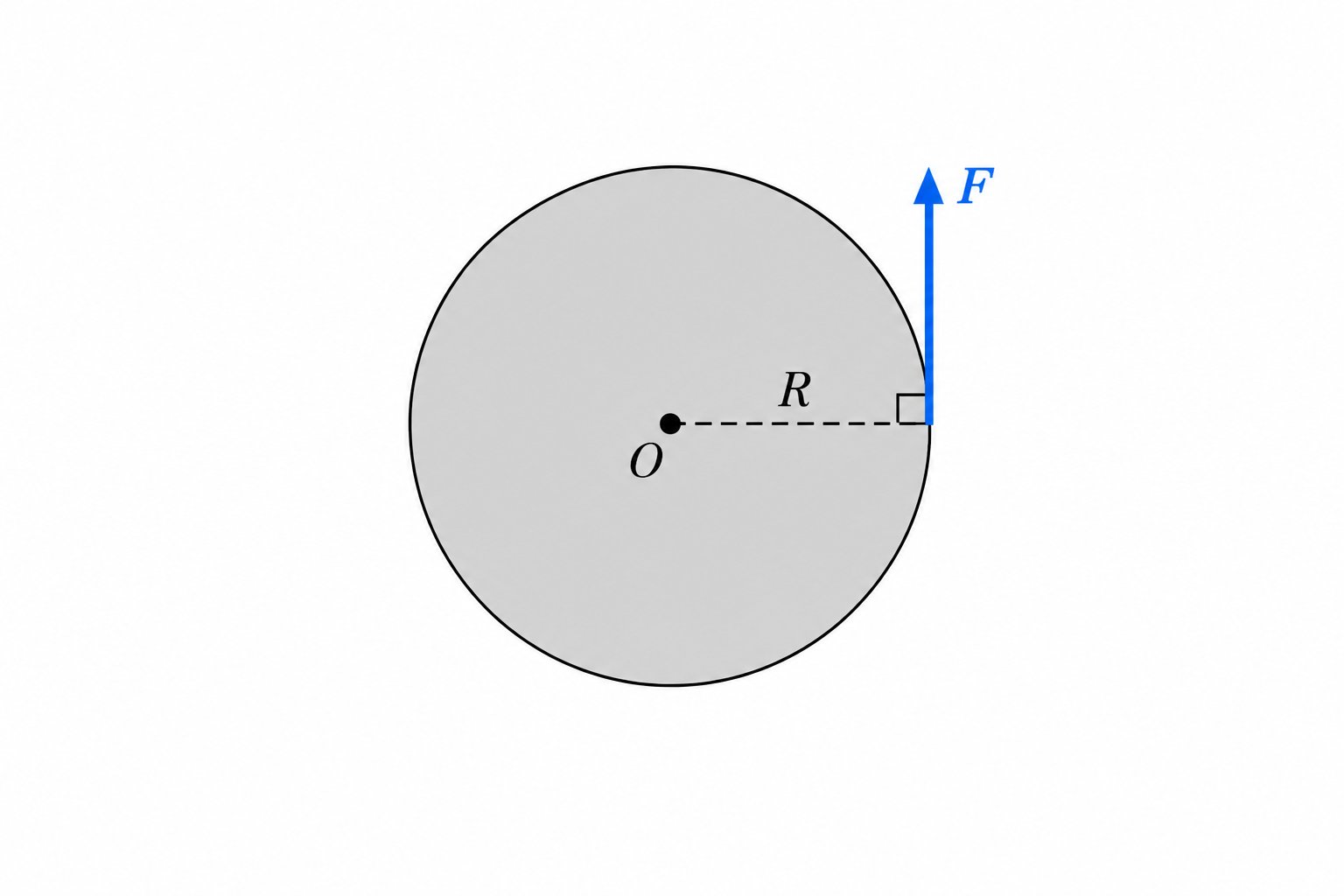
Schematic; dimensions and force-arrow lengths are not to scale.
The graph shows net torque versus angular position during counterclockwise rotation. What work is done from 0 to 4 rad?
A rotor starts with 8 J of kinetic energy. A motor does 20 J of work and a brake does -5 J. What is the final kinetic energy?
A motor holds a wheel motionless while exerting a nonzero torque opposed by a clamp. How much mechanical work does the motor torque do on the wheel?
The table lists intervals of angular displacement and constant net torque. What is the total work during the two intervals?
| Interval | Displacement (rad) | Net torque (N m) |
|---|---|---|
| 1 | 2 | 5 |
| 2 | 3 | -1 |
An axle-mounted rotor of inertia 2 kg m² starts from rest. A net torque does 16 J of work. What angular speed results?
A constant torque does the same positive work on two initially stationary rotors with different inertias. Which final quantity must be the same?
Over a positive angular displacement q, torque tau first acts and is then replaced by torque 2tau for a second displacement q. Compare the work in the two intervals.