Question 1 of 10
A rigid rotor has inertia 0.50 kg m² and angular speed 6 rad/s. What is its angular-momentum magnitude?
- A. 3 kg m²/s
- B. 9 kg m²/s
- C. 12 kg m²/s
- D. 1.5 kg m²/s
A rigid rotor has inertia 0.50 kg m² and angular speed 6 rad/s. What is its angular-momentum magnitude?
A particle of mass m travels right at speed v along a straight path. Reference point O is a perpendicular distance b below the path. What is the angular-momentum magnitude about O?
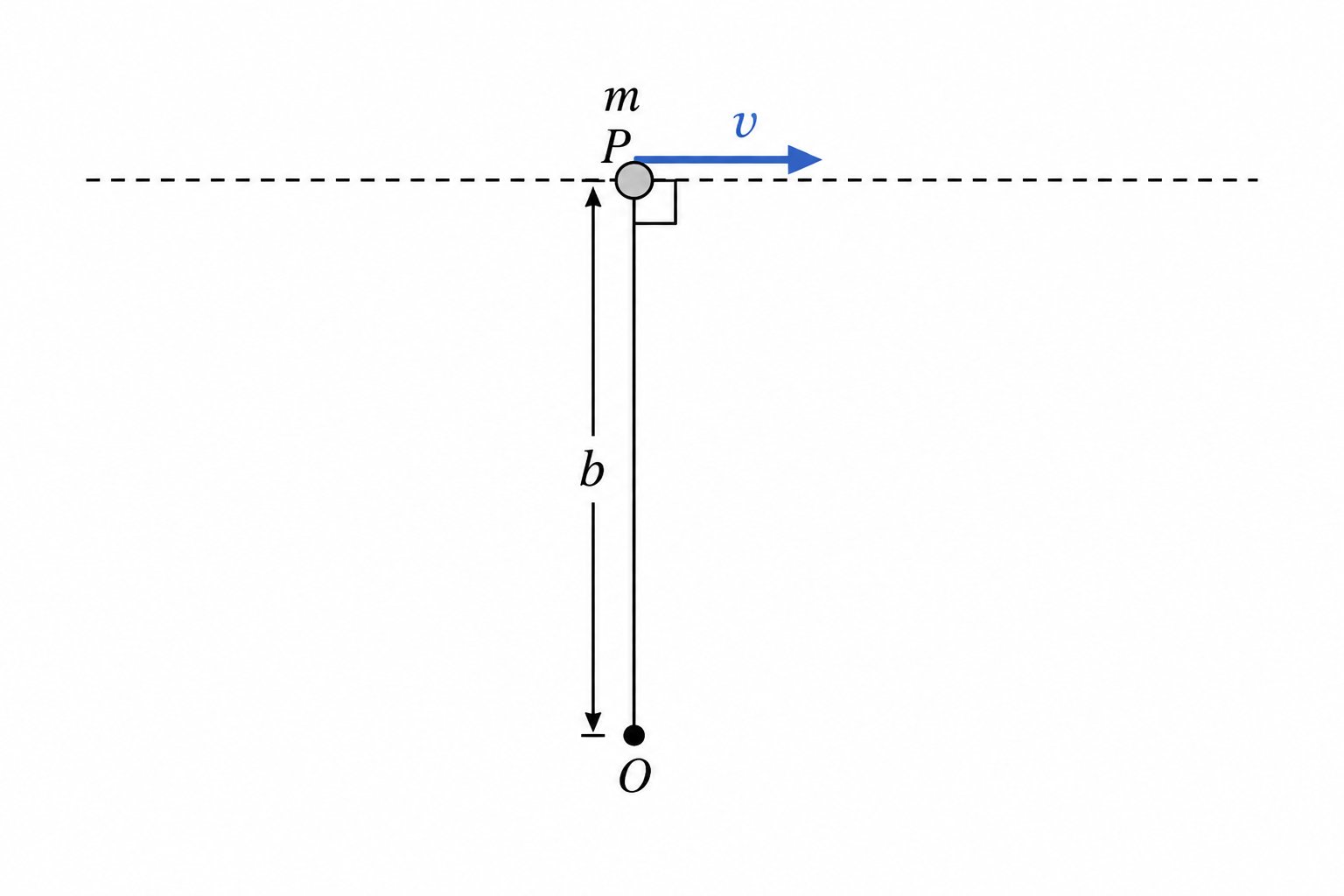
Schematic; dimensions and force-arrow lengths are not to scale.
A particle moves directly toward a reference point. What is its angular momentum about that point?
Two rotors have the same angular speed. Rotor P has three times the inertia of Q. What is L_P/L_Q?
A constant net torque 4 N m acts for 0.50 s. What angular impulse does it deliver?
Which graph’s signed area gives angular impulse?
The graph shows net torque versus time. What angular impulse is delivered?
With counterclockwise positive, a rotor has initial angular momentum +5 kg m²/s and receives net angular impulse -8 N m s. What is its final angular momentum?
A rotor’s angular momentum increases linearly from 2 to 14 kg m²/s in 3 s. What is its net torque?
The same angular impulse is applied to two rigid rotors initially at rest. Their inertias satisfy I_P=2I_Q. How do their final angular speeds compare?