Angular Momentum and Angular Impulse FRQ Practice

Responses receive AI feedback against a rubric after submission. Scores are practice estimates.

Question 1 of 5

A particle of mass 2 kg moves right at 3 m/s along a horizontal line. Point O lies 4 m below that line. (a) Find its angular-momentum magnitude about O when directly above O. (b) Find it after the particle moves farther along the same line at the same speed. (c) Explain why increasing the particle’s distance from O does not increase this magnitude.
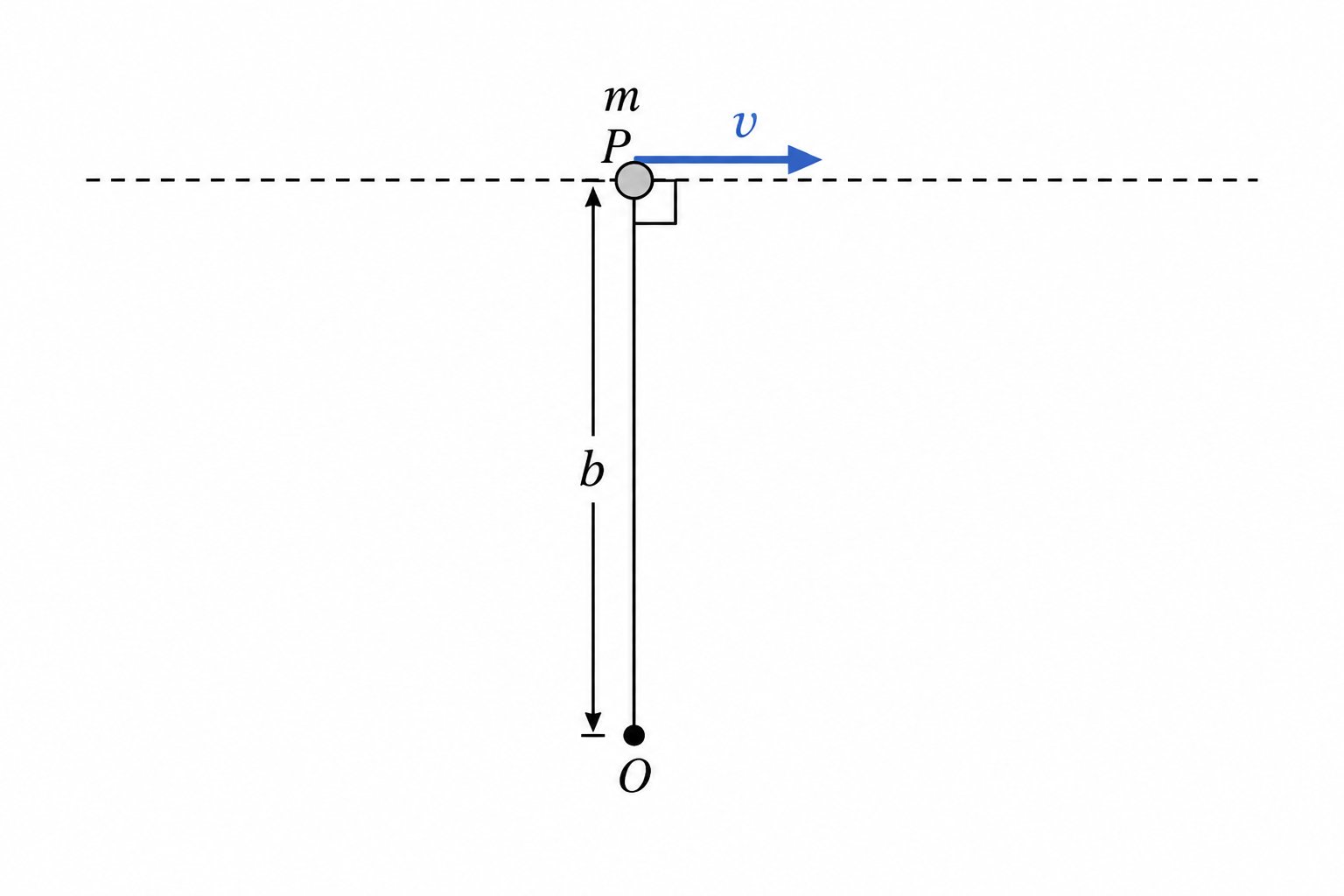
A particle travels horizontally above reference point O; b is the perpendicular separation.

Schematic; dimensions and force-arrow lengths are not to scale.

Question 2 of 5

Rotor P has inertia I and speed w. Rotor Q has inertia 4I and speed w/2. (a) Compare their angular momenta. (b) Compare their rotational energies. (c) Explain why equal kinetic energies need not imply equal angular momenta.

Question 3 of 5

The table gives constant net torques during three time intervals. (a) Find each angular impulse. (b) Find the total impulse. (c) Give a single constant torque that would produce the same total angular impulse over all 4 s.

Time interval (s) Net torque (N m)
0 to 1 6
1 to 3 -2
3 to 4 3

Question 4 of 5

A torque sensor records a short pulse. Students approximate its torque-time curve as a triangle with duration d and maximum torque T. (a) Derive the impulse estimate. (b) The actual curve lies above the triangle throughout the interior of the pulse. State the direction of error. (c) Describe a data-collection and numerical-area method that improves the estimate.

Question 5 of 5

A rotor of inertia 2 kg m² initially has angular velocity +3 rad/s. A constant net torque -4 N m acts for 2 s. (a) Find initial and final angular momentum. (b) Find final angular velocity. (c) Determine when reversal occurs.