Conservation of Angular Momentum MCQ Practice

Question 1 of 10

A spinning student pulls weights inward so the total inertia decreases from 4 to 2 kg m². External torque about the vertical axis is negligible. If the initial speed is 3 rad/s, what is the final speed?
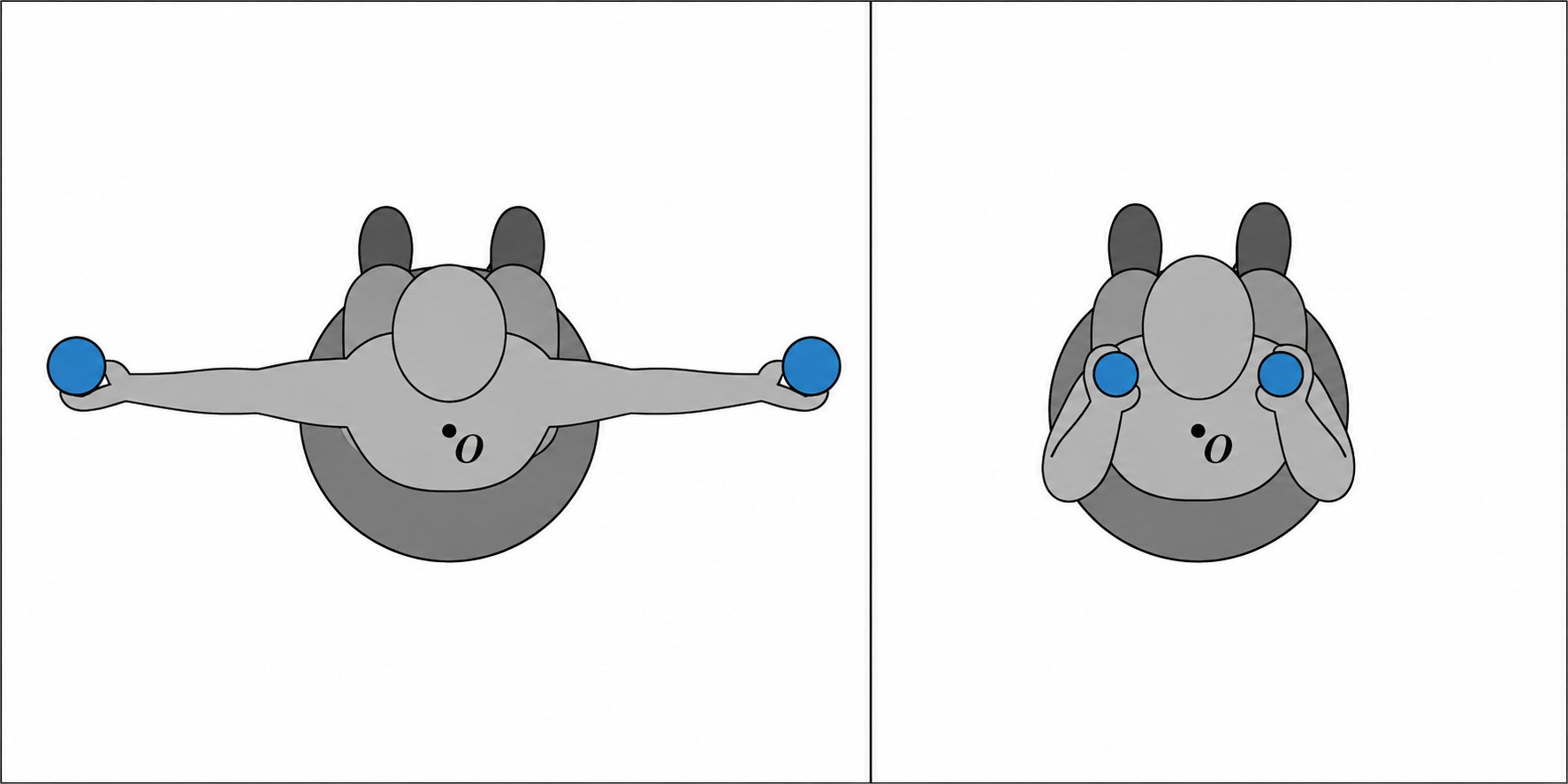
Overhead views show a student holding equal weights with arms extended and retracted.

Schematic; dimensions and force-arrow lengths are not to scale.

  1. A. 12 rad/s
  2. B. 6 rad/s
  3. C. 1.5 rad/s
  4. D. 3 rad/s

Question 2 of 10

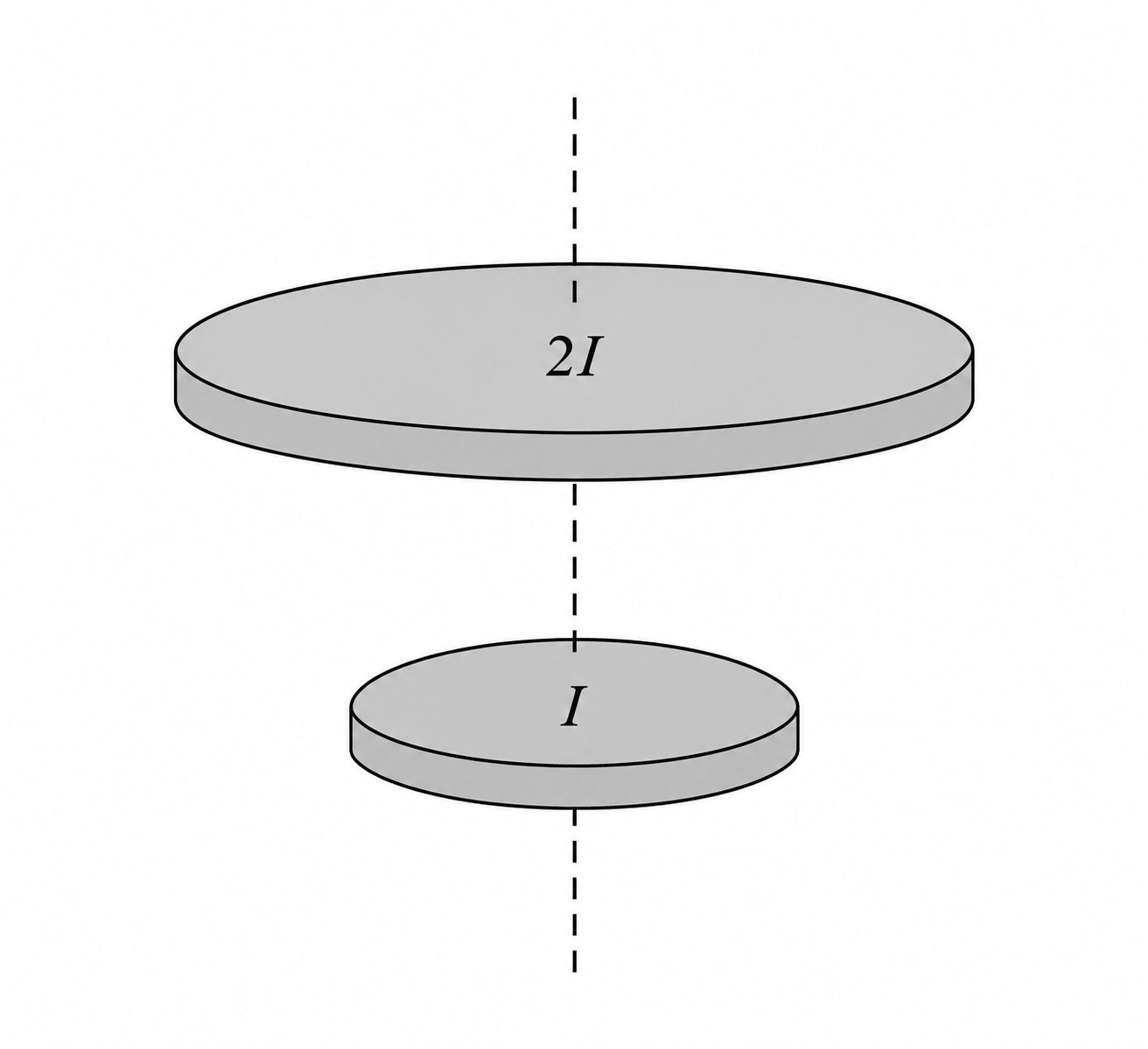
Two coaxial disks have inertias I and 2I. Initially the lower disk I rotates at w and the upper disk 2I is stationary. They contact and reach a common speed with negligible external torque. What is that speed?

Two disks on a common axle have inertias I and 2I.

Schematic; dimensions and force-arrow lengths are not to scale.

  1. A. $2w/3$
  2. B. $w$
  3. C. $w/3$
  4. D. $w/2$

Question 3 of 10

A rotating system has no net external torque while its inertia increases. What happens to its angular momentum and angular speed?

  1. A. Both stay constant.
  2. B. Momentum increases and speed stays constant.
  3. C. Both increase.
  4. D. Momentum stays constant and speed decreases.

Question 4 of 10

Two coaxial rotors initially have angular momenta +7 and -3 kg m²/s. They interact with negligible external torque. What is their total final angular momentum?

  1. A. +4 kg m²/s
  2. B. +10 kg m²/s
  3. C. -4 kg m²/s
  4. D. 0 kg m²/s

Question 5 of 10

An isolated rotating student pulls weights inward. Angular momentum remains constant, but rotational kinetic energy increases. What supplies the increase?

A student moves handheld weights from extended to retracted positions.

Schematic; dimensions and force-arrow lengths are not to scale.

  1. A. A decrease in angular momentum
  2. B. Internal energy converted through the student’s work
  3. C. A necessary external torque
  4. D. Conservation of kinetic energy

Question 6 of 10

For which selected system is angular momentum guaranteed constant about a specified axis during an interval?

  1. A. One with constant mass only
  2. B. One with constant kinetic energy only
  3. C. One with zero net external torque about that axis
  4. D. One with zero net external force but arbitrary torque

Question 7 of 10

Two disks exchange frictional torques while a frictionless axle exerts no torque about their common axis. Which system has constant total angular momentum?

  1. A. Each disk separately throughout the interaction
  2. B. Only the faster disk
  3. C. Neither the disks together nor either disk
  4. D. The two disks together

Question 8 of 10

A brake fixed to the room slows a rotor. For the system consisting of the rotor alone, which statement is correct?

  1. A. Angular momentum changes because the brake exerts external torque.
  2. B. Angular momentum must stay constant because the rotor is rigid.
  3. C. The brake torque is internal.
  4. D. Angular momentum is destroyed.

Question 9 of 10

A force points toward a fixed pivot at all times. Can angular momentum about that pivot remain constant even though linear momentum changes?

  1. A. Only if the object is stationary.
  2. B. Yes, because this force has zero torque about the pivot.
  3. C. No, because any force changes angular momentum.
  4. D. Only if the force does zero impulse.

Question 10 of 10

A rotor’s measured angular momentum changes from 8 to 6 kg m²/s. A student claims the chosen system experienced no external angular impulse. Which response is correct?

  1. A. The claim is valid if the rotor slowed.
  2. B. The claim is valid if energy was conserved.
  3. C. The claim contradicts the measured change.
  4. D. The claim is valid if inertia changed.