Rotational Equilibrium and Newton's First Law in Rotational Form FRQ Practice

Responses receive AI feedback against a rubric after submission. Scores are practice estimates.

Question 1 of 5

A uniform horizontal plank of length L and weight W rests on narrow supports at its left end and at distance 3L/4 from the left end. The supports can push upward but cannot pull downward. A person of weight P>W walks slowly from the midpoint toward the right end. The schematic shows selected forces only; support forces are not drawn. (a) Identify which support loses contact first. (b) Derive the position x, measured from the left end, at which tipping begins. (c) Explain why the weight condition P>W places this position before the right end.
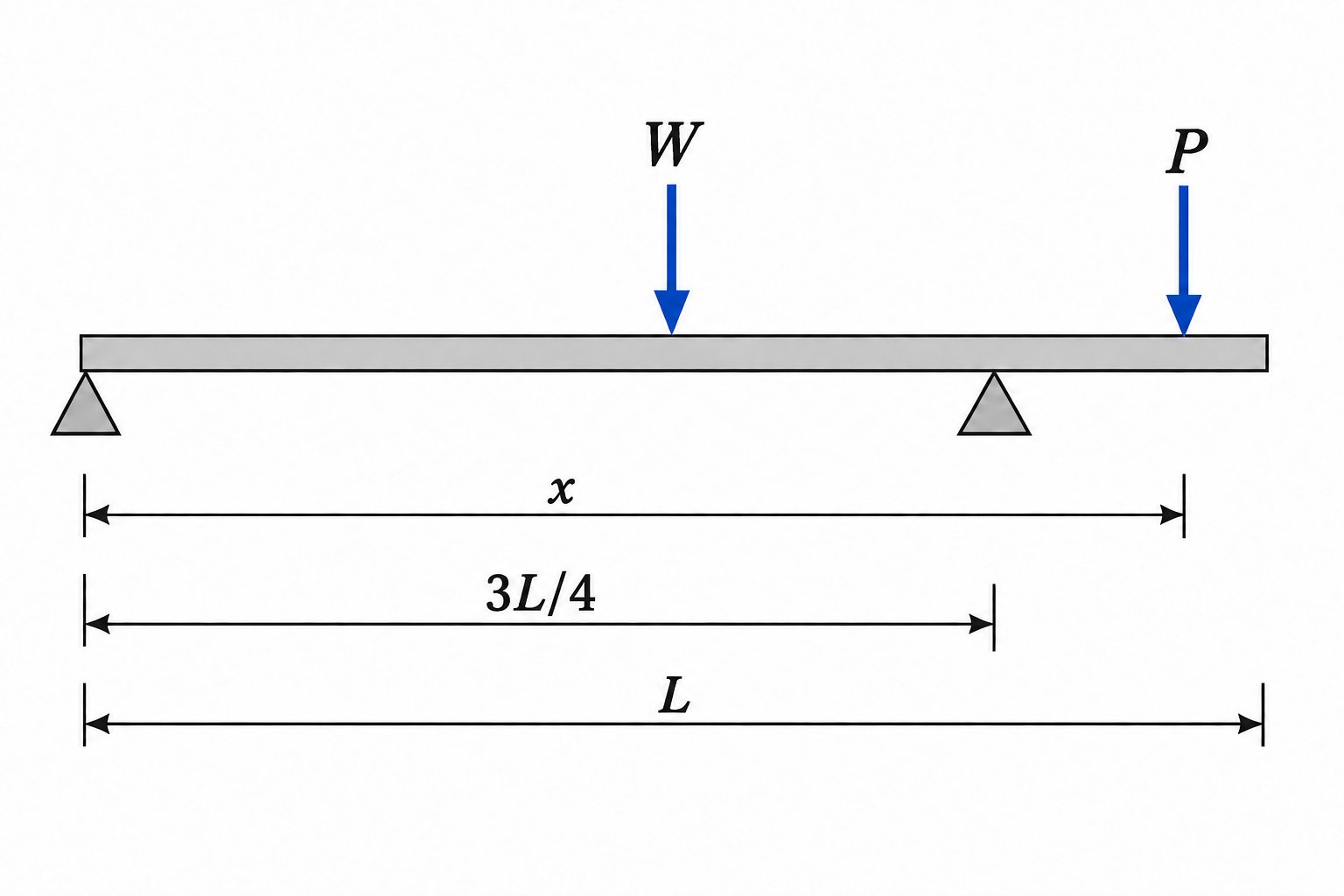
A plank of length L rests on supports at its left end and at 3L/4. Selected weights are W at the midpoint and P at position x on the right overhang.

Schematic; dimensions and force-arrow lengths are not to scale.

Question 2 of 5

A uniform rod of weight W and length L extends horizontally from a left hinge. An upward vertical support force acts at distance a from the hinge, where 0<a<L. (a) Derive this force. (b) Derive the vertical hinge force. (c) Explain why the hinge force points downward if a<L/2.

Question 3 of 5

A student observes equal clockwise and counterclockwise torque sums on a rotating rigid wheel and claims the wheel must stop. (a) Evaluate the claim. (b) Sketch angular velocity versus time if its initial value is +3 rad/s and the balance persists. (c) Give a different torque condition that would slow this wheel initially.

Question 4 of 5

A beam is balanced horizontally with a known mass m at distance d left of a pivot and an unknown mass M at distance x right. The beam center of mass is at the pivot. (a) Derive M. (b) Explain whether the result depends on local g. (c) If x was measured 5% too large while other measurements were accurate, determine whether the inferred M is too large or too small.

Question 5 of 5

A horizontal rigid bar is held at rest by several forces. (a) Explain why a correct torque balance may be written about either end. (b) Explain why zero net torque about one end alone does not prove static equilibrium. (c) Describe the additional force-balance check needed.