Rotational Equilibrium and Newton's First Law in Rotational Form FRQ Practice

Responses receive AI feedback against a rubric after submission. Scores are practice estimates.

Question 1 of 5

A uniform horizontal beam of length L and mass M is hinged at its left end. A cable attached to its right end pulls upward and leftward at 30° to the horizontal leftward direction. The beam is at rest. (a) Draw all forces, including hinge components. (b) Derive the cable tension. (c) Derive the horizontal and vertical hinge-force components. The schematic shows selected forces only.
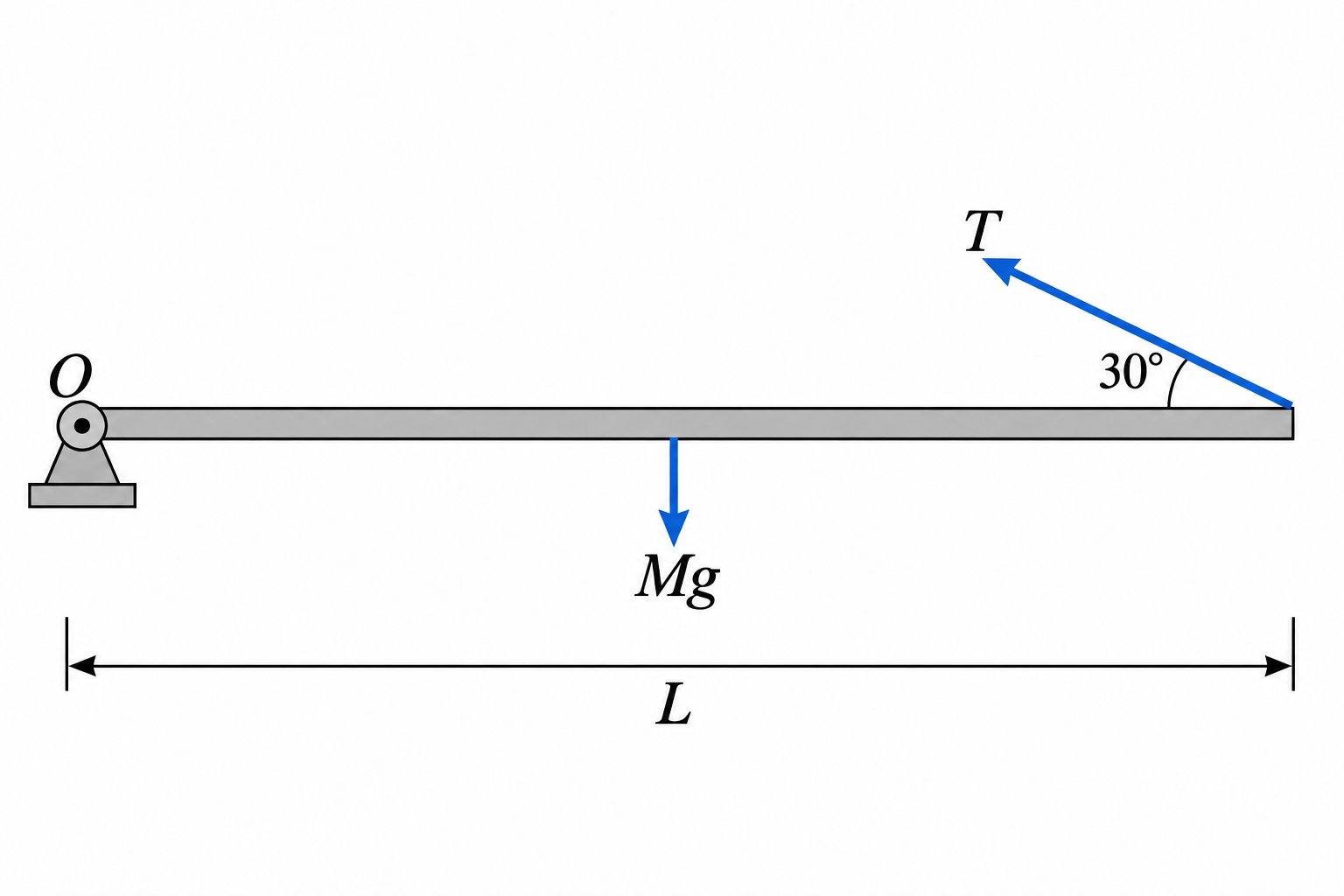
Selected forces on a uniform horizontal beam: weight Mg at its center, cable tension T at the right end directed up-left at 30 degrees to the horizontal, and a left hinge.

Schematic; dimensions and force-arrow lengths are not to scale.

Question 2 of 5

A 4 m uniform horizontal beam of weight 100 N rests on supports at its ends. A 200 N load is placed 1 m from the left end. (a) Draw the force diagram. (b) Determine the right support force. (c) Determine the left support force.

Question 3 of 5

A turntable rotates counterclockwise at constant angular velocity while a motor and bearing friction act. (a) Compare their torque magnitudes and turning senses. (b) Predict the immediate change in motion when motor torque is removed and friction remains. (c) Explain why steady rotation does not mean no torque acts.

Question 4 of 5

A negligible-mass meterstick is supported at the 50 cm mark. A 2 N load hangs at 20 cm and a 3 N load hangs at an adjustable point to the right. (a) Find the position that gives equilibrium. (b) Find the upward support force. (c) Explain how a uniform nonzero meterstick weight would change these two results.

Question 5 of 5

Design an experiment to test rotational equilibrium using a meterstick, a pivot, small hanging masses, and a balance. (a) Specify measurements and how the stick weight is handled. (b) State the quantities to compare at equilibrium. (c) Describe one systematic error and a way to reduce it.