Torque FRQ Practice

Responses receive AI feedback against a rubric after submission. Scores are practice estimates.

Question 1 of 5

A light horizontal rod of length L is pivoted at its left end. At its right end a force F points 30° above the rod toward the right. (a) Identify the force component that produces torque. (b) Derive the torque magnitude. (c) Find the perpendicular force at the midpoint that would produce the same torque magnitude.
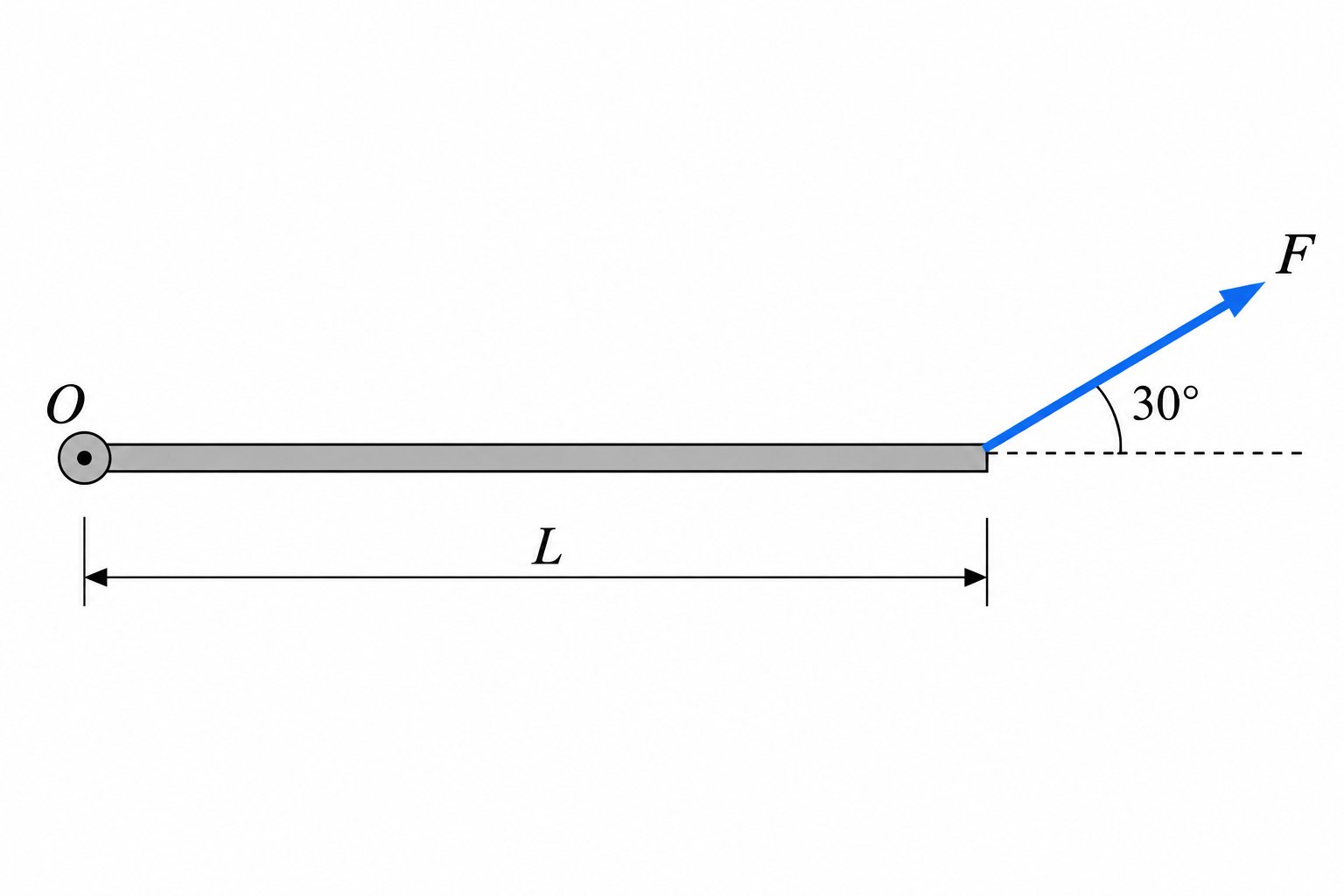
A force F points 30 degrees above a rightward horizontal rod of length L with its pivot at the left end.

Schematic; dimensions and force-arrow lengths are not to scale.

Question 2 of 5

A horizontal beam is pivoted at its left end. Its weight acts downward at its center of mass, an upward cable force acts at its right end, and the hinge exerts horizontal and vertical forces at the pivot. (a) Draw a force diagram showing application points. (b) Identify which forces have zero torque about the hinge. (c) Identify the turning sense of each nonzero torque.

Question 3 of 5

A student applies a measured force to a rigid lever at several positions and angles relative to a fixed pivot. The torque magnitude is measured by an independent calibrated torque sensor. (a) Specify the geometric measurement needed in addition to force. (b) Describe a graph testing the torque model. (c) Explain how a misidentified lever arm would affect the test.

Question 4 of 5

A 2.0 m horizontal beam of negligible weight has a pivot 0.50 m from its left end. A 12 N downward force acts at the left end and an 8 N downward force acts at the right end. (a) Find each torque magnitude about the pivot. (b) Find the net torque magnitude and turning sense. (c) Find a downward force applied 0.25 m to the left of the pivot that would make the combined torque zero.

Force location Force Distance from pivot
Left end 12 N downward 0.50 m left
Right end 8 N downward 1.50 m right

Question 5 of 5

A student draws every force on a rigid beam at a single dot to analyze its turning about a hinge. (a) Explain what useful information that representation keeps. (b) Explain what necessary information it loses. (c) Describe how to revise the diagram for torque analysis.