Rotational Inertia FRQ Practice

Responses receive AI feedback against a rubric after submission. Scores are practice estimates.

Question 1 of 5

Two small masses, each m, are fixed on a negligible-mass rigid rod at distances r to the left and right of its midpoint. The rotation axis is perpendicular to the rod through its midpoint. (a) Derive the rotational inertia. (b) Predict the inertia if both distances become 2r. (c) Explain why clockwise versus counterclockwise rotation does not change either result.
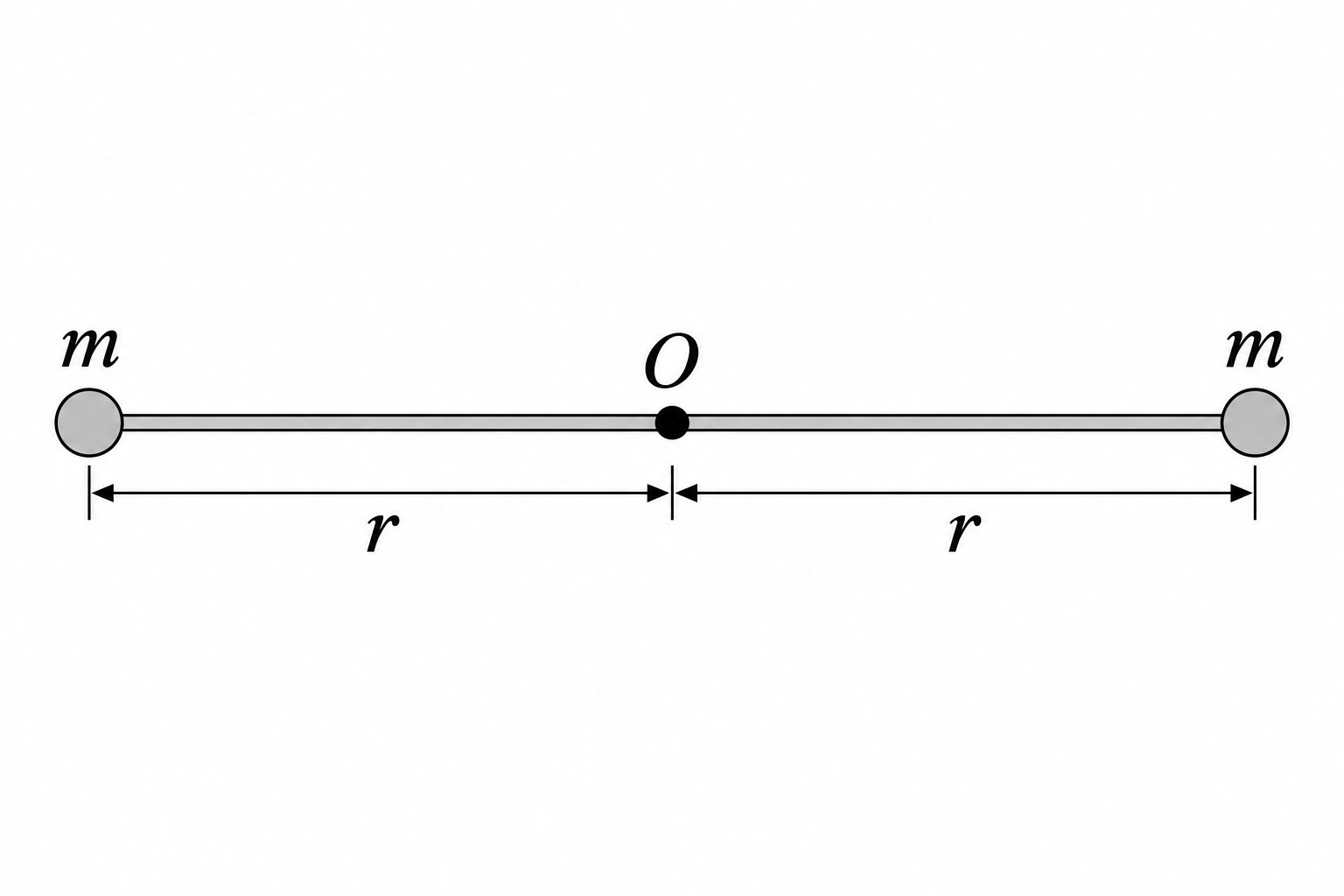
Two equal point masses m on a light horizontal rod are each distance r from the midpoint rotation axis.

Schematic; dimensions and force-arrow lengths are not to scale.

Question 2 of 5

Four point masses are attached to a negligible-mass rigid frame. Their perpendicular distances from a fixed axis are given in the table. (a) Calculate the rotational inertia. (b) Which mass contributes most? (c) If the mass on the axis is removed, explain the effects on total mass and rotational inertia.

Object Mass (kg) Distance (m)
A 3 0
B 2 0.5
C 1 1
D 0.5 2

Question 3 of 5

An object of mass M has known center-of-mass rotational inertia Ic. (a) Derive its inertia about a parallel axis distance d away. (b) Compare axes at distances d and 2d. (c) Explain why the inertia generally does not quadruple when the axis offset doubles.

Question 4 of 5

A uniform disk has mass M, radius R, and central perpendicular rotational inertia MR²/2. (a) Find its inertia about a parallel tangent axis at the rim. (b) Find the ratio of tangent-axis to central inertia. (c) Explain physically why the tangent-axis inertia is larger.

Question 5 of 5

Two rigid assemblies each contain two point masses and a negligible-mass connector. Assembly P has two masses m at radius r. Assembly Q has two masses 2m at radius r/2. (a) Find each inertia about its central axis. (b) Compare their total masses. (c) Evaluate the claim that the more massive assembly must have the larger inertia.