Rotational Inertia FRQ Practice

Responses receive AI feedback against a rubric after submission. Scores are practice estimates.

Question 1 of 5

Three small masses are fixed along a negligible-mass rigid rod at positions x=-1 m, 0, and +1 m. Their masses are 1 kg, 2 kg, and 1 kg, respectively. Axes are perpendicular to the rod. (a) Find inertia about x=0. (b) Find inertia about x=1 m. (c) Verify the second result using the parallel-axis theorem.
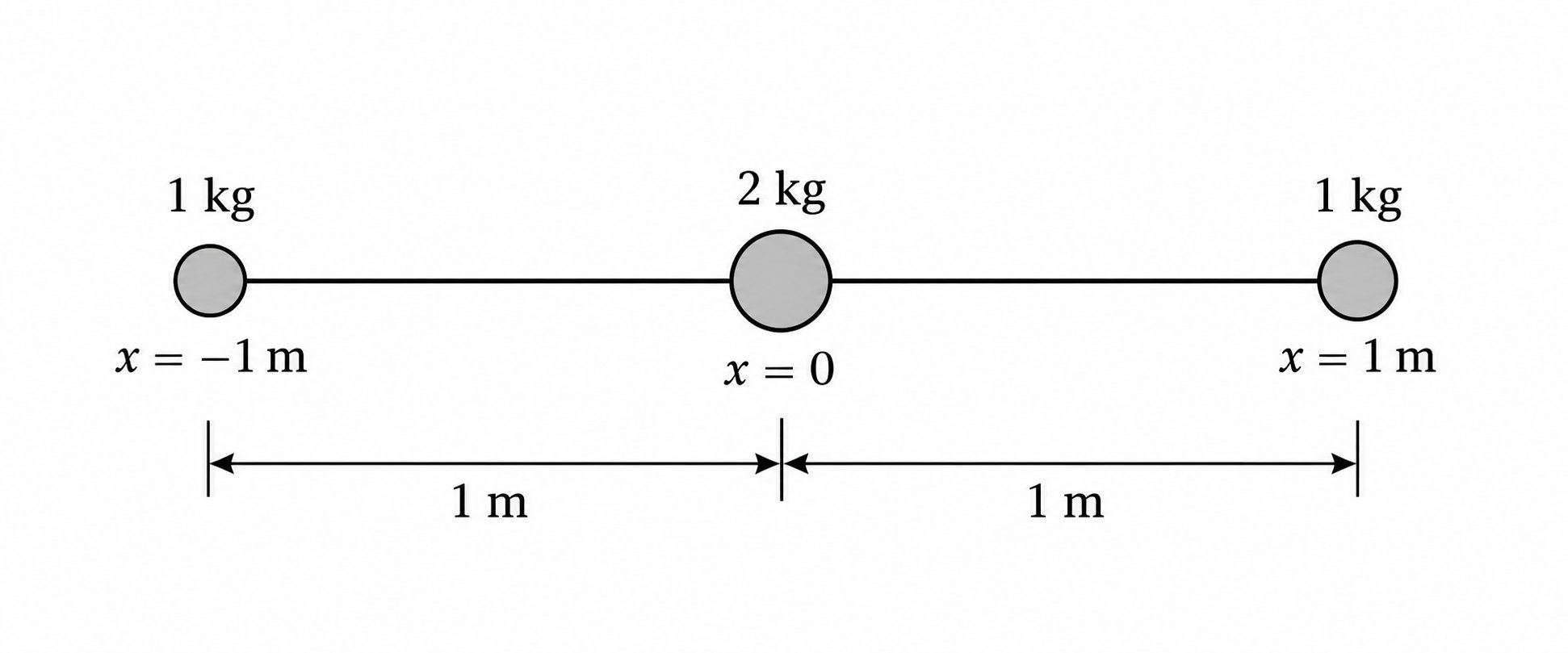
Three point masses lie along a rod: 1 kg at x=-1 m, 2 kg at x=0, and 1 kg at x=1 m.

Schematic; dimensions and force-arrow lengths are not to scale.

Question 2 of 5

A point mass m is moved among several measured radii on a negligible-mass rod. (a) Predict the shape of I versus r. (b) Specify transformed axes that give a straight line. (c) Explain how an additional fixed axle inertia I0 would change that straight-line graph.

Question 3 of 5

A rigid frame carries two adjustable equal point masses. A student wants to change the inertia without changing total mass. (a) Describe how to increase inertia about a fixed central axis. (b) Describe how to decrease it. (c) State what measurements permit calculating the change if the frame inertia is unchanged.

Question 4 of 5

The measured rotational inertias of a rigid body about parallel axes are listed versus offset d from its center-of-mass axis. (a) Determine the central inertia. (b) Determine the mass from these data. (c) Predict the inertia at d=0.30 m.

d (m) I (kg m²)
0 0.2
0.1 0.24
0.2 0.36

Question 5 of 5

A hoop and disk each have mass M and outer radius R. Their perpendicular central inertias are MR² and MR²/2, respectively. (a) Compare these inertias. (b) A point mass is attached at the disk rim. Find the mass needed to make the disk-plus-point-mass inertia equal the hoop inertia about the original fixed central axis. (c) Explain why no center-of-mass shift correction is needed for that specified axis.