Torque MCQ Practice

Question 1 of 10

A force acts on a door directly through its hinge axis. What torque does this force exert about that axis?

  1. A. Zero, because its lever arm is zero
  2. B. The force magnitude times the door width
  3. C. The force magnitude divided by the door width
  4. D. A nonzero torque whenever the force is nonzero
Question 2 of 10

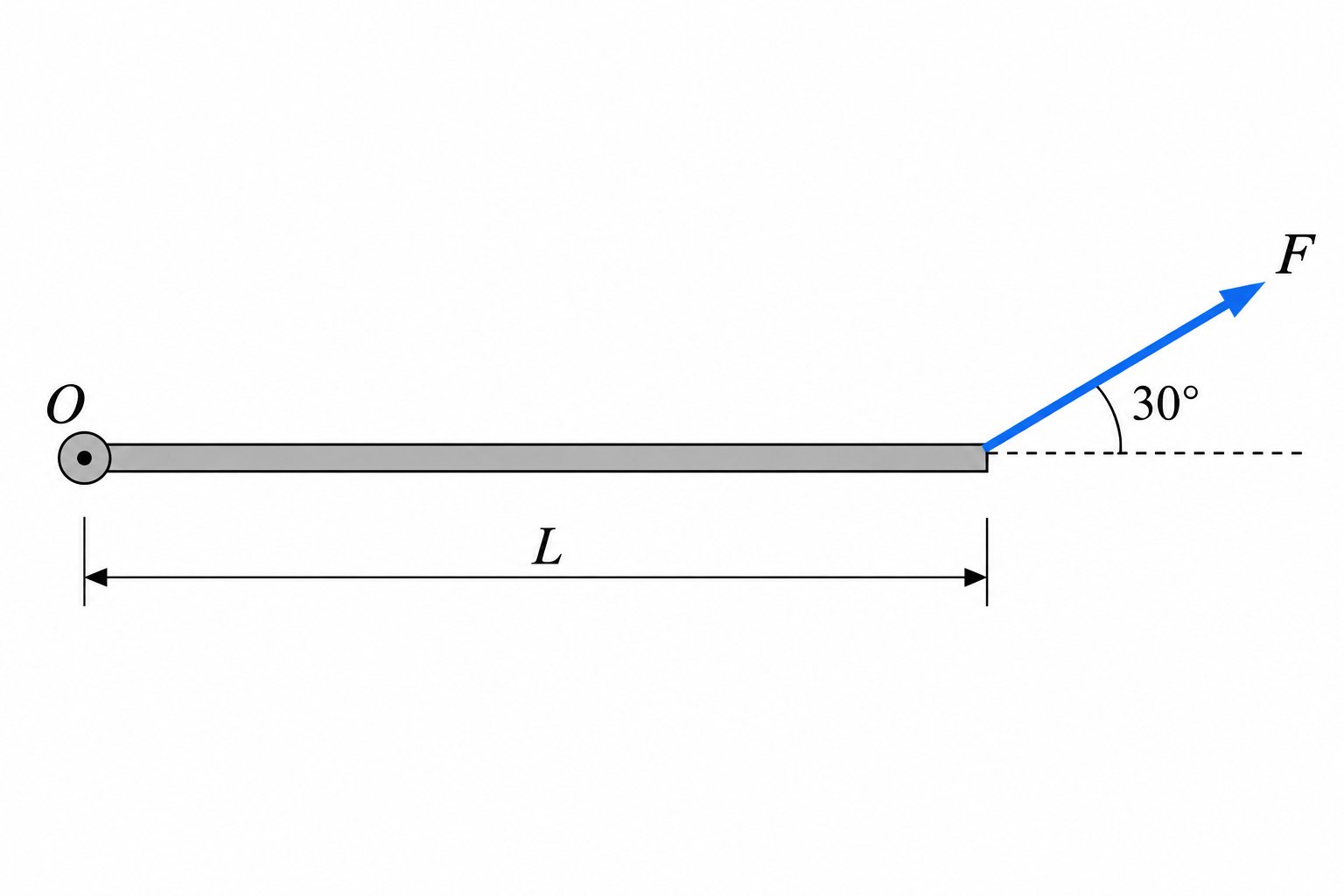
A horizontal rod of length L is pivoted at its left end. A force F at the right end points 30° above the rod toward the right. What is the magnitude of its torque about the pivot?

A rod of length L extends rightward from a left pivot; force F at the right end points 30 degrees upward from the rod.

Schematic; dimensions and force-arrow lengths are not to scale.

  1. A. $2FL$
  2. B. $FL/2$
  3. C. $FL$
  4. D. $\sqrt{3}FL/2$

Question 3 of 10

Which distance is the lever arm of a force about a specified axis?

  1. A. The length of the object
  2. B. The distance traveled while the force acts
  3. C. The perpendicular distance from the axis to the force line of action
  4. D. The distance from the center of mass to the force application point

Question 4 of 10

A 10 N force acts perpendicular to a wrench at a point 0.30 m from the bolt. What torque magnitude does it exert about the bolt?

  1. A. 33 N m
  2. B. 0.030 N m
  3. C. 10.3 N m
  4. D. 3.0 N m

Question 5 of 10

The same force is applied perpendicular to a door first 0.20 m and then 0.60 m from its hinge. How do the torque magnitudes compare?

  1. A. The second is three times the first.
  2. B. The second is nine times the first.
  3. C. They are equal.
  4. D. The second is one-third the first.

Question 6 of 10

A horizontal rod extends rightward from a left pivot. Which force at the right end tends to turn it counterclockwise?

  1. A. A leftward force along the rod
  2. B. An upward force
  3. C. A downward force
  4. D. A rightward force along the rod

Question 7 of 10

A force F has perpendicular distance d from its line of action to a pivot. If its application point moves along that same line while its direction and magnitude remain fixed, what happens to its torque about the pivot?

  1. A. It necessarily decreases.
  2. B. It becomes zero.
  3. C. It remains Fd.
  4. D. It necessarily increases.

Question 8 of 10

A horizontal rod is pivoted at its center. A downward force at its left end tends to rotate it in which sense?

  1. A. Clockwise
  2. B. Neither, because the pivot is central
  3. C. The sense cannot be determined without its mass
  4. D. Counterclockwise

Question 9 of 10

A 20 N force makes a 60° angle with the radius from a pivot to its application point 0.50 m away. What is the torque magnitude?

  1. A. $5\sqrt{3}$ N m
  2. B. $5$ N m
  3. C. $10$ N m
  4. D. $20\sqrt{3}$ N m

Question 10 of 10

Two forces each have magnitude F. Force P has lever arm 2d and tends clockwise; force Q has lever arm d and tends counterclockwise. What is their combined turning effect?

  1. A. Zero
  2. B. Magnitude Fd, clockwise
  3. C. Magnitude 3Fd, clockwise
  4. D. Magnitude Fd, counterclockwise