Conservation of Energy FRQ Practice

Responses receive AI feedback against a rubric after submission. Scores are practice estimates.

Question 1 of 5

Scenario A. A cart starts from rest at height 2.0 m and reaches the bottom with the speed shown in the table. (a) Predict the ideal speed using $g=10\,m/s^2$. (b) Using the mean measured speed, estimate the kinetic energy for mass 0.50 kg. (c) Determine energy transformed to other forms and give one mechanism.

Trial Bottom speed (m/s)
1 5.8
2 5.9
3 5.7

Question 2 of 5

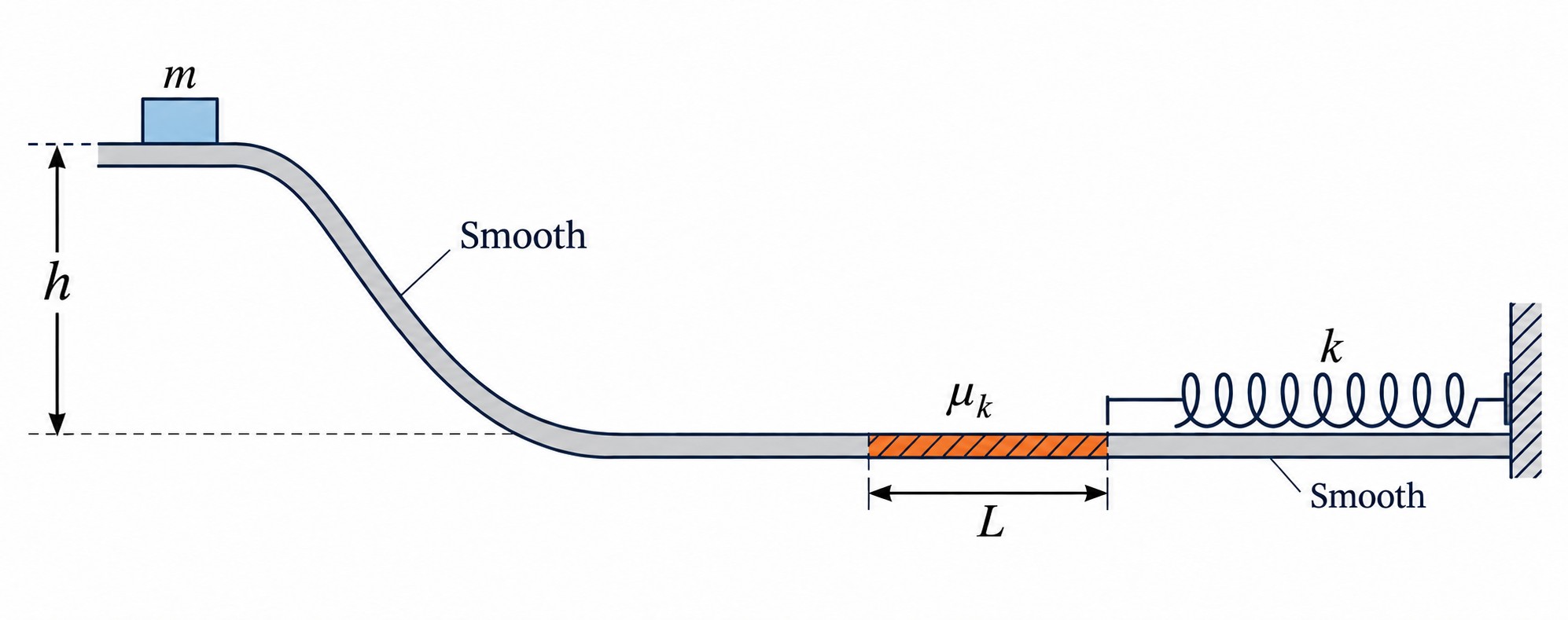
A small block of mass $m$ is released from rest at height $h$ above a level surface. A frictionless ramp leads to a rough horizontal patch of length $L$ with kinetic friction coefficient $\mu_k$. At the far end of the patch is the natural-length end of an ideal spring of constant $k$. The spring region is frictionless. Treat the block as a particle and neglect air resistance. Derive the maximum compression $x$ and distinguish the condition for just reaching the spring from the condition for compressing it.

A block descends from height h, crosses a rough patch of length L, and compresses a spring.

Question 3 of 5

Scenario A. A cart must complete a vertical loop of radius $R$. (a) Use dynamics to find the minimum speed at the top while maintaining contact. (b) Use energy to find the minimum release height from rest, measured from the bottom. (c) Explain the role of the normal force. Treat the cart as a particle moving on the inside of a fixed frictionless loop. The track can push but cannot pull the cart; it is not clamped to the track. Neglect wheel rotation and air resistance.

Question 4 of 5

Scenario A. Design an experiment to test conservation of mechanical energy for a cart on a track. Specify the system, measurements at several positions, calculated quantities, and a graph that would reveal dissipative losses.

Question 5 of 5

Scenario A. A battery-powered cart climbs a ramp while speeding up. (a) Draw an energy-accounting statement for the system containing the cart, battery, motor, ramp, and Earth. (b) Explain why $K+U_g$ is not conserved. (c) If battery energy decreases by $E_b$ and thermal energy rises by $E_{th}$, relate these to $\Delta K+\Delta U_g$. Assume no energy crosses this system boundary and no other energy stores change.