Power FRQ Practice

Responses receive AI feedback against a rubric after submission. Scores are practice estimates.

Question 1 of 5

Scenario A. The table gives energy delivered by a motor versus time. (a) Determine average power from 0 to 6 s. (b) Determine power during each interval. (c) Identify when power is greatest and explain using graph slope. Assume energy delivered changes linearly between consecutive tabulated times.

t (s) Energy delivered (J)
0 0
2 80
4 200
6 260

Question 2 of 5

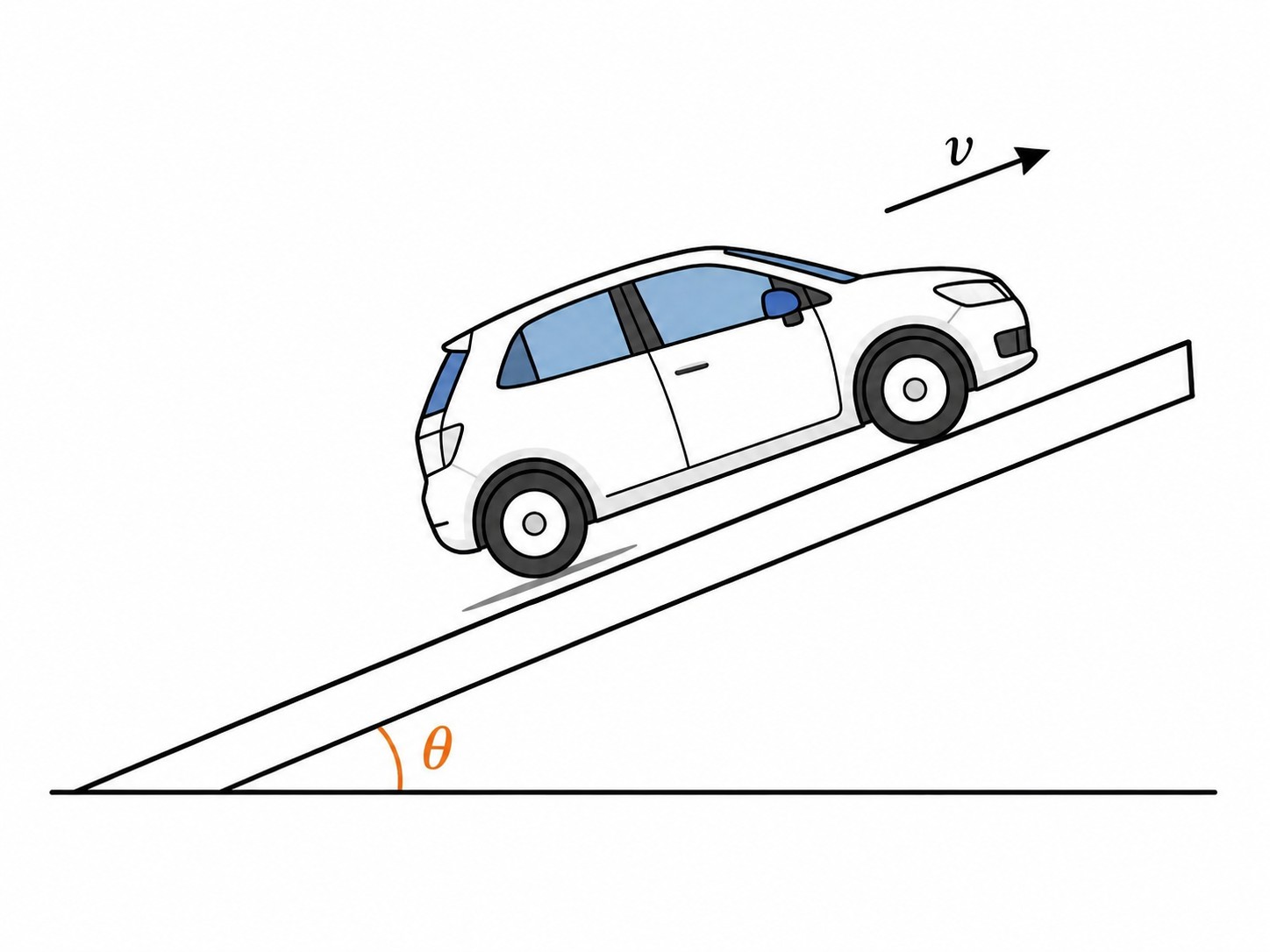
Scenario A. A car of mass $m$ climbs a grade at constant speed $v$ and angle $\theta$ against resistive force $f$. Derive the engine power required. Predict how required power changes if speed doubles. Assume $f$ is independent of speed and drivetrain losses are negligible. Find the useful mechanical output power.

A car climbs a straight incline at angle theta; its velocity arrow v points uphill parallel to the incline.

Question 3 of 5

Scenario A. A motor lifts a mass $M$ through height $h$ in time $t$ while increasing its speed from zero to $v$. (a) Determine the motor's average mechanical power if losses are negligible. (b) Compare this result with lifting the mass through the same height at constant speed in the same time. (c) Explain what additional information is needed to determine instantaneous power during the motion.

Question 4 of 5

Scenario A. Design an experiment to measure a student’s average mechanical power while climbing stairs. Specify measurements, calculation, uncertainty reduction, and why running versus walking changes power but not ideal work. Compare climbs with equal initial and final speeds and neglect changes in other mechanical energy stores.

Question 5 of 5

Scenario A. A constant-power motor accelerates a cart from rest on a frictionless track. (a) Show that $v(t)=\sqrt{2Pt/m}$. (b) Determine the ratio $v(4t)/v(t)$. (c) Compare the cart's average acceleration from 0 to $t$ with its average acceleration from $t$ to $4t$, and explain why a constant-force model is inconsistent. Treat this as an ideal limiting energy-transfer model for $t>0$, with motor power $P>0$ and cart mass $m$. Also state why a real motor cannot maintain this model exactly at startup.