Linear Momentum FRQ Practice

Responses receive AI feedback against a rubric after submission. Scores are practice estimates.

Question 1 of 5

Cart A has mass 2m and moves right at speed v. Cart B has mass m and moves left at speed 3v, as shown. (a) Find each signed momentum, taking right positive. (b) Find the system momentum. (c) Can the system have zero kinetic energy? Justify.
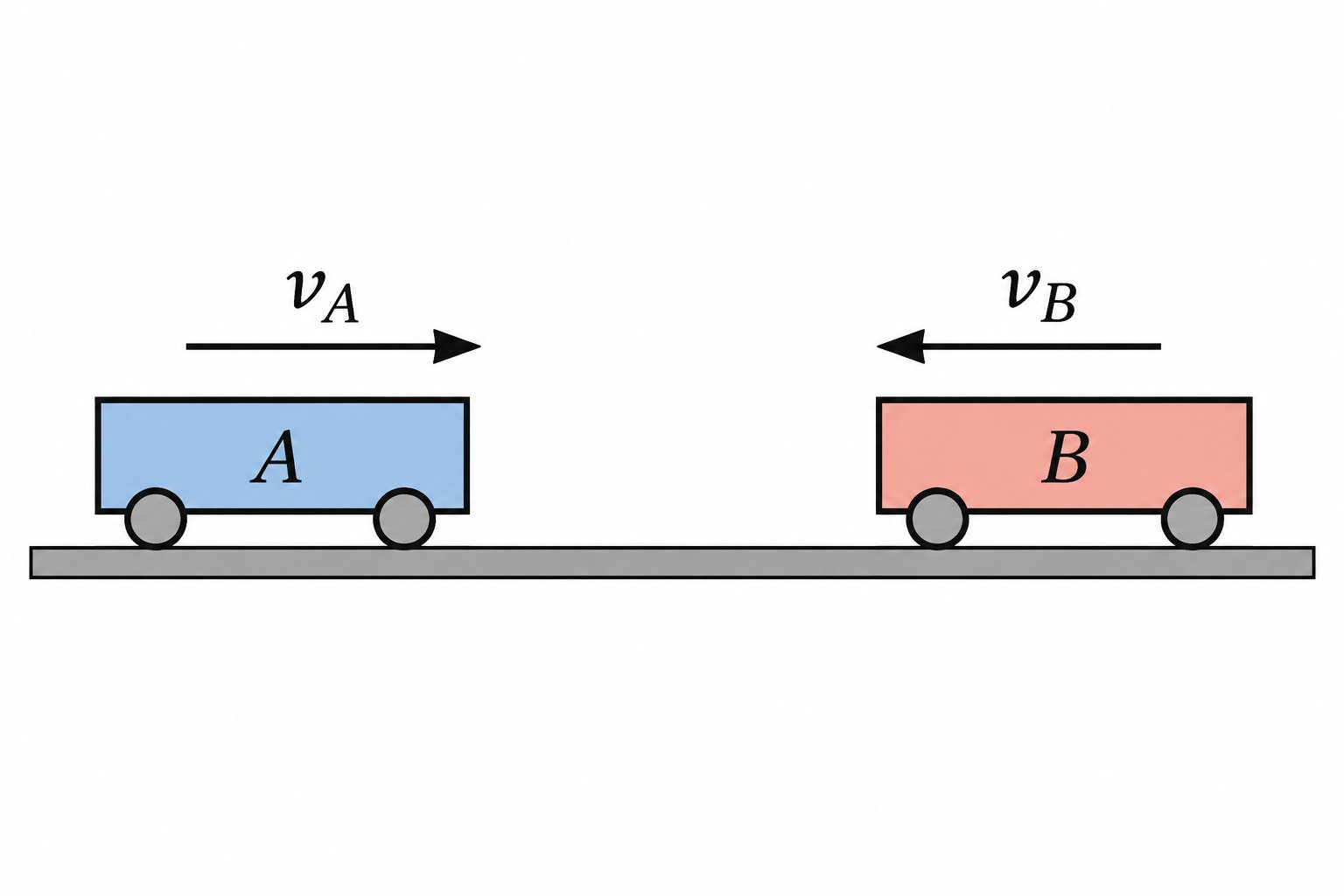
Cart A moves right and cart B moves left on a horizontal track.

Schematic: cart sizes, distances, and velocity-arrow lengths are not to scale.

Question 2 of 5

The table lists velocities of a 0.50 kg glider. (a) Calculate its momentum at every time. (b) Sketch momentum versus time, connecting adjacent data with straight segments. (c) State when the glider reverses direction.

t (s) v (m/s)
0 2
1 1
2 0
3 -1

Question 3 of 5

A student claims that the faster of two objects always has the greater momentum magnitude. (a) Construct a numerical counterexample. (b) State a condition under which the claim is true. (c) Explain why comparing speed alone is insufficient.

Question 4 of 5

A cart travels east at speed u relative to the floor. Its mass is m. Observer R moves east at u/2 and observer S moves west at u. (a) Find the cart momentum measured by each observer. (b) Explain why the different results do not mean that the cart has different masses.

Question 5 of 5

A balance and video camera are available to compare the momentum magnitudes of two rolling carts at marked positions. (a) Describe the measurements needed. (b) Explain how to determine which momentum is greater. (c) Give one way to reduce uncertainty in the velocity measurements.