Change in Momentum and Impulse FRQ Practice

Responses receive AI feedback against a rubric after submission. Scores are practice estimates.

Question 1 of 5

The table gives the net horizontal force on a 2 kg cart initially at rest. Connect adjacent force measurements with straight segments. (a) Find the total impulse. (b) Find the final velocity. (c) Sketch momentum versus time qualitatively and identify when its slope is largest.

t (s) Net F (N)
0 0
1 4
2 4
3 0

Question 2 of 5

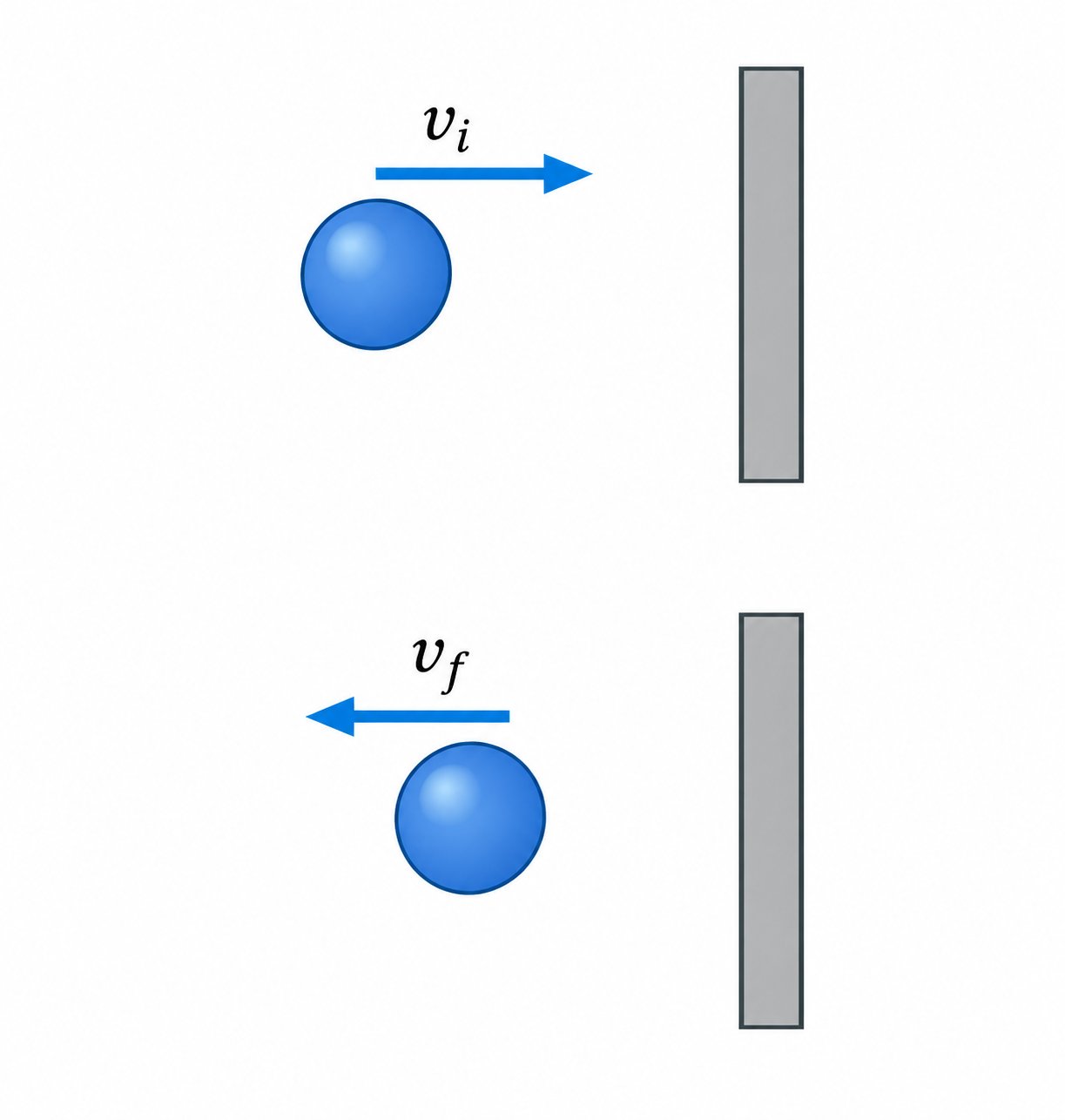
A ball of mass m hits a vertical wall at horizontal speed u and rebounds horizontally at speed u/2. Contact lasts T. Gravity has negligible impulse during contact. (a) Derive the horizontal impulse taking toward the wall as positive. (b) Derive the average wall force. (c) Compare with a ball that stops without rebounding in the same time.

A ball moves toward a vertical wall and then rebounds in the opposite horizontal direction.

Schematic: cart sizes, distances, and velocity-arrow lengths are not to scale.

Question 3 of 5

A force sensor and motion sensor are used to test the impulse-momentum theorem for a cart striking a bumper on a level track. (a) Specify the measurements. (b) Describe two independently calculated quantities to compare. (c) Explain how to account for a small constant-magnitude friction force.

Question 4 of 5

A 0.50 kg ball falls vertically at 4.0 m/s and is stopped in 0.20 s by an upward hand force. Take g = 10 m/s². (a) Find the net impulse. (b) Find the average net force. (c) Find the average hand force.

Question 5 of 5

During a time interval T, a net force varies as a triangular pulse with peak F0 and endpoints zero. (a) Derive the impulse. (b) Derive the constant force that would give the same impulse in time T. (c) Explain whether equal impulses require equal maximum forces.