Conservation of Linear Momentum FRQ Practice

Responses receive AI feedback against a rubric after submission. Scores are practice estimates.

Question 1 of 5

Two carts have masses m and 2m and initial velocities +3u and zero. They stick together during a brief collision with negligible external impulse. (a) Derive their common velocity. (b) Find the center-of-mass velocity before and after. (c) Explain why the first cart's momentum alone is not conserved.
Question 2 of 5

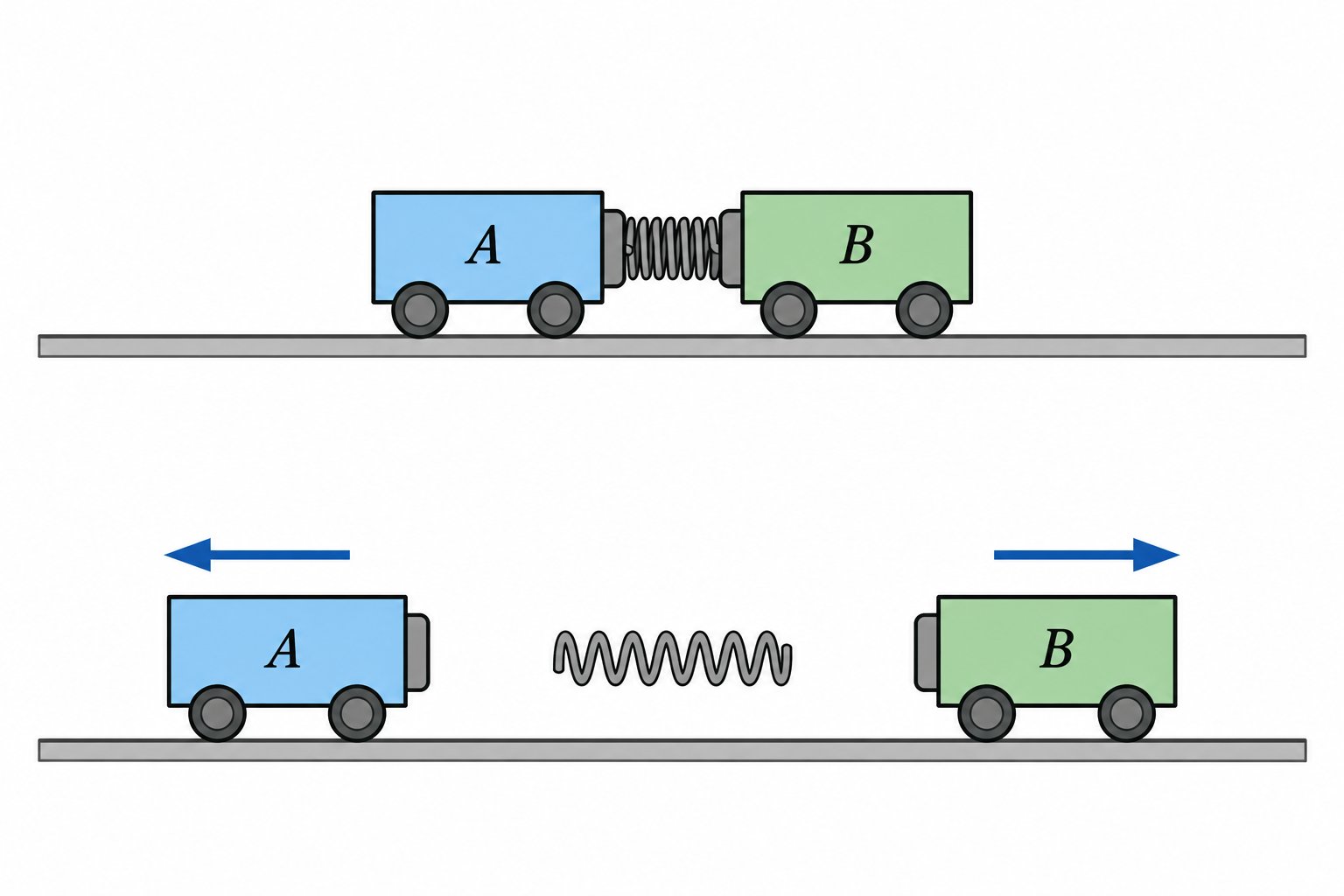
Carts A and B, of masses m and 3m, start at rest on a horizontal frictionless track. A massless compressed spring, unattached to either cart, between them is released. (a) Relate their final velocities. (b) Compare the magnitudes of their momentum changes. (c) Explain what happens to the center of mass while they separate.

Two carts initially at rest separate in opposite directions after an internal spring is released.

Schematic: cart sizes, distances, and velocity-arrow lengths are not to scale.

Question 3 of 5

The table contains signed momenta measured before and after a cart collision. (a) Determine the system momentum at both times. (b) Determine the net external impulse indicated by the data. (c) If each total momentum has uncertainty ±0.10 kg m/s, do the data establish a nonzero external impulse? Explain.

Time p_A (kg m/s) p_B (kg m/s)
Before 2.4 -0.6
After 0.7 1.2

Question 4 of 5

A student wants to test conservation of horizontal momentum during collisions between two carts on a slightly sloped track. (a) Describe the mass and motion measurements. (b) Explain a test for the unwanted external force before the collision trials. (c) Describe how to improve the apparatus or analysis.

Question 5 of 5

A puck moving east splits into two pieces on a frictionless table. One piece moves northeast and the other southeast. (a) State equations expressing east-west and north-south momentum conservation, using signed components. (b) Explain how the northward component of one piece compares with the southward component of the other. (c) Can the pieces have unequal speeds? Explain without solving simultaneous equations.